
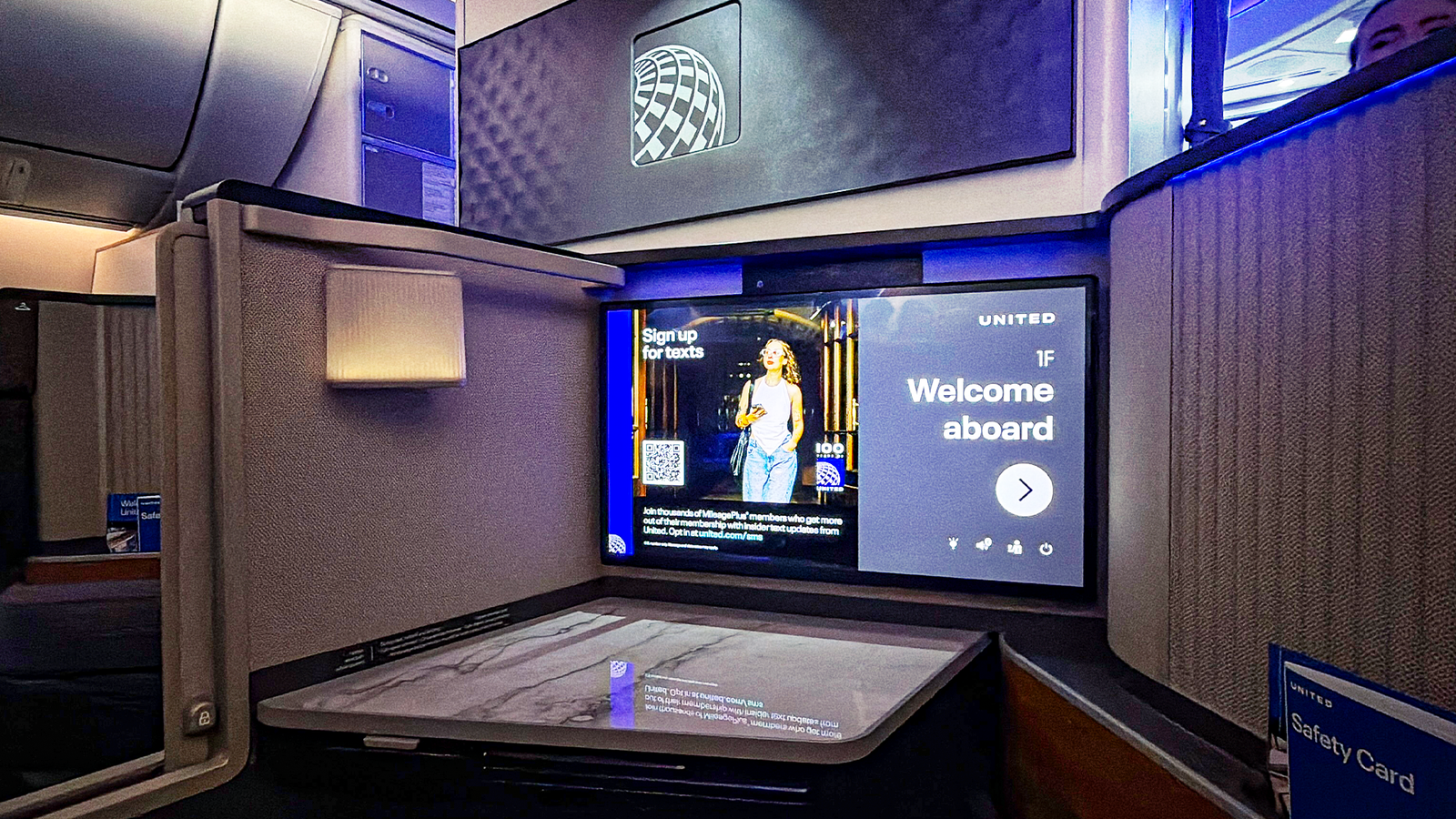
United Airlines is charging passengers up to $600 extra for a seat in a space traditionally considered the least desirable part of a business-class cabin: the bulkhead row. However, the carrier has transformed these eight positions into something far more attractive, with extra living space, privacy doors, companion dining, and exclusive onboard amenities. The result is the Polaris Studio, a premium product above regular business class but not classified as first class. The decision reflects a broader shift in the airline industry, where carriers are discovering that they can generate additional revenue by differentiating individual seats instead of introducing an entirely separate premium cabin. United's approach raises an interesting question: why invest in a dedicated first class product when passengers might pay hundreds of dollars more for an upgraded business-class experience? Why United Created A Premium Product Within Polaris Credit: EQRoy | Shutterstock United's decision to introduce Polaris Studio is primarily about monetizing space that would otherwise be difficult to utilize efficiently. The eight suites occupy the first row of each of the two business-class sections aboard the airline's new Elevated Boeing 787-9 Dreamliners. Rather than introducing another cabin, United has positioned these seats as a more exclusive version of its existing Polaris business-class offering. Bulkhead seats have traditionally posed a design challenge for airlines. Unlike standard business-class seats, which can extend their footwells into the space beneath the seat in front, the first row has no seat ahead of it. This can leave floor space unused or require a considerably different seating arrangement. United has used the extra room to create suites with approximately 25% more living space than standard Polaris seats, according to The Travel. The arrangement also allows United to maintain a relatively straightforward cabin hierarchy. Passengers can purchase standard Polaris business class and receive a fully lie-flat suite, while those seeking additional space and amenities can pay for Polaris Studio. This avoids the operational and commercial complexity of maintaining a separate first class cabin while still giving the airline another premium product to sell. However, what exactly does the additional $500 or more provide? What Passengers Get For The Additional $499 To $600 Credit: Cavan-Images | Shutterstock The most noticeable difference is the additional personal space. United's Polaris Studio features sliding privacy doors, larger seating areas, additional storage, and an oversized ottoman that can double as a companion seat. This last feature is especially useful for passengers traveling together, as it lets another Polaris customer visit and dine with the person occupying the Studio. However, the companion ottoman isn't available in all eight suites; six feature the additional seating arrangement. Entertainment is another major selling point. Each Polaris Studio has a 27-inch 4K OLED touchscreen, making it one of the largest seatback entertainment displays offered by a US airline. For comparison, regular Polaris suites on the Elevated 787-9 feature 19-inch displays. The Studio's larger screen, wireless charging, Bluetooth connectivity, and improved storage create a more spacious, technologically advanced environment. The additional charge also includes several service enhancements that extend beyond the physical seat. According to Afar, passengers receive an Ossetra caviar amuse-bouche, Laurent-Perrier Cuvée Rosé Champagne, enhanced amenity kits featuring Perricone MD skincare products, and access to United's exclusive Global Reception facilities. Preferred boarding and access to the airline's tarmac transfer service are additional benefits. Feature Polaris Studio Standard Polaris Number of seats 8 56 Screen 27-inch 4K OLED 19-inch 4K OLED Additional living space 25% more Standard Privacy doors Yes Yes Companion ottoman 6 of 8 suites No Caviar service Yes No Laurent-Perrier Rosé Enhanced service Standard service Bed length Approximately 75 inches (190 cm) Approximately 78 inches (198 cm) From the Tray Table The pricing is perhaps the most interesting part of the proposition. Initially advertised at approximately $499 per flight segment, the additional charge can reach $600 or more depending on availability and seat selection. It is an optional seat-assignment fee rather than a separate first class fare, meaning passengers already holding a Polaris ticket can purchase the upgrade. Nevertheless, United is not alone in recognizing the commercial potential of this arrangement. United Is Following A Growing Business-Class-Plus Trend Credit: Airlinephoto | Shutterstock United's strategy is part of a wider industry trend in which airlines are introducing more exclusive seating options within their existing business-class cabins. These products typically occupy bulkhead positions, where the additional floor space can accommodate larger ottomans, companion seating, and more generous sleeping arrangements. According to One Mile At A Time, airlines are monetizing these otherwise underutilized areas by offering passengers the opportunity to purchase a more spacious experience. One of United's closest competitors is Virgin Atlantic, which offers its Retreat Suite aboard selected Airbus A330neo aircraft. The product features a fully flat bed measuring six feet, seven inches (200 cm), a 27-inch entertainment screen in the original configuration, and an ottoman that doubles as an additional seat. Selected newer A330neo configurations now feature screens measuring up to 32 inches. The arrangement also supports companion dining, allowing passengers to share meals and socialize during the flight. JetBlue Airways has adopted a similar approach with its Mint Studio, available on the A321LR and A321neo. Located in the first row, the product offers additional space, a 22-inch entertainment screen, a mirrored vanity, and a separate guest seat with a table. This allows another Mint passenger to visit, work, or dine with the person occupying the Studio. Unlike United, JetBlue operates a narrowbody aircraft, showing the concept isn't limited to long-haul widebody cabins. Airline Product Aircraft Entertainment screen United Airlines Polaris Studio Boeing 787-9 27 inches Virgin Atlantic Retreat Suite Airbus A330-900neo 27 inches* JetBlue Airways Mint Studio Airbus A321LR/A321neo 22 inches *Virgin Atlantic offers screens up to 32 inches on selected newer A330-900neo configurations. Although these products share a similar philosophy, their commercial positioning differs. United combines the additional space with a more substantial collection of premium services, while Virgin Atlantic and JetBlue primarily differentiate their products through seating arrangements and onboard comfort. This raises another question: why are airlines so reluctant to introduce traditional first class cabins instead? Why Airlines Prefer Business-Plus Over Traditional First Class Credit: United Airlines The economics of introducing a separate first class cabin are considerably more complicated than simply installing larger seats. A dedicated first class section requires additional cabin space, specialized service procedures, premium catering, and a large enough market of passengers willing to buy significantly more expensive tickets. Airlines must also sacrifice space that could otherwise accommodate several business-class or premium-economy passengers. United's Polaris Studio offers an alternative. By reserving just eight positions for its premium product, the airline can generate additional revenue without substantially changing the overall cabin architecture. Passengers still receive the same core business-class experience, but those who value extra privacy, space, and exclusive amenities can pay more. This option can be attractive on routes where demand for conventional first class might not justify an entire cabin. The strategy also provides greater flexibility in revenue management. Instead of selling a limited number of first class tickets at a substantial premium, United can offer a relatively affordable upgrade to passengers who have already purchased business-class tickets. A $499 surcharge might be considerably easier to justify than the difference between a business-class fare and a traditional international first class ticket. For example, if all eight seats were sold at an additional $499, United could theoretically generate $3,992 in extra revenue per flight segment. At $600 per seat, that figure would increase to $4,800. These amounts are additional to the original business-class fares and do not require United to sell an entirely separate cabin. However, the financial benefits depend on passengers actually purchasing the upgrade. United must also consider the opportunity cost of reserving these seats for customers willing to pay the additional fee rather than including them in standard Polaris inventory. The airline's ability to consistently generate premium revenue from just eight seats will ultimately determine whether the concept deserves further expansion. The Elevated Boeing 787-9 Makes The Strategy Scalable Credit: Bradley Caslin | Shutterstock United's investment in Polaris Studio is closely connected to its wider Elevated cabin strategy. The redesigned 787-9 features 64 business-class seats, including eight Studios, alongside 35 Premium Plus seats and 123 economy-class seats. This represents a substantial shift toward premium travel compared with the previous configuration, which offered considerably more economy seating. The aircraft entered international passenger service on April 22, operating United's San Francisco to Singapore Changi route. The ultra-long-haul service provided an opportunity to introduce the new cabin on a competitive international market, where passengers have access to several established premium products, including those offered by Singapore Airlines. London Heathrow subsequently became another destination for the upgraded Dreamliners. The fleet rollout is also progressing. According to The Blue Board's fleet information, United had 16 Elevated 787-9s in service by November 2026, with the number expected to reach 33 by 2028. This growing fleet will give the airline more opportunities to sell Polaris Studio upgrades across its international network. The rollout also means that the product's availability will remain aircraft-dependent. Passengers cannot assume that every United Boeing 787-9 offers the new experience, as older aircraft retain their existing Polaris interiors. Checking the aircraft configuration and Polaris Studio seat availability before booking will therefore remain important. United Is Monetizing Luxury Without Bringing Back First Class Credit: EQRoy | Shutterstock United's decision to introduce eight Polaris Studio suites instead of a separate first class cabin reflects a broader shift in international premium travel. Many airlines recognize that passengers do not necessarily need an entirely different cabin to justify spending more. Additional privacy, a larger sleeping area, better entertainment, and the chance to dine with a companion can be enough to make a compelling upgrade. The next few years will be an important test of the concept. With 33 Elevated 787-9s expected by 2028, United will have a considerably larger pool of premium seats to monetize. Whether the airline maintains its current pricing or raises the surcharge as demand grows will help determine the product's commercial success. Polaris Studio demonstrates how airlines can create a new premium revenue category without the operational costs and space requirements of traditional First Class. For passengers, however, the central question remains whether a larger seat and additional amenities are worth an extra $500 to $600, particularly when the standard Polaris product already offers a fully lie-flat bed and direct aisle access.
Why United Airlines Sells Its Boeing 787-9's 8 Front-Row Suites As 'Business-Plus' Without A First Class Cabin
Full Article
Original Source
Read the full article at Simpleflying →KhanList aggregates and links to publicly available news content. We do not host full articles from third-party sources. Always verify important information with original sources.