
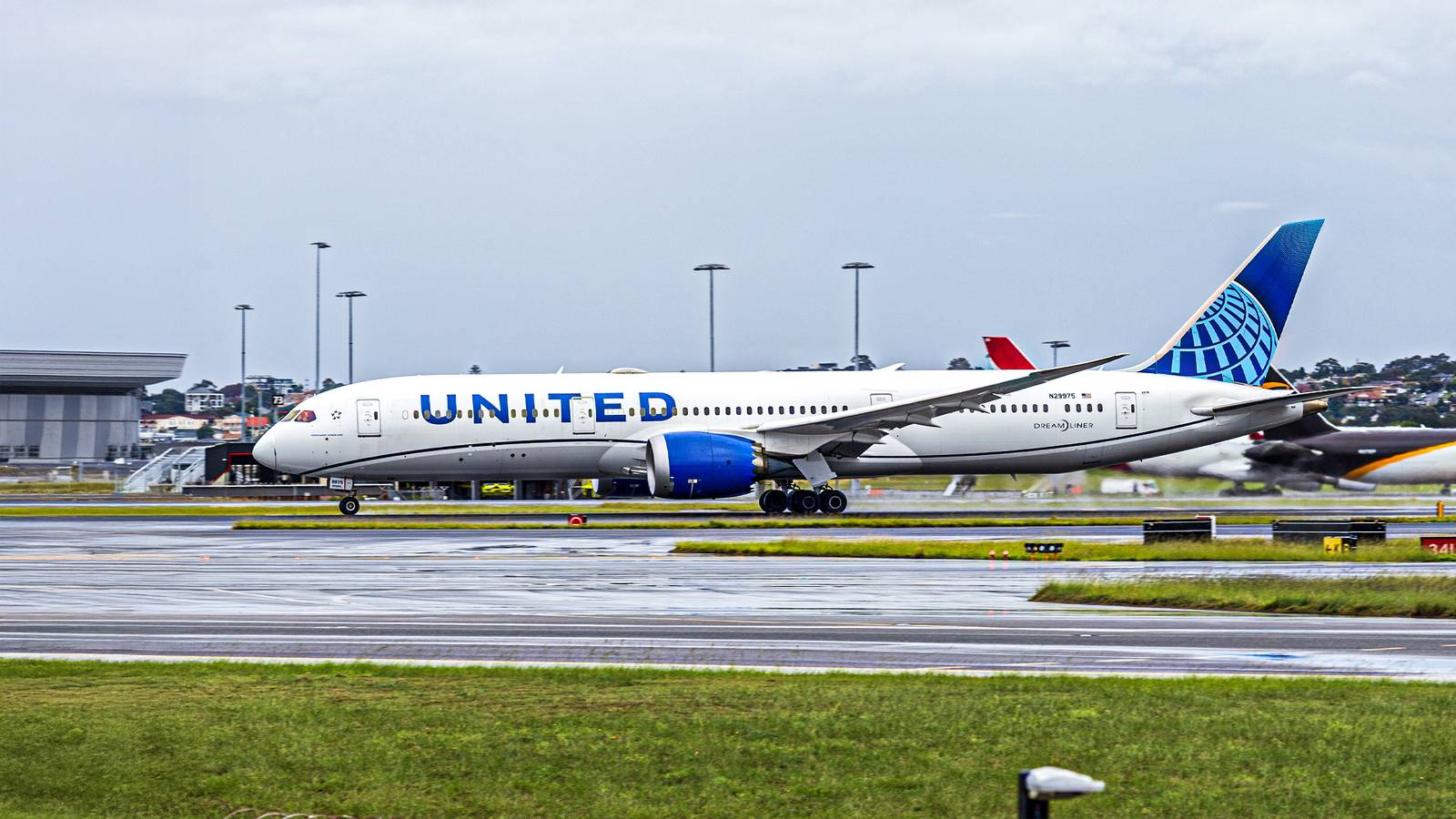
Published Nov 10, 2026, 4:00 PM EST Daniel comes to Simple Flying with a business focused approach to the aviation world. Daniel enjoys analyzing strategy and how companies move against each other to gain a step ahead in the skies. Besides strategy, Daniel also has a passion for aircraft design and the history of aviation. Based in New York In January 2027, United Airlines will begin new nonstop flights between Tokyo Narita International Airport (NRT) and Las Vegas Harry Reid International Airport (LAS). This is an unusual launch on the surface, since LAS is not a major hub for the airline, but it is a limited service scheduled around the annual Consumer Electronics Show (CES), held from January 6 to January 9. The carrier will run three NRT-LAS flights on January 3, 4, and 5, and three LAS-NRT nonstop flights on January 9, 10, and 11. The three NRT-LAS flights before the 2027 CES will use United's Boeing 777-200ER, featuring 276 seats and 50 Polaris seats. The three flights to Tokyo, however, will use the Boeing 787-9 rather than the 777. More interestingly, the airline will use its new Elevated 787-9 with its latest interiors and a premium-heavy configuration, featuring 64 Polaris suites and just 222 seats in total. It's unusual to use two different aircraft on the same route in opposite directions, especially when one has 54 more seats than the other. Scheduling And Aircraft Availability Credit: Markus Mainka I Shutterstock While LAS is a large spoke for United, it's not a particularly high-priority market, and the CES services exist to better serve existing Star Alliance customers who need to travel from Asia to CES nonstop, helping retain customer loyalty. In addition, these services also help expand United's and All Nippon Airways' (the two operate a metal-neutral transpacific joint venture) potential customer base, as some customers may have booked away from the two in the past for CES due to the lack of a nonstop. These routes work because of the sudden surge in demand to Las Vegas during this period, but they won't operate for a long period of time, which means United needs to find extra aircraft capable of operating the route. The 777 is coming from San Francisco, with United scheduling a second daily flight from San Francisco to NRT under the flight number UA 936 on January 2, 3, and 4. In NRT, the 777 turns around for UA 937 to LAS; after arrival, it operates a service to San Francisco again. The return leg with the 787-9 works slightly differently. United has not scheduled a domestic leg to LAS with the Elevated 787-9, which means that the aircraft will need to be ferried. It then operates UA 7 to NRT, turns around, then operates UA 6 to IAH. Crucially, UA 7 is ordinarily used for the airline's outbound service from IAH to NRT, but this flight simply won't operate on the three days when the LAS-NRT flights are running. In contrast, United is adding a second 777 flight from SFO to NRT to position the aircraft for the NRT-LAS flight. With these services, United is essentially using spare aircraft capacity, with the 777-200ER fleet having enough slack during those three days to operate a SFO-NRT-LAS-SFO rotation. Meanwhile, the airline felt that it was lucrative to cancel the outbound IAH-NRT leg for three days and use the Elevated 787-9 from LAS to NRT. Importantly, these decisions are being made based on what aircraft is available, not necessarily because the carrier needs to fly the 777-200ER or Elevated 787-9 on this service. Why Go For The Elevated 787-9 Credit: Travers Lewis I Shutterstock Every business decision comes with an opportunity cost. In the case of the LAS-NRT flight, United chose to cancel the IAH-NRT flight for three days and use that aircraft to operate the LAS-NRT flight, a decision weighed against pulling an aircraft from elsewhere. This doesn't necessarily mean that the IAH-NRT flight is particularly weak, but the math favored this solution above all others. In addition, the Elevated 787-9 could also be particularly desirable for this route. The Elevated Interior and 222-seat layout debuted only in 2026, while January 2027 will be the first time United operates CES services. Primarily, these flights are about increasing customer loyalty and expanding the customer base, so United is putting its latest and greatest aircraft on this route. The Elevated 787-9 not only has the airline's newest seats, but it also has an extremely premium-heavy layout, and exposing these customers to the best United can offer further supports its mission. Decisions like these involve multiple factors, including the IAH-NRT flight's performance on the selected days, the value of flying the Elevated 787-9 on LAS-NRT, the opportunity cost of pulling an aircraft from another route, and availability. It's also worth noting that mid-January generally has low travel demand in the US, which may explain why United could source a spare 777 and why United may have been inclined to cancel the IAH-NRT flight for three days. Of course, the airline has not confirmed these reasons. Benefits Of The Elevated 787-9 Credit: FiledIMAGE | Shutterstock The Elevated 787-9 has significantly fewer seats than United's standard 787-9, but it has substantially more premium capacity. For the customer base booking flights for CES, the added Polaris and Premium Plus capacity is exactly what is desired, which means that yields will likely remain high while most of the seats will still be filled. As such, the carrier should earn a substantial amount of revenue from operating this route with the Elevated 787-9, even if economy capacity is low. Although the Elevated 787-9 has significantly more premium seats than the Boeing 777-200ER, the 777 is still a very premium-heavy aircraft. With 50 Polaris seats and 24 Premium Plus seats, the 777-200ER has more premium capacity than the standard 787-9, and it is one of the most premium-heavy aircraft in United's fleet. The use of the 777-200ER demonstrates that the airline clearly saw strong premium demand, even if the return flight uses an even more premium-heavy aircraft. Offering the Elevated 787-9 on this route may have been United's priority, but the aircraft may not have been available to pull from another service in both directions. This could be why the airline instead pulled a 777-200ER for the flights to LAS, but then took an Elevated 787-9 from the Houston route on days when demand may have been weaker. Because of the limited nature of this route, opportunity cost plays a much bigger factor. What The Elevated 787-9 Brings To The Table United currently has 51 internationally configured 777-200ERs, while only 16 of its 64 787-9s are in the 222-seat layout with the Elevated Interior. There is a significant mismatch in capacity between the two segments, while premium capacity is actually much higher on the 787. United installs 50 Polaris seats, 24 Premium Plus seats, 46 Economy Plus seats, and 156 standard economy seats on the 777-200ER. Meanwhile, the Elevated 787-9 is equipped with 64 Polaris Suites, 35 Premium Plus seats, 39 Economy Plus seats, and just 84 economy seats. Inside, the Elevated 787s feature the next generation of Polaris business class seats. Based on the Elevate Ascent, these seats are configured in a reverse-herringbone layout while featuring sliding doors. The screens are larger than the prior generation of Polaris seats, and the airline has configured half of the center seats in a herringbone pattern, creating honeymoon suites that can also partially convert into a double bed. Furthermore, these planes feature front-row 'Polaris Studio' suites. United has also invested in the soft product of its cabins, including introducing new service features and amenities for the Polaris cabins. Meanwhile, the rest of the aircraft has been thoroughly updated compared to the airline's prior-generation widebody interiors. Premium Plus now offers headrest dividers for increased privacy, larger screens, new charging options, a water bottle holder, and a built-in reading light. Meanwhile, the economy seats come with larger screens and Bluetooth connectivity. Other US Airlines Running CES Flights Credit: Robin Guess I Shutterstock American Airlines has long operated January-only transpacific services from Las Vegas for CES. In 2027, the airline will operate nonstop flights from LAS to NRT and Seoul Incheon International Airport (ICN), using a 273-seat 777-200ER on both flights in both directions. As with United's CES flights, American's service will operate only for a limited time, although it is significantly larger than United in this market. While American is the more established player on CES routes from Asia, Delta Air Lines is growing quickly. In 2027, the carrier will run nonstop flights between LAS and ICN, Hong Kong International Airport (HKG), Shanghai Pudong International Airport (PVG), and Taipei Taoyuan International Airport (TPE). In addition, Delta is running nonstop flights to London Heathrow Airport (LHR), competing against American Airlines on this route, while also operating flights to Paris Charles de Gaulle Airport (CDG) and Amsterdam Schiphol Airport (AMS). Airline Aircraft Business Class Premium Economy Economy Total Seats American Airlines Boeing 777-200ER 37 seats 24 seats 212 seats 273 seats Delta Air Lines Airbus A330-900 29 seats 28 seats 224 seats 281 seats Airbus A350-900 32 seats 48 seats 226 seats 306 seats 40 seats 40 seats 195 seats 275 seats United Airlines Boeing 777-200ER 50 seats 24 seats 202 seats 276 seats Boeing 787-9 64 seats 35 seats 123 seats 222 seats (Data from aeroLOPA) These services are all limited, although United is undoubtedly the small newcomer to this market. Overall, this is a small but lucrative market that US airlines are increasingly interested in, but only for a very short period.
Why United Airlines Accepts A 222-Seat Jet Over A Standard 257-Seat One On Its CES Tokyo Route
Full Article
Original Source
Read the full article at Simpleflying →KhanList aggregates and links to publicly available news content. We do not host full articles from third-party sources. Always verify important information with original sources.