
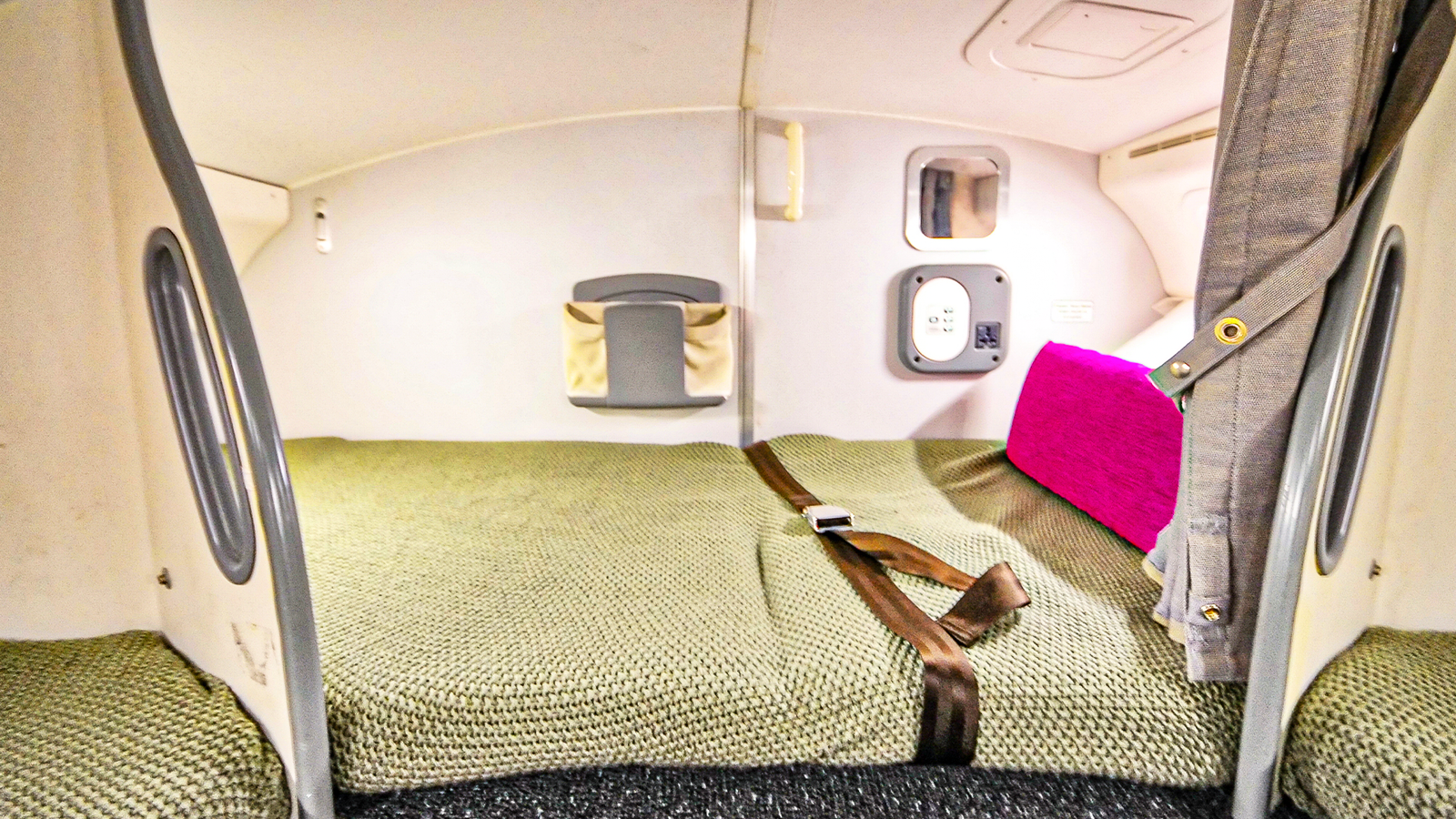
Published Oct 31, 2026, 11:00 AM EDT Based in the UK, Josh is a keen writer with a degree in Military History. Having worked previously as a financial journalist, he has covered the aviation industry extensively, reporting on airlines' results and monthly passenger statistics in the aftermath of the pandemic, alongside the likes of regulation around sustainable fuels, and the prospects for hydrogen-powered commercial flight. He joins Simple Flying with a lifelong love of all things aviation. Ultra-long-haul flight is no mean feat. For passengers, what feels like countless hours confined in an aircraft can take both a physical and mental toll. The same goes for flight crews, of course, with the difference being that those flying or providing passenger services cannot afford to lose focus due to fatigue. Resting aboard such ultra long haul flights has come to be a science of its own as a result. Where pilots and cabin crew do get dedicated rest areas to relax between shifts, the best way to utilize them is another question. Waking from a deep sleep and having to land an aircraft soon after can be just as counterintuitive as not getting enough rest, for instance. That means committing to an uneven pattern of breaks in many cases, in a bid to be as alert as possible when it comes to the final stages of a flight and having to land safely. Which Flights Do Pilots Have To Rest On? As to which flights specifically require pilots to rotate out of cockpits for breaks, there is no single set of universal rules. Instead, local regulations determine how long crews can be on active duty, and, in turn, how many pilots are needed per flight. Naturally, at least two pilots are required aboard most commercial passenger aircraft across the world. Flight time or duty hour restrictions may then call for more depending on where an airline is based. In the United States, for example, a two-pilot crew maxes out at between eight and nine flight hours, or nine to 14 duty hours. The exact figures can vary based on the likes of start time, or even whether crewmembers have had time to acclimatize — either by spending long enough within a time zone or off active duty. Nonetheless, longer flights tend to require an augmented crew, so extra pilots. In other words, those at the controls will have to take a break of sorts on any ultra-long-haul operation, wherever it is flying to and from. New Generation Aircraft Enabling Longer And Longer Routes Credit: Qantas Ultra-long-haul flight itself is by no means a new concept. Singapore Airlines flew 18-hour nonstop services to New York as early as 2004 using the Airbus A340-500, for instance. While this was ultimately discontinued a few years later due to the 2008 financial crisis and rising fuel costs, technological leaps have meant ultra-long-haul offerings are becoming increasingly common today. Indeed, next-generation aircraft like the Boeing 787 Dreamliner and Airbus A350 have only helped to make the economics of ultra-long-haul flight more attractive for airlines. Where the A340-500 required four engines to make such ambitious journeys, the clean-sheet, composite-heavy designs of the 787 and A350 mean they boast equally impressive ranges using just two new-generation engines each. Current longest commercial flights, from Flightradar24: Flight Route Aircraft Airline Great circle distance Average flight time SQ23 New York (JFK) - Singapore (SIN) Airbus A350-900ULR Singapore Airlines 8,288 nautical miles (15,349 km) 18 hours, 27 minutes SQ24 Singapore (SIN) - New York (JFK) Airbus A350-900ULR Singapore Airlines 8,288 nautical miles (15,349 km) 18 hours, 10 minutes SQ21 Newark (EWR) - Singapore (SIN) Airbus A350-900ULR Singapore Airlines 8,285 nautical miles (15,344 km) 18 hours, 45 minutes* SQ22 Singapore (SIN) - Newark (EWR) Airbus A350-900ULR Singapore Airlines 8,285 nautical miles (15,344 km) 17 hours, 58 minutes *Block time rather than average flight time provided Thanks to such new models, the idea of ultra-long-haul aviation is being pushed further and further. Qantas’ Project Sunrise is set to directly connect Australia’s east coast to London and New York from next year using the specialist Airbus A350-1000ULR. With each route set to boast a roughly 20-hour flight time, these will be the longest-ever scheduled services offered when they get underway in October 2027. Needless to say, that will leave each leg requiring an augmented crew taking it in turns to complete the journey. Longer Flights Require Additional Crew Members In the case of Qantas and Project Sunrise, four pilots will be needed for each sector. That is not uncommon, with pretty much any ultra-long-haul flight requiring effectively two sets of pilots. As a general rule, this is the case on journeys exceeding 13 or 14 hours, with a minimum of three pilots then required for flights lasting over eight to nine hours. In either situation, all pilots rostered on a flight will be present on the flight deck for take-off, as Hong Kong-based Cathay Pacific specifies on its website. Once at 20,000 feet (6,096 meters), in Cathay’s case at least, the rotation begins, with two pilots remaining on the flight deck and the one or two others starting their first break. Shifts are then staggered. Those having rested first will return to the cockpit, be briefed on the progress of the flight, and then relieve the acting pilots so they can rest next. This cycle continues until approximately an hour before landing, at which point all pilots once again return to the cockpit for the remainder of the journey. That does not necessarily mean the main and relief crew simply split the time down the middle, though. Why Not Split Breaks Down The Middle Between Operating And Relief Crews? In reality, where an augmented crew is needed, it is common practice for each member to be designated either a relief or operating pilot. Which crew one is in is determined well ahead of time when rosters are released. Alternatively, crew make-ups can depend on the airline. Qantas has been known to schedule one captain, one first officer, and two second officers on its current longest route between Perth and London, for example. Either way, each pilot’s specific role can have an impact on their rest schedule during a flight. That is because importance is placed on ensuring the crew that will ultimately handle the final approach and landing is well rested before they have to do so. As such, an equal split down the middle, whereby the operating crew takes the first shift on the flight deck, may not be the most ideal option. Returning to the controls with only an hour left before landing might not offer sufficient time to properly wake up, catch up on any developments, and actually carry out potentially the most demanding phase of the flight. The solution is to divide breaks unequally between the operating and relief crew. For a 14.5-hour flight — where each set of pilots has in the region of six hours each available to rest after the initial and final stages of the journey are accounted for — a common solution is for the operating crew to get the bulk of this in one go midway through the service. How Does The 4/6/2 Rest Pattern Work Instead? This is done by placing the operating pilots on a 4/6/2 pattern. In other words, those due to carry out the landing take the first four-hour shift behind the controls as the relief crew rests initially. They then switch for the next six hours, leaving the relief crew in charge for a prolonged period of the cruise. A final two-hour stint then means the operating crew is back in charge with plenty of time prior to descent and landing. The caveat is that the relief crew have to sacrifice their own ideal sleep schedule in order to give the operating pilots the best possible chance at quality downtime. Again, this is all in the interest of enabling those in charge at the most critical stages of a flight to be properly alert when the time comes. While the 4/6/2 pattern itself is specific to flights of around 14 hours, the thinking can remain the same on longer journeys. Simply put, the relief crew goes for their break first, before returning to give the operating pilots the longest and most ideal period to rest in the middle of the service. Come the end of the flight, it will then once again be the operating crew that has covered the run-up to descent and landing. Newest-generation widebodies typically found on the longest routes today are well suited for this too. Boeing 787 And Airbus A350 Rest Areas Both the 787 and A350, which are commonly found on the longest routes today, incorporate purpose-built areas for pilots to spend their time when not actively flying. Aboard the 787, this is situated above the passenger cabin behind the first set of exit doors. Two adjacent beds separated by a curtain and a single rear-facing seat make up the options for those off-duty to relax. Pilots are also graced with storage areas, reading lights, and a mandatory phone linked with the flight deck if needs be. On the A350, pilots similarly tend to find their rest area above the main cabin towards the front of the plane, though this can vary airline to airline. Again, beds are separated by curtains, and those inside have access to reading lights, ventilation controls, storage space, and so on. All told, the idea is to give pilots quiet, discreet areas away from passengers and the flight deck to try and rest between shifts behind the controls. No doubt, that may be easier said than done sometimes, given the demanding nature of working long- or ultra-long-haul operations and constantly crossing time zones. That said, the staggered rest cycle is only intended to aid pilots with this, so that they can be as alert as possible when it is most important.
Why Ultra-Long-Haul Pilots Prefer An Uneven 4/6/2 Rest Pattern Over An Even Split On A 14.5-Hour Flight
Full Article
Original Source
Read the full article at Simpleflying →KhanList aggregates and links to publicly available news content. We do not host full articles from third-party sources. Always verify important information with original sources.