
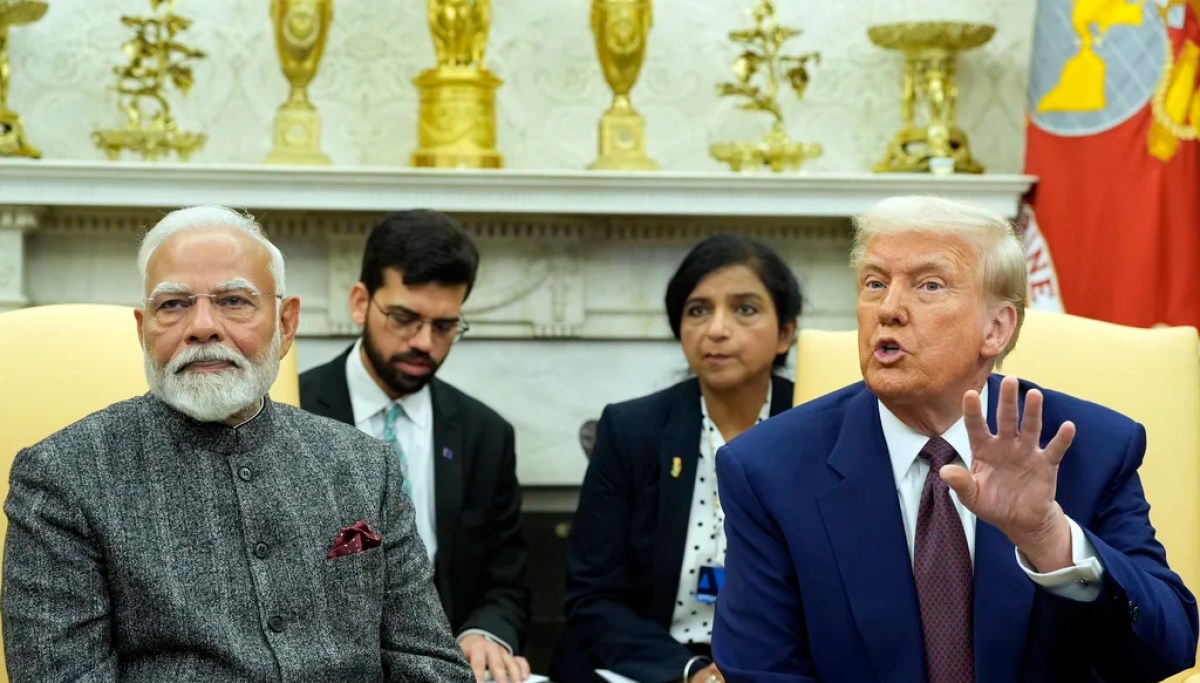
A little over 18 months into the second Trump administration, the imposition of tariffs on India and the administration’s renewed engagement with Pakistan have been interpreted by many analysts as signs of a more turbulent bilateral relationship.However, judged by the administration’s “America First” objectives — which emphasize greater reciprocity, expanded market access, increased purchases of American goods, and closer alignment on economic security — President Donald Trump’s pressure-based approach has produced results. It has prompted Indian concessions and policy adjustments across trade, energy, defense, nuclear cooperation, and sanctions enforcement. Thus, viewed from the administration’s perspective, Trump’s India policy is working. The Indian government itself noted that sustained engagement with the U.S. trade representative helped secure placement in the lower tier, with around 45% of its exports to the United States remaining exempt. Indeed, following the policy change, the Trump administration placed India in the 10% Section 301 tariff tier, lower than the 12.5% tariff applied to countries that had not adopted comparable forced-labor import restrictions.The move was one in a series of shifts that started even before Trump’s “Liberation Day” tariffs in 2025. Before and during Prime Minister Modi’s Washington visit in February 2025, India reduced tariffs on U.S. bourbon whiskey from 150% to 100%. India was also one of the first countries to launch negotiations for a bilateral trade agreement on Feb. 13, with negotiations including some of the long-standing U.S. concerns such as medical devices, ICT import licensing, customs procedures, technical and non-tariff barriers on trade, digital trade, and agriculture market access.President Donald Trump meets with India’s Prime Minister Narendra Modi in the Oval Office of the White House, Thursday, Feb. 13, 2025, in Washington. (Photo/Alex Brandon) Furthermore, when “Liberation Day” tariffs came into effect, unlike several other major U.S. partners, India did not retaliate nor pursue WTO litigation. Instead, it reportedly offered to eliminate or reduce tariffs on nearly 55% of U.S. imports, worth more than $23 billion, and accelerated trade negotiations. Most importantly for the U.S. administration, India reworked its energy policy around U.S. priorities. In February 2026, as part of an interim trade deal, India made efforts to stop purchasing Russian oil. In exchange, the U.S. cut its reciprocal tariff on Indian goods from 50% to 18%, rescinding the punitive 25% duty tied to those Russian purchases.India also increased its purchases of U.S. LNG and liquefied petroleum gas, both of which have been a priority for Trump. During the war with Iran, the U.S. emerged as the single largest liquefied petroleum gas exporter to India, accounting for almost 55% to 65% of all imports.Perhaps the biggest policy shift in New Delhi has opened doors to U.S.-India nuclear cooperation. In December 2025, India passed the SHANTI Bill, which replaced the existing framework and eased the supplier-liability obstacle, a long-standing impediment to U.S. companies investing in nuclear technology in India. While the landmark U.S.-India nuclear deal was signed nearly two decades ago in 2008, the nuclear liability law made U.S. companies wary of investments.Defense cooperation tells a similar story. India has continued to deepen its reliance on U.S. systems, moving new deals this year despite aspersions that the defense relationship may suffer due to tariffs, including reports that India had paused deals to purchase Javelin and P-8I systems from the U.S.In November 2025, weeks after renewing their 10-year defense framework, India bought Javelin anti-tank missiles and Excalibur precision-guided munitions from the U.S. under emergency procurement. Notably, this was the first time India bought Javelin missiles, even though the platform had first been offered over 15 years earlier. A state-owned Indian firm also signed a roughly $1 billion deal for 113 GE F404 engines to power its domestically built Tejas fighters, and India’s Defence Acquisition Council cleared the proposed acquisition of six additional P-8I maritime surveillance aircraft. This shows a continuing trajectory of India buying U.S. weapon systems and platforms.In a first for India, the Indian Coast Guard also enforced U.S. sanctions in its own waters. On Feb. 6, 2026, it seized three U.S.-sanctioned tankers, the Stellar Ruby, Asphalt Star, and Al Jafzia, about 100 nautical miles off Mumbai. It marked India’s first-ever operation against the shadow fleet that moves sanctioned Iranian oil through ship-to-ship transfers. All three vessels had been previously sanctioned by the U.S. for their ties to Iran. India has since deployed dozens of ships and aircraft for round-the-clock surveillance of its maritime zone to prevent its waters from being used to disguise the origin of sanctioned cargoes.The U.S.-India economic relationship has also become more balanced. Recent data show that in the first five months of 2026, U.S. exports to India rose nearly 21% to $21.9 billion, while imports from India fell about 14% to $40.4 billion, narrowing the goods deficit from $29 billion to $18.5 billion. Furthermore, many key Indian conglomerates announced and undertook investments in the U.S., with the recent SelectUSA summit showing commitments of over $20.5 billion. These measures help India, too, and are a part of a long-standing policy to diversify energy sources. Investments in the U.S. represent the growing maturity of Indian firms seeking a more global footprint. India’s maritime overtures can be examined within the context of its own Indo-Pacific strategy.The Trump administration’s “tough love” approach has notched some important wins for Washington, and a more balanced relationship serves both countries’ interests. As India’s global standing and prestige rise, it increasingly approaches and bargains with major powers as an equal, accepting greater responsibilities while expecting its interests to be respected.POLL OFFERS RAY OF HOPE FOR MIDTERM REPUBLICANSAt the same time, it’s in America’s long-term interest to continue developing a strong partnership with a rising Asian giant seeking to balance China. The results of the past 18 months are an American win, but importantly, they need not be an Indian loss. Kriti Upadhyaya is a visiting fellow for India at The Heritage Foundation.
Why Trump’s India policy is working
Full Article
Original Source
Read the full article at Washingtonexaminer →KhanList aggregates and links to publicly available news content. We do not host full articles from third-party sources. Always verify important information with original sources.