
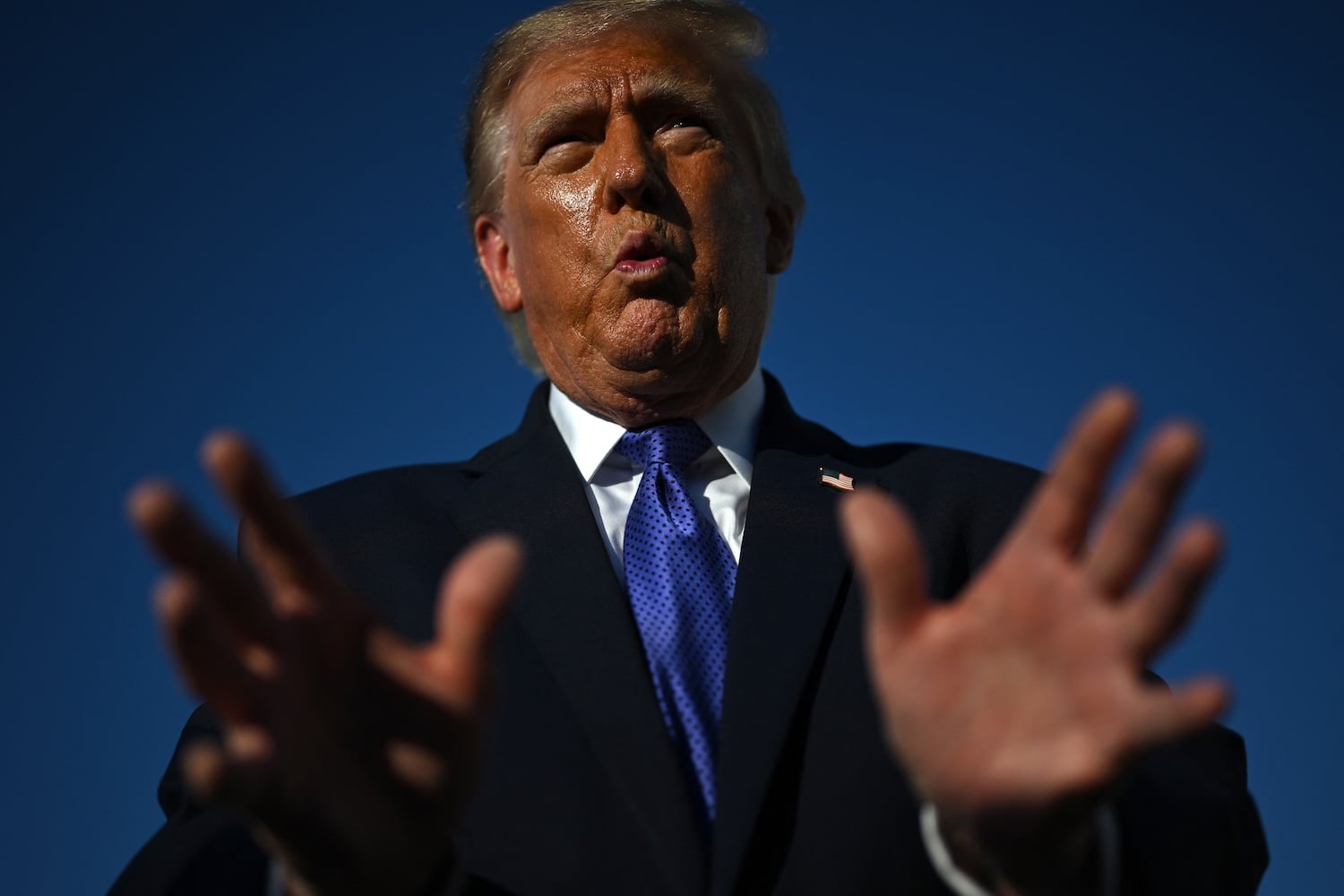
Appeasing Moscow and punting on Iran haven’t calmed oil markets or voters. A low-angle view of a man in a dark suit and blue tie speaking outdoors with both hands raised, palms open, against a solid blue sky. U.S. President Donald Trump speaks to reporters after exiting Air Force One at Joint Base Andrews, Maryland, on Oct. 29. Kent Nishimura/AFP via Getty Images October 30, 2026, 1:31 PM U.S. President Donald Trump’s eleventh-hour pivot back toward Moscow in a desperate bid to lower fuel prices ahead of next week’s midterm elections is not going great. But neither is his war on Iran, with oil prices climbing toward $120 a barrel and one U.S. lawmaker describing the administration’s plans for a renewed war on Iran as “insane.” Three weeks ago, in a telephone call with Russian President Vladimir Putin, Trump made a deal to purchase Russian diesel, which is forbidden under U.S. law. While the measure would have involved risible amounts of additional barrels into a strained global market, it has descended into farce. The three Russian tankers loaded with fuel may not be allowed to dock in U.S. ports. U.S. energy traders are unwilling to chance running afoul of long-standing sanctions against buying Russian energy. And Democratic lawmakers have said that any buyers will face congressional and legal scrutiny. U.S. President Donald Trump’s eleventh-hour pivot back toward Moscow in a desperate bid to lower fuel prices ahead of next week’s midterm elections is not going great. But neither is his war on Iran, with oil prices climbing toward $120 a barrel and one U.S. lawmaker describing the administration’s plans for a renewed war on Iran as “insane.” Three weeks ago, in a telephone call with Russian President Vladimir Putin, Trump made a deal to purchase Russian diesel, which is forbidden under U.S. law. While the measure would have involved risible amounts of additional barrels into a strained global market, it has descended into farce. The three Russian tankers loaded with fuel may not be allowed to dock in U.S. ports. U.S. energy traders are unwilling to chance running afoul of long-standing sanctions against buying Russian energy. And Democratic lawmakers have said that any buyers will face congressional and legal scrutiny. The global benchmark price of oil, which was about $70 a barrel before Trump started the Iran war in February, rose to over $117 a barrel on Friday. U.S. nationwide average gasoline prices are $4.20 a gallon, more than a dollar higher than the year before; no president ever has kept gasoline above $4 more than Trump. Diesel, which powers the entire economy, is worse: At $6.32 a gallon, it is about 70 percent higher than one year ago. Another of Trump’s pro-Russia moves to keep energy prices in check was a pressure campaign on Kyiv to refrain from targeting Russian oil refineries with drones and missiles. U.S. negotiators including Steve Witkoff said that Kyiv should show “gratitude” toward Washington by curtailing strikes. Ukraine complied for a spell in October, before remembering that what Ukrainian President Volodymyr Zelensky calls “long-range sanctions” are the country’s best way of severing the sinews of Russia’s war machine. Overnight Thursday, Ukraine resumed strikes on Russian oil targets, with a devastating attack on a large Rosneft refinery that makes jet fuel for the military. U.S. leverage over Ukraine is less than it used to be, since the Trump administration has not delivered any new military or financial assistance since Trump took office for a second time, and on several occasions, including this past month, has suspended what assistance there is, including some access to Starlink’s military-grade satellite internet service and intelligence sharing about inbound missile strikes. (While Ukraine has pleaded in vain for additional missile interceptors, the United States has pleaded poverty. This week, the United States sent a Patriot air defense system from Texas to Israel ahead of an anticipated restart to the fighting in the region.) The U.S. pivot to Russia isn’t limited to diesel deals and strong-arming Ukraine, though. In addition to stopping future aid, U.S. officials have reportedly been cautioning countries on the front line of Russia’s shadow war to tone down their warnings about Moscow’s hostile intentions. And on Friday, the U.S. welcomed Russian Foreign Minister Sergey Lavrov to the G-20 foreign ministers’ meeting in Atlanta, to the irritation of European allies. The abandonment of Ukraine has lately raised bristles in the European Parliament, where some politicians are redoubling their support for Ukraine even as Trump retreats. “This is not one of those instances of many different shades of gray. There’s clearly an aggressor who is in the wrong, and that’s Russia, and so I think, for me, that stands clearly,” said Reinier van Lanschot, a Dutch member of the European Parliament from the Volt Europa party and a vocal critic of Russia’s invasion. But Trump’s travails aren’t limited to his limited leverage over Ukraine. The war in Iran, which is now in its eighth month and likely to escalate in coming weeks, has kept oil prices high as shippers struggle to navigate a strait strewn with high costs, Iranian drones and missiles, and, for the first time, limpet mines. It may get uglier after the midterms. The Trump administration is reportedly considering a sharp military attack to try to once and for all break the back of a regime that has withstood war and sanctions for nearly half a century. Democratic Sen. Chris Murphy, who was briefed on defense planning, described the war plan as “insane.” None of Trump’s moves to placate Putin will help him in the midterms, but they could haunt him in the two years remaining in his presidential term. Winter is coming for Ukrainians who endure daily and undefended assaults from Russian missiles, but it may be coming as well for an administration that has aided and abetted. Russia Iran Ukraine Keith Johnson is a staff writer at Foreign Policy covering geoeconomics and energy. Bluesky: @kfj-fp.bsky.social X: @KFJ_FP Read More A large ship is seen on the water at sunset. Don’t Blame Ukraine for High Gas Prices Kyiv’s energy war on Russia may hurt on the margins, but the real culprit is Trump’s war on Iran. A large inflatable red gas tanker ship labeled "FOSSIL GAS" sits on display in a public urban square. Emerging from the deck of the inflatable ship are two large, distinct caricature heads dressed in white captain uniforms. Below the installation, a yellow banner featuring a graphic portrait and text hangs near a traffic cone. Pedestrians walk past the display along a sidewalk framed by buildings and trees. Trump’s Diesel Deal Has No Winners It won’t help consumers, won’t help Kyiv, and won’t mean riches for Moscow. OTHER SUBSCRIPTION OPTIONS Stories Readers Liked Go to slide 1 Go to slide 2 Go to slide 3 Go to slide 4 Go to slide 5 Go to slide 6 Go to slide 7 Go to slide 8 Go to slide 9 Go to slide 10 Three people rest on a sandy beach while a large, partially submerged and tilted ship sits out in the water in the background. The sky above is a hazy gray with cloud cover. A Taiwanese crowd protests while waving flags of the Republic of China. U.S. Undersecretary of Defense for Policy Elbridge Colby, left, and NATO Secretary-General Mark Rutte, right, stand during a press conference at NATO headquarters. Rutte is looking over at Colby, whose fingers are pressed together in a steeple gesture in front of him. Both men are wearing dark suits and ties, standing in front of a blue backdrop and U.S. and NATO flags. A camera rig and a red light are partially visible in the foreground, slightly obscuring the center of the frame. Xi (left) and Trump (right) are shown up close, with Xi looking at Trump. Putin and Xi are both seen in profile as Putin walks to the right and away from Xi, just a few feet of space between them. Xi, meanwhile, is also faced away from Putin, standing and looking down at his feet or the red carpet beneath them. Both men wear dark suits. A man wearing a dark suit jacket, light blue button-down shirt, and patterned red tie sits on a dark gray couch against a textured dark blue wall. He is looking off to the side with a mild smile, next to a teal pillow. The Twilight of the Francis Fukuyama Era By Jeremi Suri An illustration in red and blue tones depicting five silhouetted figures running forward through a dark corridor flanked by large, textured Russian lettering on the walls and floor. Light radiates from the far end of the tunnel behind them A statue of a seated, bearded man with a bare torso and draped cloth around his waist, holding a scroll in one hand, positioned in front of a row of large classical columns. Negotiators from the United States, Canada, and five European countries converse after finishing the draft of the North Atlantic Treaty in Washington on March 18, 1949. Trans-Atlanticism Isn’t Dead—It’s Being Renegotiated By Alexandra de Hoop Scheffer An aerial photo shows Doha in the booming petrostate of Qatar.
Why Trump’s Hail Mary on Fuel Prices Fell Short
Full Article
Original Source
Read the full article at Foreignpolicy →KhanList aggregates and links to publicly available news content. We do not host full articles from third-party sources. Always verify important information with original sources.