
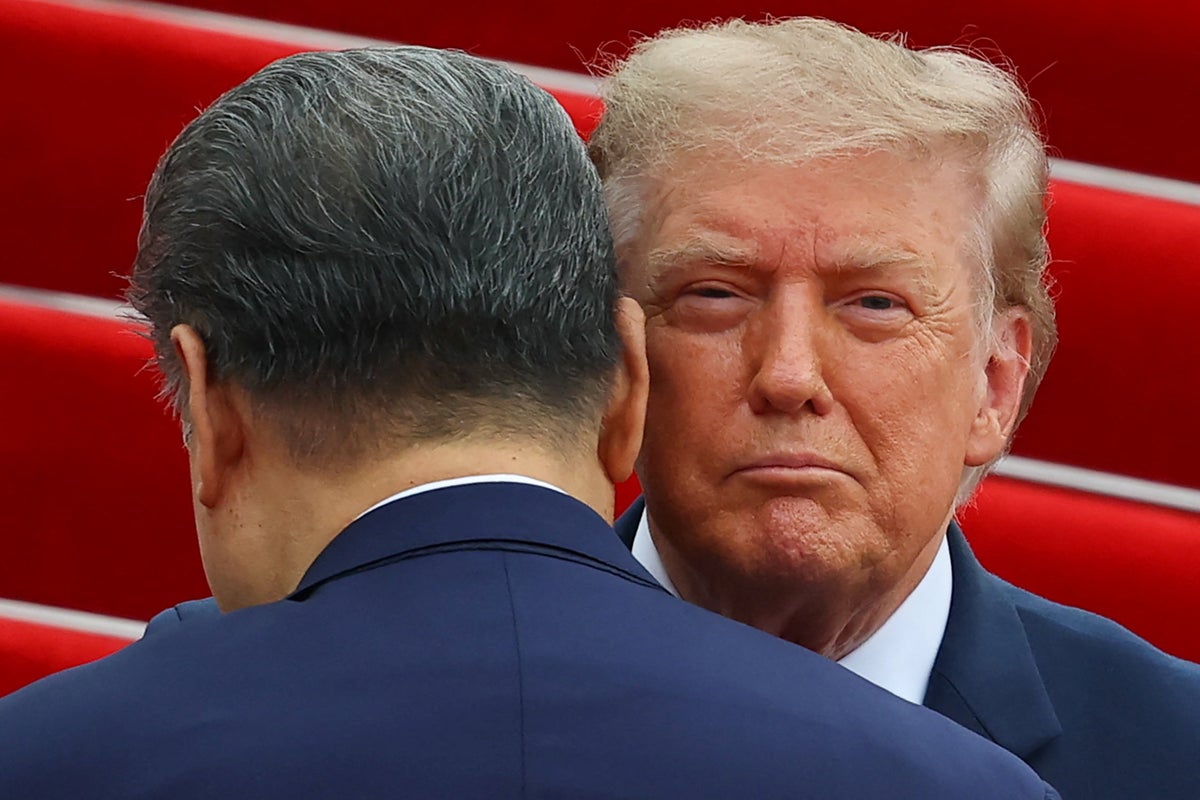
Donald Trump, Xi Jinping and Vladimir Putin will converge in the Chinese city of Shenzhen for a rare meeting that has drawn comparisons with the Yalta Conference, which helped shape the world after the Second World War.But the three leaders may have far less power to reshape global politics than the spectacle of their meeting suggests.Xi is set to host the Russian and US leaders at this year's Asia-Pacific Economic Cooperation (Apec) forum, which Beijing has hailed as being of "groundbreaking significance" in promoting world peace and stability.The summit in the southern tech hub of Shenzhen began with a CEO Summit of business leaders on Tuesday, followed by an Economic Leaders' Meeting beginning Wednesday.As the Ukraine war drags on and tensions between the US and Iran simmer, all eyes are on Thursday's unprecedented trilateral meeting, which has drawn comparisons, particularly in Russia, with the 1945 Yalta Conference between the so-called Big Three – the US, the UK and the then Soviet Union – to discuss the fate of postwar Europe.Chinese President Xi Jinping welcomes U.S. President Donald Trump upon his arrival at Shenzhen Bao'an International Airport ahead of the Asia-Pacific Economic Cooperation (APEC) Economic Leaders' Meeting (Getty)But unlike the wartime allies at Yalta, analysts tell The Independent the summit may be more consequential for its symbolism than its agreements, with each leader seeking individual gains despite their own vulnerabilities.“The upcoming trilateral meeting between Trump, Xi and Putin is likely to be more of a photo-op than a substantial event,” Dr Kevork Oskanian, an expert on Russia at the University of Exeter, says.“Agreement on substantial issues, which would, in any case, require extensive preparatory negotiations, is unlikely, beyond perhaps vague generalities and statements of intent,” he adds.For China, the meeting comes amid pressure at home from slowing growth, with retail spending and investment weakening amid a prolonged property slump. Its economy is still growing at more than four per cent, largely driven by surging exports that are provoking a backlash from trading partners.Hosting Trump and Putin offers Xi an opportunity to demonstrate to the Chinese public that Beijing is operating at the highest levels of global diplomacy.It is particularly important in the run-up to next year's Party Congress, where Chinese Communist Party leaders will select the next slate of leaders and are likely to grant Xi an unprecedented fourth term.On Wednesday, Xi urged Asia-Pacific economies to deepen cooperation to keep global supply chains stable, warning against rising unilateralism and protectionism.Russia's President Vladimir Putin and Chinese President Xi Jinping shake hands prior to a meeting on the sidelines of the Asia-Pacific Economic Cooperation (APEC) Summit (AFP/Getty)“Global growth lacks momentum, and unilateralism and protectionism are rampant,” Xi said at the CEO Summit in Shenzhen, referring to the Trump administration's tariffs on China, along with growing US technology restrictions, which have disrupted global supply chains."For Putin, it plays into his claims of great power status while distracting from the quagmire of his Ukrainian misadventure. For the host, Xi, it provides the appearance of China shaping the world order as an equal to the United States,” Oskanian says.For Trump, he adds, the meeting would provide a stage on which to perform his role as a "dealmaker" following what he describes as a "humiliating defeat in the mid-terms".This marks Trump's first trip to Asia since his Republican Party's defeat in the midterm elections and after allegations that Nvidia founder Jensen Huang was dating a suspected Chinese spy – news that sent shockwaves through American political, diplomatic, and trade circles.“The trilateral meeting between Trump-Xi-Putin will overwhelm the narrative of the Apec summit. This meeting appeals to all three leaders, each for their own reasons,” Ryan Hass, a China expert at the Brookings Institution, says.“Trump will be eager to turn the page from his recent midterm election setback and reassert himself as a central figure on the world stage,” he adds.It could be a case of the Chinese aphorism “all thunder, no rain”. The previous two summits, in Beijing and Washington, ended without substantive breakthroughs, as the sides appeared content to prioritise optics over substance.Chinese President Xi Jinping welcomes US President Donald Trump upon his arrival at Shenzhen Bao'an International Airport ahead of the Asia-Pacific Economic Cooperation (APEC) Economic Leaders' Meeting in Shenzhen (Reuters)“Theoretically, there is much for the two leaders to discuss – everything from the risks of AI to global hotspots – but it seems more likely than not that these two leaders will miss the moment, again,” says American political scientist and sinologist Jonathan A Czin, calling it “pantomime diplomacy”.Swaran Singh, a professor at the Jawaharlal Nehru University in Delhi, says Trump would approach the trilateral meeting with the aim of finding resolutions to the wars in Ukraine and Iran, adding that the talks were taking place at the US president's initiative."If you look at what can happen in this meeting, one can easily learn from what happened in their bilateral meeting last year in August in Alaska. Nothing came out of it,” he says."We cannot ever expect that Apec will deliver any breakthroughs. It will always be very piecemeal, behind-the-curtain, slow-motion activities that will happen. Therefore, they will definitely have a declaration, and it'll be more sentimental in terms of semantics expressing intent rather than actionable things," Singh adds.One area where the limits of Trump's dealmaking ambitions could become particularly apparent is nuclear arms control, with Beijing showing little appetite for restrictions on its rapidly expanding arsenal.The Chinese foreign ministry has, however, pushed back against suggestions of trilateral nuclear talks, citing the disparity between its arsenal and those of the US and Russia.China has around 600 nuclear warheads, compared with 3,700 for the US and 4,400 for Russia. Despite an 80 per cent reduction in the US stockpile since the fall of the Berlin Wall, Beijing continues to demand further cuts before joining arms control talks, even as its own arsenal has roughly tripled since 2020.“Beijing is unlikely to slow its nuclear expansion soon,” Tong Zhao, a nuclear policy expert at the Carnegie Endowment for International Peace, says, pointing to Beijing's continued investment in infrastructure for producing fissile material and researching, testing and manufacturing nuclear warheads.People watch the arrival of US President Donald Trump at his hotel where he will stay during the Asia-Pacific Economic Cooperation (APEC) summit in Shenzhen, in China's southern Guangdong province (AFP/Getty)China's latest Five-Year Plan, covering 2026 to 2030, explicitly commits to "strengthen and enlarge" its strategic deterrence.“Beijing has resisted trilateral talks in particular. It insists that Washington and Moscow bear primary responsibility for arms control and rejects any format implying that China owes comparable obligations. Substantive outcomes at a trilateral summit, such as arsenal limits or greater transparency, are therefore highly unlikely,” Zhao adds.Trump also wants to start nuclear talks with Russia following the expiration of the START treaty on 5 February this year. The two countries currently have no nuclear arms control agreement. It marked the first time since 1972 that there have been no legally binding limits constraining the nuclear arsenals of the world's two largest nuclear powers.Prof Singh says: “Trump is restarting arms control negotiations with Russia not simply to put certain control on Russian nuclear weapons, but also to bring China into nuclear negotiations and build consensus to deny Iran any possibility of building nuclear weapons."However, Zhao says the three leaders could agree on smaller measures to reduce nuclear risks, including keeping artificial intelligence out of decisions to launch nuclear weapons and establishing advance notification of missile launches.A trilateral missile notification agreement would be particularly significant, building on existing arrangements between the US and Russia, and Russia and China, while closing a gap between Washington and Beijing.The leaders could also reaffirm the Cold War-era Ronald Reagan-Mikhail Gorbachev declaration that "a nuclear war cannot be won and must never be fought", although Zhao cautioned that such pledges have limited value without concrete action.Russian President Vladimir Putin speaks at the APEC CEO summit held ahead of the APEC summit in Shenzhen, southern China's Guangdong province on Wednesday, Nov. 18, 2026 (AP)More meaningful progress, Zhao argues, would involve agreeing on what constitutes a nuclear threat and how to prevent nuclear signalling from being used as a tool of coercion.For Putin, who was seen as an international pariah following Russia's invasion of Ukraine, the symbolism of sitting alongside the American and Chinese presidents carries significance of its own.More than four years after launching Russia's full-scale invasion, the Russian leader remains embroiled in a costly conflict that has reshaped European security and strained Moscow's relations with Western governments.A summit that places him on equal diplomatic footing with Trump and Xi offers an opportunity to challenge the perception of Russia's international isolation.Russian state media has already hailed the trilateral summit as a "diplomatic victory", even before Putin sits down with the leaders of the world's two largest economies.Meanwhile, Moscow continues to refuse to agree to a comprehensive ceasefire and is pressing ahead with a war that has destabilised Washington's European partners.Oskanian argues that the comparison with Yalta is “unduly alarmist” as this is not a meeting of allies with distinct interests united around a specific goal, total victory; neither is it one where the participants have gained control over spoils they are supposed to divide.“Russia has not conquered Ukraine, far from it; Trump comes to this meeting with an adversarial Congress holding the purse-strings; for all the talk of ‘rejuvenation’, China is facing increasing economic and demographic challenges. And one does not create a 'new world order' over a day or two,” he adds.
Why Trump, Putin and Xi’s summit is doomed to fail to deliver
Full Article
Original Source
Read the full article at Independent →KhanList aggregates and links to publicly available news content. We do not host full articles from third-party sources. Always verify important information with original sources.