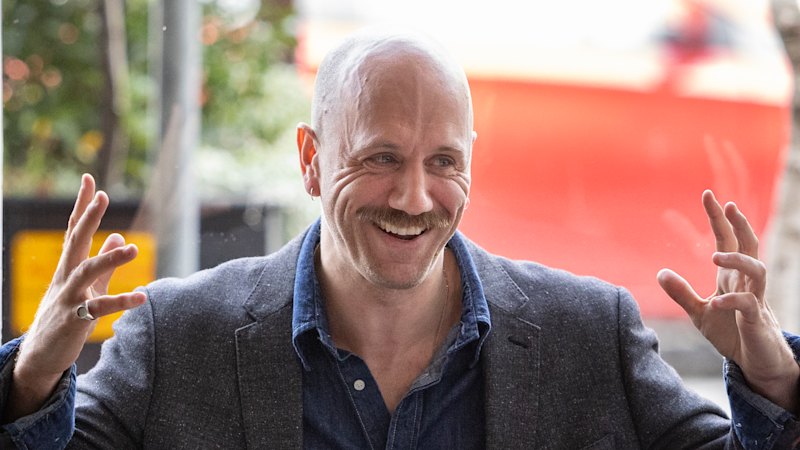
There are numerous considerations when ordering food for the Lunch With feature. You want to get something different to the subject, for example, so the photography won’t be boring. You probably want to get something that you are unlikely to spill all down your front, embarrassing yourself in front of an interesting person you want to open up to you.But never has the choice seemed as fraught as it does right now, as environmental science journalist Michael Dulaney and I are poring over the menu at Fitzroy wine bar Marion.Not because there aren’t many wonderful things to eat at Marion – the hatted restaurant is one of Melbourne’s best. And not because the menu is perplexing, or we aren’t happy to be here – the staff are warm and helpful, and Dulaney has been here once before, to celebrate finishing his book. The book is called Sentinels: When diseases spread between animals and humans.Although he does not have any scientific training, he was a journalist at the ABC for more than a decade and was a 2024 Climate Futures Fellow at the State Library Victoria. He got the idea for the book during COVID, when everyone became obsessed with zoonotic disease, or diseases that jump from animals to people. “The more I started reading about zoonotic disease, the more there was this overlap between the stuff I was already concerned about with climate and biodiversity, and this thing that was taking over the world at the time,” he says. Its most terrifying chapter, he admits, is about bird flu.We stare at the menu.“I don’t eat a lot of meat,” says Dulaney. This is unsurprising, as eating less meat is one of the most important choices individuals can make for the health of the planet, and Dulaney has been writing about climate change for the bulk of the past 15 years. But there’s a menu item that I think I’m going to have to insist on.“We should get the chicken.”He laughs, but agrees that for the sake of the story, the chicken is necessary. It’s a favourite at Marion – a half chicken with new potatoes and a glossy white wine sauce. We add Marion’s famous pillowy flatbread with gooey fromage blanc, tuna crudo with a zingy yuzu vinaigrette, a green salad and the salt-baked beetroot with goat’s curd and pecans.For the record, you can’t get bird flu from eating chicken, even if the chicken you are eating had the disease (which, at this point in Australia, is very unlikely). But our conversation still makes me look at the glistening bird with suspicion.The current scary form of bird flu that has been detected in Australia, by the way, is not your nanna’s bird flu. It’s not even the same strain as the bird flu outbreak in 2024, when Victorian farmers slaughtered hundreds of thousands of chickens to contain the disease. The current strain of bird flu, H5N1 clade 2.3.4.4b, is much worse. It’s both highly pathogenic (as in, dangerous or deadly) and highly transmissible (easy to catch), a very bad combination. And the fact that it’s mutated into this form is kind of our fault.Chicken with new potatoes and white wine sauce.Cass Knowlton“The really bad bird flu we have now comes from a low pathogenic flu that birds just have anyway,” says Dulaney. “It doesn’t have anything to do with chicken farming. There’s just bird influenza that circulates around; it just causes a mild sickness. But it’s not until we start industrially farming chickens that that very mild one meets [other strains in] that environment. Then it becomes a very serious one.”Industrialised chicken farming provides the perfect environment for different strains to crash into each other, mutating and jumping from bird to bird in closed sheds stuffed with thousands of animals.Most of the time, those mutations stay low pathogenic, but because it mutates so many times and has so many chances to infect and change in a giant chicken shed, once in a while bird flu will evolve into something much worse than the common avian flu that’s always in circulation. Bad luck for us, that’s what our new friend 2.3.4.4b has done.Worse luck, this adaptable strain has already jumped into mammals, with 13,000 baby seals dying of the disease on Heard Island, an Australian territory.According to the Australian Centre for Disease Control, it is rare for people to contract bird flu, and those who do are mostly those who work closely with birds, breathing in contaminated dust or air or touching their eyes, nose or mouth after touching an infected animal.“One or two people from a particular shed or farm might get infected, but then it sort of burns out,” Dulaney says. “They might die or they overcome the illness, but that’s it.”Marion’s famous pillow-soft flatbread and tuna crudo with yuzu.Jason SouthWhat has not happened – and might not ever – is any kind of person-to-person transmission. But Dulaney says that’s the nightmare scenario, the potential link in the chain that scares him most.“It’s not every chicken farm, and it’s not every outbreak,” says Dulaney. “Like any industry, different farms have different standards of biosecurity and how they respond to it, and some are better than others. There are chicken farms all over the world. It may not be an Australian thing that happens. It could be something in America or somewhere in Europe.“The virus itself is constantly circulating around the world. It’s sort of in that system, so my fear was not that it would happen in Australia per se, but that it would happen somewhere ... A flu virus can move around the world now in a matter of weeks because of how interconnected we are, with planes and international travel and shipping and all the global linkages we have.”If he hears of any kind of person-to-person transmission of this strain of H5N1, Dulaney says he intends to hole up in his parents’ farm in Western Australia and stock up on supplies.Person-to-person transmission of this strain doesn’t necessarily mean the start of a pandemic, he emphasises, but it’s good to be ready.“My proposal to them was not like I have all the answers to survive this thing; we just need to be prepared as best we can, which was have a bunch of food on hand, have a bunch of medical supplies, essentially just trying to think about what happened during COVID and to prep for that,” he says.At least we have the lessons of COVID to fall back on, right? This would not be our first pandemic rodeo, so surely we would know exactly what to do should H5N1 mutate into a pathogenic disease that spreads from person to person? Dulaney, who is by nature an optimistic person and really does not want to burst my bubble on this, has some more bad news. According to the World Health Organisation, “the world is less prepared now than it was during COVID”.“At the heart of this reality is a profound erosion of trust and unresolved inequities in access to basic services and medical countermeasures,” the WHO report states.Another problem is that there isn’t a lot of funding for the study of animal disease. In Sentinels, Dulaney interviews Deakin University professor Marcel Klaassen and Dr Michelle Wille, of Melbourne University, both bird flu experts. In fact, they are the only bird flu experts – Wille told him that by speaking to the pair of them, he had “pretty much covered the entire avian influenza community in Australia”.“We could have invited them,” says Dulaney with a laugh. “The bill would have been the same.”But the paucity of disease specialists is at least partly offset by the thousands of people who volunteer their time to monitor and care for wildlife. Dulaney met many such people in the course of writing his book, from a wildlife carer who takes a truckload of injured bats with her on holiday to birders who stand in freezing lakes in predawn winter mornings to capture and monitor the health of wild ducks.“Diseases give such an insight into our interconnectedness with animals, with the natural world,” he says. “It very quickly became clear that there were these big opportunities to tell these complex stories around our connection to nature and the climate.”And it’s not just bird flu, by the way. Bird flu might never make the jump into humans, and if it does, it might not be as dangerous for us as it is for birds. Dulaney has a chapter in Sentinels on “Disease X”, essentially a World Health Organisation thought experiment on humanity’s preparedness for a deadly pandemic.“There were some people who thought COVID was Disease X, but [it could be] bird flu, pox viruses,” says Dulaney. “They’ve got a whole range of candidates. There’s no one way that it would happen. I think the point of that idea is to illustrate the concept that it could be something we just don’t know about, and what would we do to prepare for that if it came. How would we game-plan for this Disease X if and when it emerges?”It certainly does not sound like a barrel of laughs, but the book is written with a lightness of tone that stops it from getting too bleak. Dulaney concedes that the climate crisis – and its attendant increase in the possibility for zoonotic disease to make the jump into mammals, particularly humans – can be overwhelming, even depressing. But he sees plenty of reasons for optimism.“Ordinary people do care a lot about the environment, about climate change, about animals,” he says. “Poll after poll shows that the majority of people really care about this stuff and want to make a difference, and are doing things in small ways, big ways to fight that to address that. So that gives me hope.”One of the things he found fascinating in researching the book was learning about the history of the chicken’s relationship with humanity. “They were kept as companions and as sort of beings of devotion and reverence; they were worshipped,” he says.Journalist Michael Dulaney says there has not been person-to-person transmission of this strain of bird flu – but if there is, he will be worried.Jason South“The archaeological record of chickens passing from where they first appear, which is in South-East Asia about 4000 years ago, they slowly travelled with people along the Silk Road up from India, Thailand up to Europe over hundreds of years, and everywhere they appear pretty much they’re worshipped, or they enter into myth.”He does recognise the irony of explaining the reverence owed to chickens while there is one on his plate, but he wants people to give the animal its proper due. “Going back to our friends here,” he gestures to a drumstick, “there’s something beautiful in that. You know, the dignity of the chicken restored.”Our server comes over to clear the plates and asks how everything was. We assure her it was wonderful, and Dulaney tells her, “We’ve been talking about bird flu for the last hour and a half.”The billShe eyes the few chicken bones remaining on the plate and gives a nervous laugh. “I’ll let you guys get back to it.”This, Dulaney says, is a common response. People don’t know much about zoonotic disease, and when they learn what his book is about, they often do not want to know much more. He does not bring up his speciality at parties. “You have to draw people in by other means,” he says. “Carrot and stick.”But we both agree: the chicken really was delicious.Read more great conversations over lunchCara Waters talks food and infidelity with Kate Legge : The unfaithful ex-husband and the cancelled friend: Inside Kate Legge’s complicated inner circleSelf-described AFL WAG Chloe Pink discusses being trolled with Hannah Kennelly: Footy players added Chloe Pink to their group chat. Then the abuse startedDavid Wenham bares his scars to Louise Rugendyke: David Wenham on cancer, getting older and being lusted afterStart the day with a summary of the day’s most important and interesting stories, analysis and insights. Sign up for our Morning Edition newsletter.
Why this science writer will hole up on a farm in WA if bird flu strain mutates
Full Article
Original Source
Read the full article at Smh →KhanList aggregates and links to publicly available news content. We do not host full articles from third-party sources. Always verify important information with original sources.