
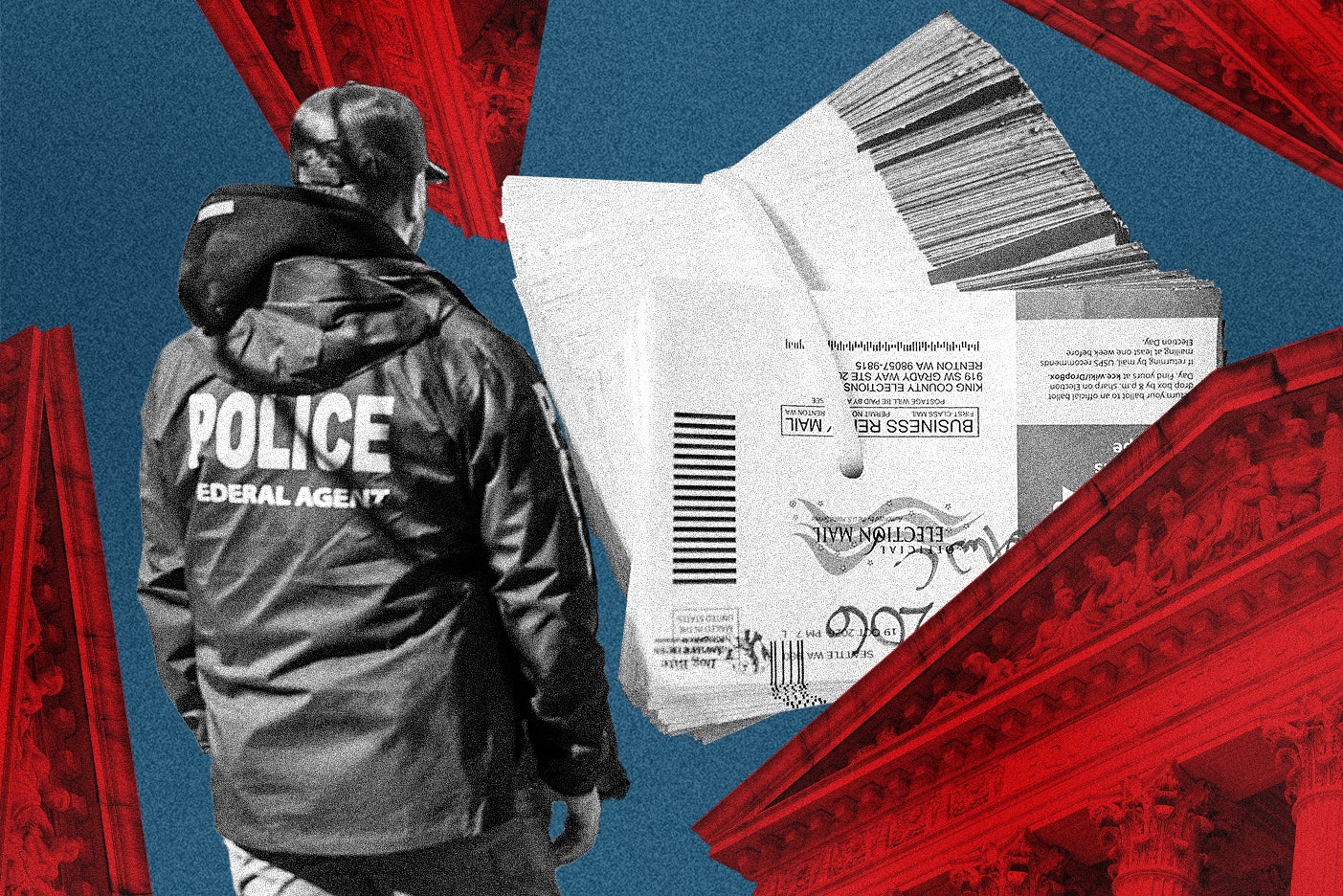
Jurisprudence By Enter your email to receive alerts for this author. Sign in or create an account to better manage your email preferences. Unsubscribe from email alerts Are you sure you want to unsubscribe from email alerts for Shirin Ali? Oct 29, 20265:45 AM Photo illustration by Slate. Photos by David Ryder/Getty Images and Spencer Platt/Getty Images. This is Executive Dysfunction, a newsletter that highlights one under-the-radar story about how Trump is changing the law—or how the law is pushing back—and keeps you posted on the latest from Slate’s Jurisprudence team. Click here to receive it in your inbox each week. The midterm elections are now underway across the country and as voters decide who should hold the levers of power in Washington, all eyes are on President Donald Trump. He’s spent the last decade baselessly questioning the integrity of U.S. elections—despite plenty of evidence finding they are safe and secure—with things coming to a violent head on Jan. 6, 2021. This year, as more and more polling is suggesting Democrats will sweep Republicans, even in solidly red districts, it raises the question: Will the president accept the results of critical House and Senate races, or won’t he? “I will, if they’re honest elections,” Trump ominously responded when asked this very question on Tuesday. Since Trump began his second term, he’s been laying the groundwork to try to nationalize U.S. elections and go after “voter fraud” through executive action and lawsuits against states, though most of these efforts have been struck down in court. Yet, the Justice Department has not given up. In fact, in recent weeks the agency filed at least two more dubious election lawsuits against California and Alaska, plus a series of cases against immigrants for alleged noncitizen voting. The legal challenges suggest the administration is planning ahead this time around, planting lawsuits that might create a foothold in the courts for the GOP to seize on if the midterms don’t end up going their way. To Charles Stewart III, a political scientist and professor at MIT who has spent decades studying American congressional politics, elections, and political development, the current situation created by Trump is a test of America’s democracy. “Not primarily because of fundamental shortcomings in American election administration, but because political actors associated with the Administration will attempt to delegitimize or overturn its work,” he wrote in a newly published paper, “The Day After: Threats and Guardrails in the 2026 Election.” Stewart believes that Trump’s efforts to thwart this year’s midterms should be viewed in three distinct phases: Before Election Day, during the vote counting and certification process, and when the new Congress convenes on Jan. 3, 2027. In practice, this looks like Trump beginning to seed baseless claims that losing Republicans can make after Election Day: mail ballots are suspect, voter rolls are contaminated with noncitizens, slow ballot counts are evidence of fraud, and any Democratic victories in close races shouldn’t be accepted. After Election Day, the lawsuits begin, harkening back to the days and weeks following Trump’s 2020 loss to Joe Biden, and finally things might culminate at the Capitol, where lawmakers could be pressured not to certify election winners. I spoke with Stewart to understand how this framework can help us see important red flags in the hours immediately following Election Day, plus the chances that Trump incites yet another angry mob to take over the Capitol. And is there any silver lining to hold on to? Here’s our conversation, lightly edited and condensed for clarity. Shirin Ali: In your paper, you drill down on the president’s efforts to undermine the midterms into three flashpoints: Before Election Day, during the vote counting and certification process, and when the new Congress convenes. Can you explain what each of these are? Charles Stewart III: The ideas behind those flashpoints come from what we’ve seen the Trump administration working on in the second term: two executive orders, activities at the Justice Department and Homeland Security, actions that are beginning to nibble around the edges of the election administration process. Particularly before Election Day, putting pressures on mail voting, highlighted by the executive order from this past March that basically directed the U.S. Postal Service to create a new series of procedures for handling mail voting, marrying that together with directives to DHS to create these lists of citizens. The second flashpoint has to do with pressures on election administration, especially election administrators and the institutions themselves. There, I think the pressures go beyond even what the administration has been doing. Certainly, a lot of the activity of the administration has been focused on the possibility that if election officials don’t do what the administration wants, they will not only bring civil complaints against them, but they may very well bring criminal complaints against them. Then after Election Day, that’s where we’re thinking about getting the final count in. We shift into the formal process of canvassing the vote, certifying it, and making sure that we’ve named the winners. I’m thinking broadly about a potential replay of what happened after the 2020 election, where the Trump campaign lodged a number of lawsuits in battleground states like Wisconsin and Pennsylvania. I’m still anticipating, even more now, that coming true. The final flashpoint is what happens when the 120th Congress convenes on Jan. 3, 2027, particularly the House. And there the question is whether there will be efforts to bar the seating of senators or members of the House who’ve been elected, specifically Democrats who would be the pivotal members of the two chambers that would flip control of the chamber to the Democrats. There’s another obvious parallel with 2020, when there were efforts to deny the certification of the presidential election. How do the Justice Department’s lawsuits against California and Alaska fit into this? Those are kind of jumping the gun on the timeline that I had suspected, because they’re really almost preempting post-election challenges and making them pre-election challenges. About a week ago I was saying, “Well, they’ve filed this lawsuit against California, it’s getting kind of close to the election. If there’s just California, it’s kind of a weak rule in terms of applying formal pressure on the states.” Then came Alaska, and this one makes me wonder what else the DOJ is going to do in the next week to bring early lawsuits against states and kind of do a shot across the bow. The California lawsuit is the sort of thing that we that we’ve long expected the Trump administration to do, and in fact in the first administration, there were rumors that they were trying to put together a national voter database and merge it with immigration records to begin to go after states for having noncitizens on the rolls. This has been a long dream of the administration and people associated with the administration, and it’s taken them basically a decade in order to act on it. It doesn’t look like they’ve done a particularly sophisticated job, both in terms of the actual job of database matching or on the legal side. The Alaska case seems to be the most frivolous election challenge that I can imagine, and in fact it’s kind of orthogonal. It’s unrelated to the things I had anticipated, because the lawsuit they’re bringing is the sort of lawsuit that you would expect a candidate to bring. Really, it’s up to Sen. Sullivan to bring these challenges under Alaska law and then potentially to bring a contest to the U.S. Senate. I only have to believe that the Alaska case is the classic case of pleasing an audience of one; Donald Trump wanted it and he got it. There’s just no way in the world this is going to go forward. It’s sort of like going after James Comey or going after the members of Congress who reminded service members they didn’t have to follow illegal orders. It’s really performative, to please the boss, and hard to take seriously, except the degree to which it’s predictive of what we’re likely to see after the election: the federal government putting the thumb on the scales of candidate-oriented post-election litigation. Next week, immediately after Election Day is over, what are you going to be watching for? I think there will be two things. One will be legitimate, and the other will be illegitimate. The legitimate thing is that we may very well see more losing candidates contest their elections and begin taking legal actions to try to save evidence, within the normal contest laws. Some of it may very well be performative to garner support from the administration or local political actors, but those are the ill-fated sorts of things that there’s a legal framework for doing. Plus there’s a legal framework for judges throwing these cases out, right? And that’s the way it should happen. What I think we need to be prepared for, and I don’t think it’s going to be widespread, are candidates supported by the administration going into court to attempt to impound voting machines and ballots and to remove them from where they’re normally housed. Basically, a repeat of the Fulton County event a year ago where the FBI removed ballots. Those are the things I think we should anticipate, and I think that the Department of Justice may very well take matters into their own hands that are quasi-independent of the candidates themselves. For instance, the Alaska lawsuit was just something that the DOJ did because the president wanted it. That’s a disturbing thing that I think we need to be prepared for after the election because we’ve already seen it happen before the election. That is the DOJ just going into places they don’t like and filing lawsuits. In your paper, you wrote, “The greatest danger is not that even a few challenges will succeed; it is that a small number of delayed certifications could matter greatly if control of either chamber is in doubt.” What did you mean by that? If you think about Jan. 6, 2021, in Congress and leading up to that, there was a whole lot of noise in the political system about whether the vice president could refuse to accept electors and whether Congress could impose their own view on what state electors they should accept, and all those sorts of things. In retrospect, traditional constitutional election lawyers had it right all along in terms of the law. The correct person was elected president, but the political ramifications of that whole episode and Jan. 6 itself were just catastrophic for American politics and certainly transformative in many ways. The law held, the right guy was elected president, but antidemocratic elements were energized and we had a riot at the Capitol. A social movement has arisen in the country that makes millions of dollars based on stoking a view that elections in America are illegitimate. It’s an extreme view, and a minority view even within the Republican Party at that level of extremity, but it’s really been politically consequential over the last six years. I think we could be in an Act 2 of that, and that’s what I’m getting at here. Imagine that this was a decade ago and we’re coming into a Congress where the Democrats were going to take over the chamber and have about a 20-seat lead. You wouldn’t have imagined anything major to come out of any contest, any seat. There might have been a couple of contests and it might have been highly politicized, but they would have been handled in the regular order. Imagine right now if Democrats have that same margin of success. I think we have to assume there will be at least a few members of the House on the Republican side who will make a lot of hay around refusing their being seated, refusing to allow them to vote for the speaker, pressuring the clerk not to accept their certificates of election, those sorts of things. All of those would be illegitimate. The rules of the House are very clear about the clerk of the House accepting the properly given certificates of election for members of the House for the purpose of the roll-call vote at the beginning and electing the speaker. There is a very prescribed way of handling contests in the House of Representatives, and there is no legitimate, legal way for the current Congress to be the judge of those elections. Now, one of the things I think will stoke the political fires, though, is the investigations into any contest that any member would want to bring in the 119th Congress. There will be pressures in the current Congress for House Speaker Mike Johnson to highly politicize those investigations, use them as opportunities to shine a spotlight on California and other states that are not cooperating with the administration over noncitizens on the rolls, for instance. Or on states with high levels of mail voting. It’s going to unleash this political theater in hopes of blowing up regular procedures that are very clear, much more clear than the Electoral Count Act was in 2020, into something that looks like a rejection of this election. And the closer it is, the higher the stakes and the higher the temperature. Despite having serious concerns about what the Trump administration will do in the event Republicans lose control of Congress, you’re optimistic that the 2026 midterms will be resilient enough to withstand a Trump bashing. Why? It starts with the decentralized nature of election administration. When I’ve been asked about whether the Trump administration is going to be successful in overthrowing this election, I’ve generally responded with two words: Feckless—they’ve not been very good at what they’ve done; and capacity—there are just not enough lawyers left in the Department of Justice, or enough immigration agents, there’s not enough of anything to take over the American electoral system. If it’s a matter of mobilizing the federal government, there are more local election officials running elections than there’s the capacity of the Trump administration to go after enough of them. That’s decentralization. The second thing is that we continue to see evidence that the facts-based institutions of our electoral system continue to hold. That includes state and local election officials who are nothing if not careful about following the law. And there are the county boards of elections; we’ve seen general election boards stand by the canvassed results. There have been several states that have passed laws over the last few years reinforcing the notion that the certifications of elections at the local level are ministerial and that the proper place for conducting contests, if something is seen to be amiss, is in the court system, not in the election boards. Finally, I think we continue to see the courts holding to what the law is, holding to the precedents that have been established in the past about what do you do when someone contests the results of an election. There’s established law there, and trial courts have, on the whole, held, and when they haven’t, they’ve been admonished or overturned on appeal. It would be nice if we didn’t have to say, “Well, at the end of the day, we’re relying on the Alaska Supreme Court.” It would be much better if it didn’t have to get that far, but we do still have a robust and independent judiciary that has been willing to stand up to nonsense. We hope you learned a thing or two from this edition of Executive Dysfunction, and if you enjoyed reading it, please consider supporting our legal journalism by becoming a Slate Plus member! Elsewhere in Jurisprudence In this week’s episode of Amicus, Dahlia Lithwick weighs the million-dollar question: To impeach or not to impeach? If Democrats gain control of the House and Senate, this will be one of the first issues they will need to grapple with, and Frank Bowman, law professor and former federal and state prosecutor, tells Dahlia that Trump’s actions are definitely impeachable. However, Congress is likely to face obstacles that may just be insurmountable.In the Amicus bonus episode, Dahlia is joined by Madiba Dennie of Balls and Strikes to discuss Supreme Court Justice Elena Kagan’s biting remarks about originalism, plus a flash of positive court news that includes a rejection of the Trump administration’s ability to harm transgender inmates in an emergency.States that have struggled to enforce strict abortion laws have found a new avenue to force their agenda, and it focuses on controlling speech. Mary Ziegler, law professor at the University of California, Davis, writes in Slate about a new frontier around reproductive rights that’s brewing for after the midterms.Ohio Republican candidate for governor Vivek Ramaswamy’s decision to run an ad accusing his Democratic opponent Amy Acton of lying about sexual abuse she endured at the hands of her stepfather gets at a dark and damning trend: We don’t believe children. Dale Margolin Cecka, associate professor of law at Albany Law School, explains in Slate the statistics around child sexual abuse and how Ramaswamy turned Acton’s vulnerability into a campaign tactic.Immigration is very much on the ballot this midterm election cycle, and Chika Okafor, economist and assistant professor of law at Northwestern University, conducted a new study that found voters are very much in control of what law enforcement policies get adopted and which don’t. In Slate, he argues that on Election Day, voters will get to directly decide whether more Americans will be killed by federal immigration agents. Thank you for reading Executive Dysfunction! We’re thrilled to be in your feeds and will be back with more dysfunction analysis next week. Donald Trump Elections Voting Voting Rights Capitol Riot 2026 Midterms Executive Dysfunction
Why There’s a Real Risk of a Replay of the 2020 Election Come Tuesday
Full Article
Original Source
Read the full article at Slate →KhanList aggregates and links to publicly available news content. We do not host full articles from third-party sources. Always verify important information with original sources.