
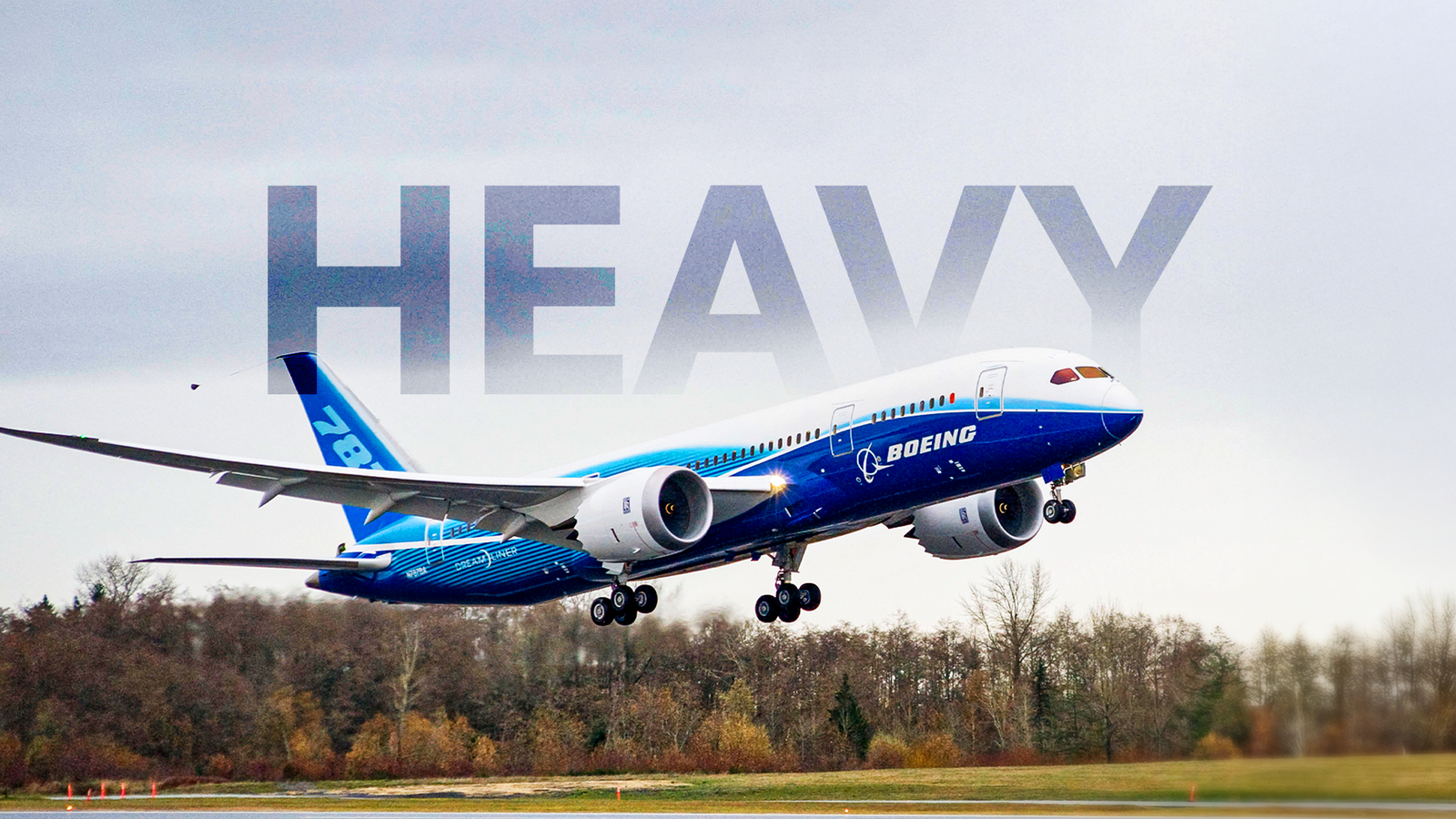
The Boeing 787 Dreamliner is now the world's best-selling widebody jet of all time, but there is a major difference between the aircraft that roll out of the factory doors today and the one that pioneered the host of innovative technologies packed inside. As the first clean-sheet design in decades, the 787 pioneered composite construction, 'bleedless' electrical systems that replaced forced air, a lower pressurized cabin altitude, and numerous other technologies that have made it so popular since its debut. The primary cause of the excessive weight stemmed from the aircraft’s groundbreaking transition to a carbon-fiber composite airframe. Eager to beat a next-generation Airbus competitor to the market, Boeing started building airplanes before engineers had finished the design. The most concentrated weight additions occurred during the rigorous ground testing phase, when physical stress tests revealed unexpected structural weaknesses. Then it was discovered that early estimates failed to account for small secondary components like wiring harnesses, brackets, and hydraulic hose clamps. The first Dreamliners to leave the factory were so heavy that airlines refused many of them. The prototype emerged nearly 22,000 pounds (9,979 kg) heavier than its design target weight. Some sat in Washington state for years. These aircraft were referred to as the 'terrible teens', and one was particularly unlucky, logging only 13 hours of flight before it was scrapped for parts. The manufacturer eventually resolved the underlying weight issues starting with the 20th example, going on to achieve 2,489 orders and 1,311 deliveries. A Tumultuous Debut For The Best-selling Widebody In Aviation History Credit: MC MEDIASTUDIO | Shutterstock Boeing admitted the problem early. FlightGlobal reported that the company confirmed its early airplanes were heavy and that it was working hard on weight improvements, while promising customers their contracted payload. The Seattle Times reported that Bernstein Research estimated early jets could arrive up to 8% overweight, costing 10% to 15% of range. The composite widebody officially entered commercial service in October 2011 with All Nippon Airways, following years of high-profile industrial delays. Boeing’s swift market penetration initially upended the development pipeline for the Airbus A350 program. Airbus originally responded to the Dreamliner by proposing a modest, cheaper-to-build derivative of the existing A330. This misstep forced Airbus to completely scrap its blueprint and invest billions in a clean-sheet design, launching the A350 XWB. This stable widebody production became absolutely critical as the manufacturer navigated a series of severe corporate and industrial crises. While the catastrophic 737 MAX groundings paralyzed narrowbody handovers, and billions of dollars in losses accumulated from fixed-price defense contracts like the KC-46 tanker, the Dreamliner line provided vital operational cash flow. The next-generation 777X program was mired in extensive certification delays and pushed further down the decade. The competition between the 787 and A350 would also spark a 17-year feud as the US and Boeing sued Airbus and the European Union in the court of the World Trade Organization over illegal government subsidization. The matter was eventually concluded when the WTO decided that both companies received illegal subsidies. The delays saw Airbus lose much market share to the 787 but, today, the A350 family has matured into a formidable competitor, securing 1,624 firm orders with 737 aircraft delivered and a remaining backlog of 887 units. Even with intense widebody competition, the 787 program maintains a healthy backlog of 1,178 unfilled aircraft. The Flaw Where The Wing Meets The Fuselage Credit: InsectWorld | Shutterstock The problem surfaced in 2009 during ground tests that bent a 787 wing to simulate flight loads. Workers found greater stress than expected in the side of the body structure where the wing attaches to the fuselage. Delamination of the carbon fiber reinforced polymers (CFRP) proved to be a steep learning curve for the company as it pushed ahead to deliver the world's first primarily composite twin-aisle jetliner. The individual plies of carbon fiber fabric physically separate from one another. In the early 787s, this occurred under high tension and compression forces, causing the split composite layers to splay outward in a structural failure mode that engineers visually described as 'flowering.' The most severe manifestation of this issue occurred at the side-of-body joint, where the upper wing skin meets the center fuselage section. During the critical May 2009 limit-load wing-bend test, the massive upward deflection of the wings concentrated immense, unexpected local shear stress right at the squared-off ends of these 17 stringers. The severe compression forces caused the layered carbon-fiber plies at the stringer ends to crack and physically delaminate. Because these test aircraft were already fully built, Boeing could not cleanly restart production. To pass Federal Aviation Administration (FAA) certification, engineers had to devise a retrofitted modification. Workers had to manually cut U-shaped stress-relief notches into the ends of every single stringer and bolt them down using massive, dense titanium reinforcement brackets and dual-sided metallic fittings. These heavy metal patches across 34 separate stringer locations instantly saddled the early terrible teens fleet with thousands of pounds of permanent dead weight. Credit: Bogaletzki Pressefoto | Shutterstock Ultimately, these structural errors occurred because Boeing was writing the regulatory rulebook for commercial composite widebodies in real time. Before the 787, commercial planes were predominantly aluminum metal structures. Aluminum is predictable; it dents, bends, and shows clear signs of fatigue long before total failure. Composites, conversely, hide internal damage. Because there was zero historical fleet data for an all-composite widebody passenger plane,the FAA required Boeing to prove an ultimate load safety margin of 150%, meaning the structure had to withstand one-and-a-half times the absolute maximum load the plane could ever experience in real-world flight. To ensure the plane wouldn't suffer catastrophic structural failure, the initial design overcompensated by laying down excessively thick, dense, and heavy composite plies across the entire fuselage. Only after years of real-world flight-test data were collected could Boeing safely thin the composite layers and permanently eliminate the heavy titanium brackets on subsequent line numbers. However, engineers also face the challenge of the revolutionary new subsystem architecture that eliminated traditional pneumatic bleed-air systems and heavily downsized the hydraulics in favor of electrical power. The Price Tag for Pioneering Aerospace Engineering Credit: Sergey Kustov | Shutterstock The Boeing 787’s transition to a More Electric Aircraft (MEA) architecture was highly innovative and is now praised as one of its finest features, but it also initially became a major contributor to the aircraft's excess weight. In conventional aircraft, high-pressure hot air is bled directly off the engines to run air conditioning packs, power wing anti-ice systems, and drive heavy pneumatic pumps. The 787 eliminated pneumatic bleed infrastructure and replaced many hydraulic systems with electric equipment. Eliminating thermodynamic efficiency losses with the new MEA design dramatically optimized engine fuel burn, but the initial execution of this all-electric architecture was much heavier than projected. To generate enough electricity to power the cabin environmental control systems and wing anti-ice, Boeing had to mount four massive 250 kVA Variable Frequency Starter Generators (VFSGs). To prevent the massive motor control units and electrical liquid pumps from melting, Boeing installed a dedicated, independent Power Electronics Cooling System (PECS). Additionally, instead of using hot engine bleed air to naturally pressurize the cabin, the 787 relies on four massive, electrically driven Cabin Air Compressors (CACs). VFSGs, combined with the heavy-gauge copper wiring, massive power distribution panels, and solid-state power controllers needed to distribute nearly 1.5 Megawatts of electricity safely across a composite hull, instantly added thousands of pounds. PECS added heavy liquid-cooling loops, specialized heat exchangers, coolant pumps, and reservoirs filled with liquid coolant, negating much of the weight saved by removing pneumatic plumbing. In the early production line numbers, CAC assemblies were over-engineered, heavy, and drew staggering amounts of localized current, requiring heavily insulated structural mounts and local housing reinforcement to handle vibration and torque. Over the last decade of production, suppliers have worked hand in hand with Boeing to refine all of these major systems. On the 787 Dreamliners rolling off the assembly line today, the electrical architecture has finally realized its weight-saving potential through structural evolution and component maturity. The Terrible Teen That Never Entered Service Credit: Bogaletzki Pressefoto | Shutterstock Boeing struggled to find buyers for 11 of its earliest Dreamliners, valued at $1.1 billion, after two airlines dropped their orders. The aircraft sat unfinished at Paine Field in Everett, Washington. They were originally meant for Lion Air, RwandAir and Transaero, and Garuda Indonesia reportedly considered taking them at a discount. Buyers finally emerged in 2015. The Seattle Times reported that Boeing had found takers for 10 of the jets, with Ethiopian Airlines in advanced talks for eight and Air Austral, based on Reunion Island in the Indian Ocean, already ordering two. Both airlines accepted a shorter range in exchange for a lower price. Not every teen found such an owner. Some carried defects beyond weight, and one became an unusual record holder after almost a decade in storage. The most acutely effective jet was N947BA, the 17th 787 built, which was meant for Royal Air Maroc. The airline declined it because of manufacturing issues, and the luxury travel firm Crystal Luxury Air later planned to convert it for private world tours, but that would not prove to carry the jet into airline service. The Boneyard Of Ill-Fated Dreamliners Credit: kamilpetran | Shutterstock The plan collapsed after the COVID-19 pandemic, according to Aerospace Global News, when the cruise line abandoned its idea. The jet had been ferried to Victorville, California, in 2017 and stayed there for years. Its flying total reached only about 13 hours across its whole life. Its low hours at least made it valuable in pieces. The teardown would take place in Roswell, New Mexico, the first dismantling of a new, unused 787 anywhere in the world. Engines and other components were returned to service on other Dreamliners, making the airframe worth less than its parts. It wasn't the only early model to meet an unceremonious end, as a Boeing test jet, N787FT, would also be broken up in 2018. The teens still in storage face similarly bleak options if no buyer appears soon. Tail number VP-CSC, another of the teens and a sister ship of N947BA, is the next possible candidate for the boneyard. It was also meant for Royal Air Maroc, which last flew in 2017, and now sits at Moses Lake Airport in Washington State. It remains to be seen if that jet becomes a parts donor or finds a buyer.
Why The World's Original Boeing 787s Were Up To 22,000 Lbs Heavier Than The Ones Built Now
Full Article
Original Source
Read the full article at Simpleflying →KhanList aggregates and links to publicly available news content. We do not host full articles from third-party sources. Always verify important information with original sources.