
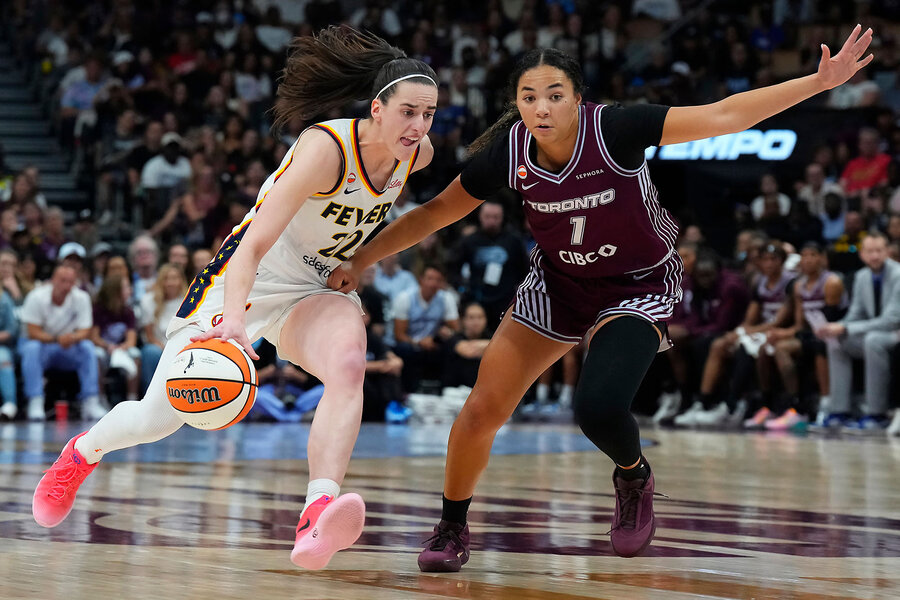
Records in the Women’s National Basketball Association have been falling all year. It has produced all-time highs in regular-season attendance, cable viewership, franchise sale price, and player compensation.Yet those benchmarks often have been overshadowed by league headlines that have nothing to do with basketball and everything to do with rivalries, political agendas, and player unrest.Consider a recent game in Toronto. When Caitlin Clark, one of the top players in the league, led the Indiana Fever on Aug. 18 against the Tempo, one of the worst teams in the league, thousands came decked out in Tempo gear, embracing the WNBA expansion team in its inaugural season. Plenty of others wore Ms. Clark’s No. 22 jersey. Why We Wrote This Thirty years after its founding, the WNBA has hit a new stride, with a growing fanbase and soaring revenue. Alongside those successes has come greater public attention on player controversies, turning the league into a microcosm of social issues which divide Americans. Among them were mother and daughter Shandelle and Jordan Randall, basketball fans so devoted that teenage Jordan was named after NBA legend Michael Jordan.“We’ve loved basketball our whole lives,” Ms. Randall says.They whooped as the trailing Tempo suddenly pulled within four points of the Fever in the fourth quarter when Marina Mabrey sank back-to-back three-pointers, electrifying the 19,000 fans packed into the Scotiabank Arena.But a player considered by many fans as a villain in their midst also spurred the Toronto crowd. When the Fever’s Sophie Cunningham checked into the game, she was met with boos every time she touched the ball. Ms. Cunningham, a shooting guard, ignited national debate in July over comments she made in support of limiting transgender athletes’ participation in women’s sports. The jeers made it clear: America’s culture wars had followed the Fever across the U.S. border into Canada. Toronto Tempo guard Marina Mabrey (3) drives to the basket against Dallas' Aziaha James, center, and Alanna Smith in the second half of their WNBA game in Arlington, Texas, Aug. 12, 2026. And, somehow, it also means that the WNBA, in its 30th year, has finally arrived in the nation’s zeitgeist.As attention on the league has amplified, so have discussions around it centered on race, gender, and sexuality. The debate about transgender athletes is just one of the media firestorms. Other headlines have touted flagrant fouls between white and Black players. Racist and misogynistic online attacks against players have proliferated. Political commentary about the league from both the right and left continues to fan the flames of public opinion. But some observers of women’s sports say the culture wars running through the WNBA are simply a microcosm of issues roiling society – and that it’s certainly nothing new.“It’s so quintessentially American,” says Theresa Runstedtler, author of “Black Ball: Kareem Abdul-Jabbar, Spencer Haywood, and the Generation That Saved the Soul of the NBA.” Similar social anxieties surrounded the struggling National Basketball Association of the 1970s, when the men’s league became a proxy for broader cultural conversations. At the time, the NBA was considered “too Black,” and players were too violent on the court for mainstream white audiences, she says.“As soon as a sport really starts getting popular, selling tickets, becoming commercialized in the way that the WNBA is now, it becomes a barometer for U.S. race relations,” Dr. Runstedtler says. “Add in sexual orientation and gender presentation, and all of these things are now being talked about through the lens of the league and its players.”She adds that it wasn’t until the NBA figured out how to market a Black league to a white mainstream audience – leveraging the rivalry between superstars Magic Johnson and Larry Bird – that the NBA gained traction, paving the way for Michael Jordan and an “apolitical Blackness” to emerge.In contrast, the WNBA, a majority Black league with a strong culture of LGBTQ+ inclusion, “has always stood for nonconformity and pushing against the grain from the beginning,” Dr. Runstedtler says. “And now, as more of mainstream America suddenly begins to pay more attention to the WNBA, it’s like all of the questions about gender identity and race have become so central to the storyline.” Chris Young/The Canadian Press/AP Indiana's Sophie Cunningham points during a WNBA game in Toronto, Aug. 18, 2026. Ms. Cunningham's July comments in support of limiting the league to biological females has drawn both scrutiny and protest. A history of fighting exclusionThe forces that shape headlines around women’s sports extend much further back than the modern era, says Mary McDonald, a professor of American culture and sports at Georgia Tech. As American sports entities developed in the late 1800s, masculine exceptionalism was the standard. To this day, Dr. McDonald adds, there’s still lingering societal discomfort about women’s physical capabilities and competitiveness, even though in the decades since Title IX, the presence of girls and women in sports has grown exponentially.“You could really think about sport more broadly as a history of exclusion in terms of who gets to play,” she says.That history of establishing who gets to play has now expanded to transgender athletes. While there are no openly transgender athletes in the WNBA, the league has become a de facto arena for the debate around whether transgender athletes can be included in women’s sports.Ms. Cunningham, the Indiana guard, fired up those opinions when an ESPN interview published in July included her comment: “I want to protect young girls in a locker room, or young girls in sport who shouldn’t have to go against biological men.”The national furor that followed the article unleashed rallies of protest in support of trans youth, fans holding signs saying “Thank You, Sophie,” and approval from conservative pundits. Ms. Cunningham, who claims no political affiliation, has since said, “I want to get back to basketball. ... I want the focus to stay where it should because people are playing at such a high level.”Professor McDonald says Ms. Cunningham’s comments have come at a moment of political backlash against trans rights. As of this month, 27 states have passed laws that ban transgender students from participating in sports consistent with their gender identity. In June, the Supreme Court upheld state laws in West Virginia and Idaho barring transgender female athletes from competing on women’s high school and college sports teams. A spectator holds a sign in support of transgender people during the first half of a WNBA game between the Seattle Storm and the Indiana Fever, in Seattle, July 28, 2026. Some fans have opposed Indiana guard Sophie Cunningham's comments in support of limiting the league to biological females. “If you look at the narrative shifts around trans inclusion in sport, they’ve shifted over the course of the last six or seven years. There’s just been a lot of confusion about what that actually means,” says Dr. McDonald.Indeed, the WNBA is not the only professional women’s sports league wrestling with how to define female athletes, an issue that cuts across politics. A New York Times-Ipsos poll last year found that 79% of Americans opposed allowing transgender female athletes to participate in women’s sports, including a majority of Democratic voters. Nationally, the number of transgender athletes at the collegiate level appears small. In 2024, the president of the NCAA said there were fewer than 10 transgender athletes among the half-million student athletes at member schools.In July, the Women’s Tennis Association, the governing body for women’s professional tennis, issued a statement that all players will now be required to undergo testing for the SRY gene, which helps determine biological sex. While this is essentially the same policy the International Olympic Committee has adopted, the WTA is the first major pro sports organization to follow this protocol.After a flurry of protests appeared before and during its games, the WNBA this month convened a task force to address issues related to transgender athletes and online hate toward its players.“We will continue to engage all league stakeholders in the coming weeks and months. We will approach these important conversations thoughtfully and in alignment with the values of our league,” the WNBA said in a statement.Because the league’s collective bargaining agreement states that “only players who are women are eligible,” and lacks a policy defining eligibility for transgender athletes, two former NBA players have said they will declare for the WNBA draft by invoking gender “self-identification” to challenge transgender inclusion.In response, league sources told Front Office Sports that the former NBA players are not eligible for the draft and that it “will not allow outside pressure or manufactured controversy to dictate league processes.”Statements like those, however, have done little to quell the demonstrations that have continued to spring up at stadiums where the Indiana Fever are playing. Before a recent game in Dallas, WNBA commissioner Cathy Engelbert decried people using the league trying to “sow divisiveness.”“We’re being the center of political football for people who have never watched the WNBA, never have written about the WNBA, or reported on the WNBA,” she said.The commissioner’s office could go further, says Christine Brown, a sports attorney focused on athlete rights, gender equity, and sports governance. She says the league should either be a leader in the trans athlete discussions or create messaging about the players themselves, how they got into the league, and the evolving game of basketball to introduce them to the scores of people now following the league for the first time, instead of relying on social media for fan engagement.“If we were able to have clear communication from the [WNBA] commissioner’s office ... there’d be a lot more for people to sink their teeth into than just all of this clickbait,” says Ms. Brown. “All of the negativity that’s going on ... is not what is happening [in the league]. What is happening is the evolution, and finally, the recognition of women’s sports in the way that it should be.”Staff writer Sara Miller Llana contributed reporting to this story from Toronto.
Why the WNBA is playing defense over clashes about gender, race
Full Article
Original Source
Read the full article at Csmonitor →KhanList aggregates and links to publicly available news content. We do not host full articles from third-party sources. Always verify important information with original sources.