
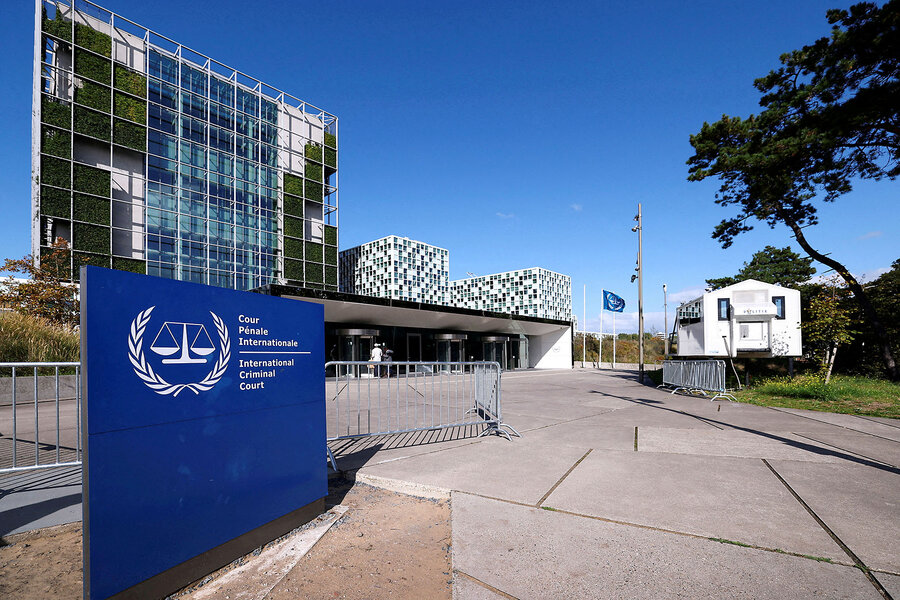
The International Criminal Court has faced a host of challenging, high-profile cases in its first quarter of a century. But its current struggle might be the greatest yet.As it has shifted its focus in recent years from African dictators and bad guys to some of the world’s most powerful leaders, its very survival is now in question.The United States has made no secret of its opposition to the court, which sits in The Hague. Secretary of State Marco Rubio announced in July that the U.S. was launching a campaign to dismantle the ICC, bringing hearty cheers from some quarters – and deep misgivings from others. Why We Wrote This The International Criminal Court was set up to bring individuals to justice for war crimes. But its future is now being questioned by the United States. At issue is whether the U.S. should maintain its commitment to international justice or try to end an organization it sees as flawed and overreaching its authority. The backers of the U.S. include those who have long since concluded that the court has become a den of anti-Israel zealots.Moreover, court cases against Israeli Prime Minister Benjamin Netanyahu and Russian President Vladimir Putin for alleged war crimes have set off alarms within U.S. conservative foreign policy circles – including the White House.Might an unchecked court decide to charge U.S. President Donald Trump with war crimes over the boat strikes targeting suspected drug runners in the Caribbean and eastern Pacific?“We have lunatics and crazies involved in the ICC that are talking about charging members of the U.S. military, maybe even the president,” Mr. Rubio said in announcing the U.S. effort.Opponents of the campaign, on the other hand, call it a betrayal of the U.S. commitment to international justice since the Nuremberg trials after the end of World War II, and they warn it foreshadows a dark international climate where criminal regimes and their senior officials fear no consequences for their atrocities. Secretary of State Marco Rubio speaks as President Donald Trump listens during a Cabinet meeting at Camp David in Maryland, July 31, 2026. “This is the United States turning its back on 80 years of international justice, on 80 years of supporting international justice institutions and advancing the concept of consequences for the world’s worst violators of human rights and international norms,” says Jennifer Trahan, director of international law and human rights at New York University’s Center for Global Affairs.“Essentially,” she adds, “this is the United States declaring that the world’s worst of the worst should have impunity.”The death in prison of convicted war criminal Ratko Mladić on Aug. 27 underscored for some the kind of international accountability that could be lost. Mr. Mladić, a Bosnian Serb general known as “the butcher of Bosnia,” was found guilty in 2017 of perpetrating the massacre of more than 8,000 Muslim men and boys in Srebrenica during the 1990s Balkan wars.Many international human rights and rule-of-law organizations have harshly criticized the U.S. effort, as have some governments, including the European Union.The ICC has 125 members and was established in 2002 as a “court of last resort” to investigate and prosecute individuals accused of crimes including genocide, war crimes, crimes against humanity, and aggression. In an image taken from video, former Bosnian Serb military leader Ratko Mladić is seen at the International Criminal Court in The Hague, July 9, 2012. Mr. Mladić died in prison on Aug. 27. The U.S. never joined the ICC and distrusted it at the start. Just two months after the ICC’s founding, Congress passed what is colloquially known as “The Hague Invasion Act,” which authorizes the president to use any means to free U.S. citizens or allies from ICC incarceration. The act remains in force.But from late in President George W. Bush’s second term until Mr. Trump first took office, the U.S. supported and assisted ICC investigations and cases, including the one against former Sudanese president Omar al-Bashir for the Darfur genocide. The U.S. even financed the case against former Liberian President Charles Taylor, convicted in 2012 by the Special Court for Sierra Leone at the ICC on charges ranging from war crimes to recruitment of child soldiers.But U.S. cooperation with the ICC shifted after the court broadened its focus beyond mostly Africa to include the Middle East and conflicts to which the U.S. was a party, such as the war in Afghanistan.“The ICC had extended its interpretation of its jurisdiction to countries that are not a party to the court, including the United States and Israel, and that was not something the U.S. was ever going to tolerate,” says Orde Kittrie, a professor of international law and international negotiations at Arizona State University.Indeed, under the first Trump administration, the U.S. imposed sanctions against the ICC’s lead prosecutor and her chief of staff over the court’s stated willingness to investigate alleged war crimes in Afghanistan. John Bolton, then the White House national security adviser, made it clear that the end goal was the dismantlement of the court.The current Trump administration is taking similar action. In August, the State Department announced sanctions against ICC President Tomoko Akane of Japan and senior trial lawyer Abdoulaye Seye of Senegal over their involvement in the court’s investigation of Israel’s war in Gaza. Tomoko Akane, president of the International Criminal Court, attends a news conference in Tokyo, June 14, 2024. The Trump administration in August announced it would add her to its sanctions list. The administration had already sanctioned former ICC prosecutor Karim Khan for issuing arrest warrants against Mr. Netanyahu and former Israeli Defense Minister Yoav Gallant. At the time, President Trump said the court had “engaged in illegitimate and baseless actions targeting America and our close ally Israel.”New this time, however, is the administration’s goal of “disabling the ICC’s ability to operate” by convincing member countries to withdraw, along with the financial support they provide to keep the court running.Venezuela recently announced its intention to do so – a move some observers find hardly surprising given what they see as U.S. tutelage over the country since Washington removed former President Nicolás Maduro from power in January.Some see a lack of transparency in the U.S. pressure campaign on ICC members as a particular concern. “They will be going around convincing states to withdraw behind closed doors,” says Dr. Trahan, “and we’re not going to know about it until it’s too late.”But Professor Kittrie, who is also a senior fellow at the Foundation for the Defense of Democracies in Washington, says the dismantlement campaign has little chance of succeeding. The smaller countries that the U.S. might influence contribute only minimally to the court’s budget, he notes, while the larger countries that foot the bill – Japan contributes half – are unlikely to buckle to U.S. pressure.Calling the ICC a “deeply flawed institution,” Professor Kittrie says the U.S. would be better off working with its allies to reform the court – something he says that with some “sophisticated” diplomacy should be possible. Even arriving at a “hands-off” policy toward nonmember countries is “attainable.”But there’s still the matter of the U.S. strikes on alleged drug boats and President Trump’s concerns over his vulnerability to international prosecution, Professor Kittrie says.“There are reforms of the court that are achievable, but are they going to give Donald Trump everything he wants?” he asks. “I don’t see that happening.”
Why the US seeks to dismantle the International Criminal Court
Full Article
Original Source
Read the full article at Csmonitor →KhanList aggregates and links to publicly available news content. We do not host full articles from third-party sources. Always verify important information with original sources.