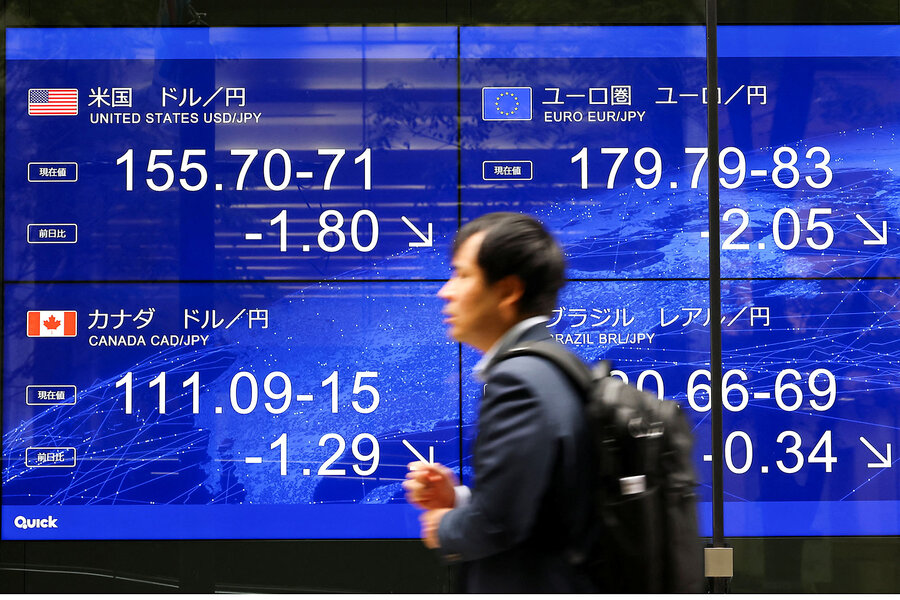
When TV cameras zoomed in on Treasury Secretary Scott Bessent’s notepad at Friday’s Cabinet meeting at Camp David, they captured a striking item on his to-do list: “Buy Japanese Yen (JPY) $5-10 bil.”The note referred to the extraordinary action to support the beleaguered Japanese currency from a 40-year low. Speaking with reporters, President Donald Trump acknowledged: “They wanted a little bit of help, and we’re always there for Japan.”But the U.S. action was not entirely altruistic. The price in Japan of U.S. exports, the potential impact on U.S. interest rates of a stubbornly low yen, and the economic impact that instability in a Group of Seven country could have in Asia and throughout the global financial system were also factors. Why We Wrote This The U.S. intervention in Japan to help steady the yen, a move not taken since the height of the Asian financial crisis, was motivated as much by American self-interest as it was by a desire to help out a close ally. The rare U.S. intervention in Japan, the first in nearly 30 years, has drawn some comparisons to President Trump’s $20 billion loan to Argentina last October aimed at rescuing a falling peso. There, too, Mr. Trump was intervening on behalf of a “friend,” Argentine President Javier Milei.For some international economics experts, the U.S. effort suggests a new era of what some are calling “currency activism” – a perspective that gained traction after comments by Mr. Bessent on Aug. 3.“Friday’s coordinated foreign exchange actions countered disorderly yen movements,” he wrote on X. “We will not hesitate to participate in further joint intervention.” U.S. Treasury Secretary Scott Bessent speaks to members of the media outside the White House, July 30, 2026. Indeed, the U.S. decision to purchase billions of yen, while effective in the short term, is not likely to be a one-time action, says Joseph Foudy, a clinical professor of economics and expert in Asian economies at New York University’s Stern School of Business. That's especially the case with the yen still not that much above its 40-year low last week. “The intervention has injected some caution into the speculators who were betting against the yen,” Dr. Foudy says, “but it’s unlikely to be enough of a response to keep this from happening again.”He cites two key motivations of self-interest behind the U.S. action in Japan.First, a constant weakening of the yen widens the U.S. trade deficit, as it makes Japan’s exports to the United States cheaper and U.S. exports more expensive.The second concerns interest rates. Without a coordinated international effort to strengthen the yen, Japan might move on its own to sell U.S. Treasurys it holds to finance a currency rescue. Such a move could jolt the bond market, pushing up interest rates as it gets harder to attract buyers for the bonds that finance the huge U.S. debt. In turn, that could slow the American economy by raising the cost of credit more broadly.Currently, Japan’s benchmark interest rate stands at 1% – having actually been raised in June by the Bank of Japan – while the U.S. rate stands at 3.75%. The Federal Reserve left the rate unchanged at its July Board of Governors meeting but suggested a rate increase might be on the table in September if inflation pressures mount.More broadly, the coordinated U.S.-Japan action underscored growing concerns over stresses in the global financial system at a time of deepening U.S. national debt and huge new borrowing to finance AI development.Secretary Bessent will host his colleagues from the Group of 20 nations at a meeting in Asheville, North Carolina, at the end of this month. The gathering will already face the pressures on the global economy from the energy reverberations of the Iran war and from President Trump’s tariffs, without also having to consider a major currency challenge.The risk is far lower for the U.S. than last year’s loan to Argentina, Dr. Foudy says. Argentina has defaulted nine times on its international debt, most recently in 2020.There, it was also a highly political move. The U.S. rescue came just days before a crucial midterm legislative election that would determine the fate of Mr. Milei’s drastic libertarian economic reforms – reforms the Trump administration wanted desperately to see succeed. Japan is a very different story. “It is the fact that they are our ally, but it is also true that we are giving them this help at little cost to ourselves,” Dr. Foudy says. “When you can help out an ally at little cost to you, and when it’s in your self-interest, why not do it?”
Why the US propped up Japan’s struggling yen
Full Article
Original Source
Read the full article at Csmonitor →KhanList aggregates and links to publicly available news content. We do not host full articles from third-party sources. Always verify important information with original sources.