
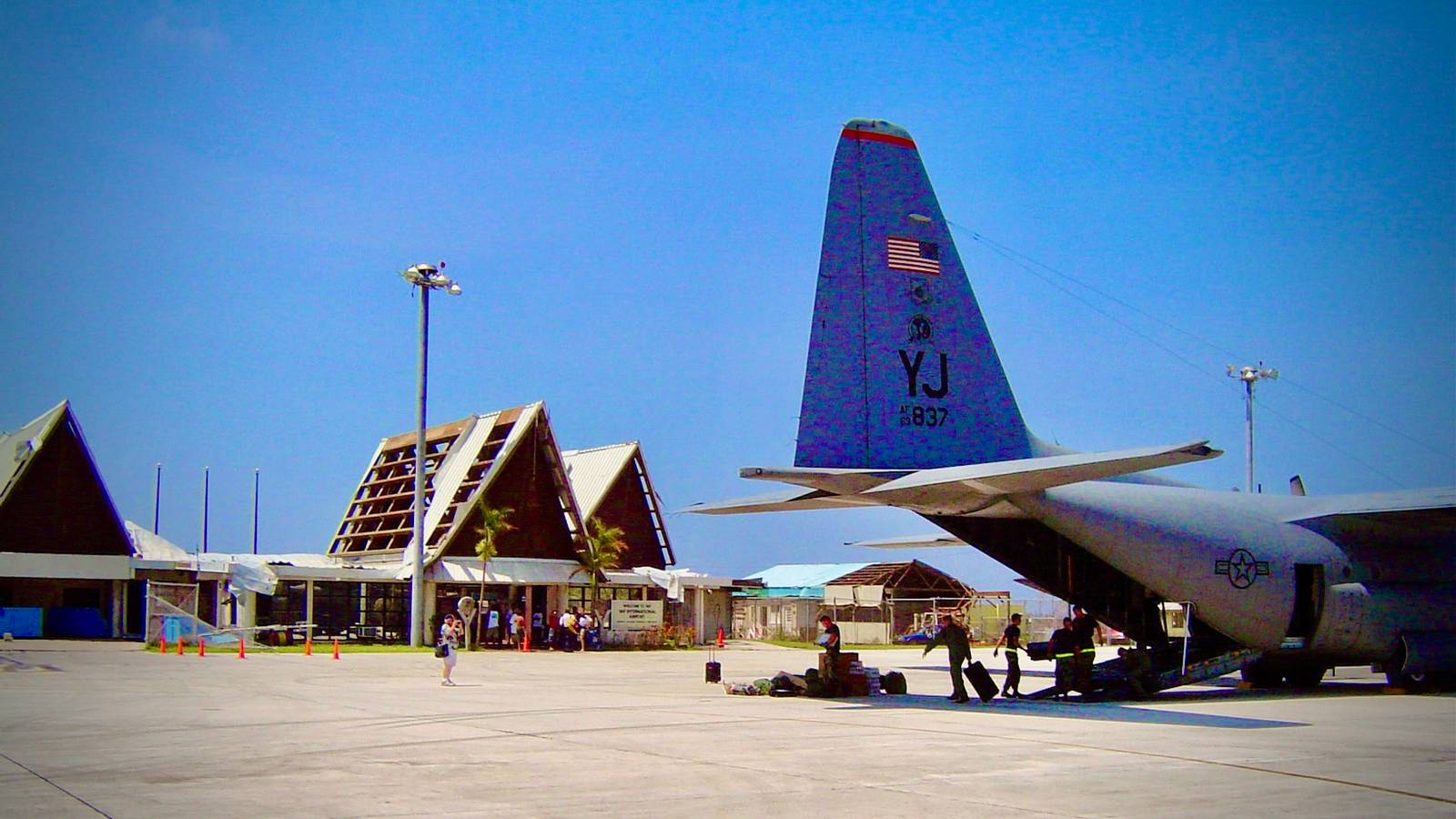
Published Nov 24, 2026, 7:00 PM EST Aaron is an aviation enthusiast and world traveler with a deep interest in aerospace history and technology. He has traveled around the world numerous times, often incorporating visits to aviation museums and historic aircraft collections into his journeys. A native of New Zealand, he is an expert in aviation and maintains a broad interest in a variety of other subjects. In October and November, I visited the Micronesian island countries of Palau and the Federated States of Micronesia (FSM). The FSM consists of four states: Yap, Chuuk, Pohnpei, and Kosrae. I visited Yap, whose airport is set to receive some major work by the United States to prepare it for war as part of the USAF's broader Agile Combat Employment (ACE) doctrine to disperse aircraft from Guam. Separately, US Navy personnel on the island informed me that there are plans to dredge the island's harbor to allow large warships to berth. Funding has not yet been approved. When I visited, work on the airport had not yet started, and the US military footprint on the island was minimal. The hotel I stayed at houses around half the personnel (mostly US Navy) on the island for periods of six months. I arrived in Yap from Palau, where the minor airfield of Peleliu was closed because major construction work to expand the airport for ACE operations was underway. Here is what to know about the US's plans to expand Yap International Airport to relieve wartime strain on Andersen Air Force Base in Guam. Echoes Of The Pacific War Credit: Aaron Spray The knowledge that Yap Island's airport was soon to be transformed was surreal. The island is one of the remote islands in the Pacific and is difficult and expensive to reach. Adjacent to the international airport is an old Japanesee WWII airfield littered with aircraft destroyed by American bombing and lost to the jungle. I found around eight Japanese airplanes, some marked, some not marked. Here and there around the islands are the remains of lost US Vought F4U Corsairs and bombers. Today, the island feels like a world away, but the USAF plans to improve the airports and airfields on the Second Island Chain as competition with China heats up. The echoes from WWII are clear. In 1944, the US island-hopped to Japan to project airpower over the Japanese home islands. Now those same islands are needed to project airpower over the First Island Chain. The First Island Chain includes Taiwan, Japan's southern islands, and the Philippines. Following WWII, the US consolidated its airpower and military bases on Guam, while maintaining forward bases in Japan and Korea. The rise of China puts not only those forward bases at risk, but also Guam, which is now a prime target. Without Guam, or an effective alternative, the US's ability to project airpower over the region would diminish drastically. Yap International Airport Today Credit: Aaron Spray The WWII US invasion of the island of Peleliu was one of the deadliest operations for the US Marines during the Pacific War. Fortunately for the native Yapese, the island was not invaded. Instead, it was intensively bombed, bypassed, and rendered irrelevant. Japanese forces remained on the island until the surrender. Most of their aircraft were destroyed in air campaigns. The Japanese airfield is now abandoned and overgrown, but next to it, Yap International Airport operates. Yap Airport is a simple single-runway airport with a basic terminal building. The only scheduled passenger flights that use the airport are United Airlines and Pacific Missionary Aviation (PMA) United operates 737 MAX 8 flights from Guam twice weekly; this is the primary connection to the outside world. Outside of United's flights, Yap's terminal building is generally closed. PMA operates passenger flights once a week (soon to be twice) from neighboring Palau using its two Super King Airs (seven to nine seats, depending on freight). PMA also operates flights to Yap's outlying islands as well as MEDEVAC and emergency services. I flew the PMA passenger flight from Palau to Yap, was invited on a flight to an outlying island (Ulithi), and flew out on United. PMA operates from its own private hangar and operates domestic flights from there. International (Palau) flights run through the main terminal. US Funding For Yap International Airport Credit: Aaron Spray Funding for Yap Airport's transformation appears in two main categories: civilian FAA Airport Improvement Program (AIP) grants and the Department of Defense/Air Force military construction and related funding. The Air Force's Fiscal Year 2025 Military Construction budget request included around $400 million for runway extension and related work. This is labeled "PDI: Runway Extension, Inc." in the documents. The first increment funding is $96 million. A modest reduction appears in Fiscal 2027 documents with the explanatory note, "Program execution encountered delays and slipped from FY2025 to FY2026, funding reflects the one-time decrease after increase to support acquisition of land for an agreed upon defense site under appropriate international agreement required to complete the runway extension, parking apron, and taxiway construction at Yap International Airport, Wake Island." The decrease is $31 million, but as the note includes Wake Island, it is unclear how much of this is relevant to Yap. The justification language for the funding emphasizes the need for a longer runway and facilities to support larger military aircraft for training, operations, contingency, and Agile Combat Employment. In the event of a high-end conflict with China, this likely means that Yap will be on China's list of strategic targets to be hit and neutralized. The Broader Pacific Basing Efforts Credit: Aaron Spray | Simple Flying The United States is currently upgrading numerous airports and airfields across the Second Island Chain as part of its ACE doctrine and preparations to counter China. As stated, one of the most significant programs currently underway is rehabilitating Palau's Peleliu airfield, while Angaur Airfield is already complete. On Guam, the USAF is expanding parking areas on its primary Andersen Air Force Base and rehabilitating its adjacent, formerly abandoned Northwest Field. One of the biggest areas of effort is on the island of Tinian in the Northern Mariana Islands. There, the USAF is expanding and rehabilitating Tinian International Airport and the formerly abandoned North Field. Nearby, the island of Rota (home to fewer than 2,000 inhabitants) has also been an area of interest and increased military exercises. The civil airports on Palau, Saipan, and Guam also factor into US ACE planning, even if no work is being carried out to expand them. Select Micronesian airports/airfields being expanded for ACE (per budget documents) Island Country/territory Yap International Airport Yap FSM Tinian International Airport Tinian Northern Mariana Islands (US) North Field (WWII-era) Tinian Northern Mariana Islands (US) Rota International Airport Saipan Northern Mariana Islands (US) Angaur Airfield Angaur Palau Peleliu Airfield Peleliu Palau Northwest Field (Andersen AFB) Guam Guam (US) One important effort is Australia. Australia is not part of the Second Island Chain, and the relationship with Washington is very different from that of small Pacific islands. In Australia, effort is mostly focused on Australia's northern RAAF bases: Tindal, RAAF Darwin, and possibly RAAF Amberley. These are being prepped primarily for US strategic bomber use with associated aerial tankers. The Compact Of Free Association Credit: Aaron Spray Following WWII, the United States occupied the Japanese South Seas Mandate and formally took over administration as the Trust Territory of the Pacific Islands (TTPI). Eventually, the Trust Territory was broken up. The Northern Mariana Islands joined the United States as a commonwealth, while Palau, the FSM, and the Marshall Islands became independent nations with full United Nations membership. However, sovereignty for these islands is nuanced. As part of the process, the newly independent states signed the Compacts of Free Association with the United States. Of interest to this article is that the United States retained responsibility for the defense of the islands. In practical terms, this gives the US military the benefits of basing in US territories without the islands actually being US territories. The FSM government states, "Under the Compact, the United States provides financial assistance, defends the FSM’s territorial integrity, and allows FSM citizens unrestricted travel to the U.S. In return, the FSM grants the United States exclusive access to its land and waterways for strategic purposes." The Compact grants the United States "full authority and responsibility for security and defense matters," although in practice, the US extensively collaborates with the government rather than dictates. Chinese And American Adaptation & Counter-adaptation Credit: Aaron Spray Visiting Yap today, it is surreal to feel so isolated and yet also see the island reprising its role as potentially returning to the frontline of a major Pacific competition. In the years ahead, the airport may start to see the deployment of US tankers and F-35 fighter jets just hundreds of feet (meters) away from the rusting hulks of Japanese Zeros and American Corsairs rotting in the jungle. In WWII, the US Navy drew up a plan to invade Yap, but this was scrapped in favor of bombarding it and bypassing it. China’s primary counter to ACE is the continued expansion of the People’s Liberation Army Rocket Force (PLARF) and supporting systems, including large inventories of ballistic missiles, cruise missiles, and hypersonic missiles. These are intended to hold US airfields at risk across the First and Second Island Chains. The US is aware of this. Increasingly, the US Air Force, Marines, and Navy are focusing on increasing the range of next-generation fighter jets (e.g., F-47 and F/A-XX). Logistics and assault requirements increasingly focus on being runway-independent, with the US Army's incoming MV-75 tiltrotor being an example. The Marines, in particular, are investing in a range of runway-independent and sea-skimming drone options for the 'last mile' of resupply and MEDEVAC.
Why The US Military Is Expanding A Remote Pacific Airport To Reduce Its Reliance On Guam
Full Article
Original Source
Read the full article at Simpleflying →KhanList aggregates and links to publicly available news content. We do not host full articles from third-party sources. Always verify important information with original sources.