
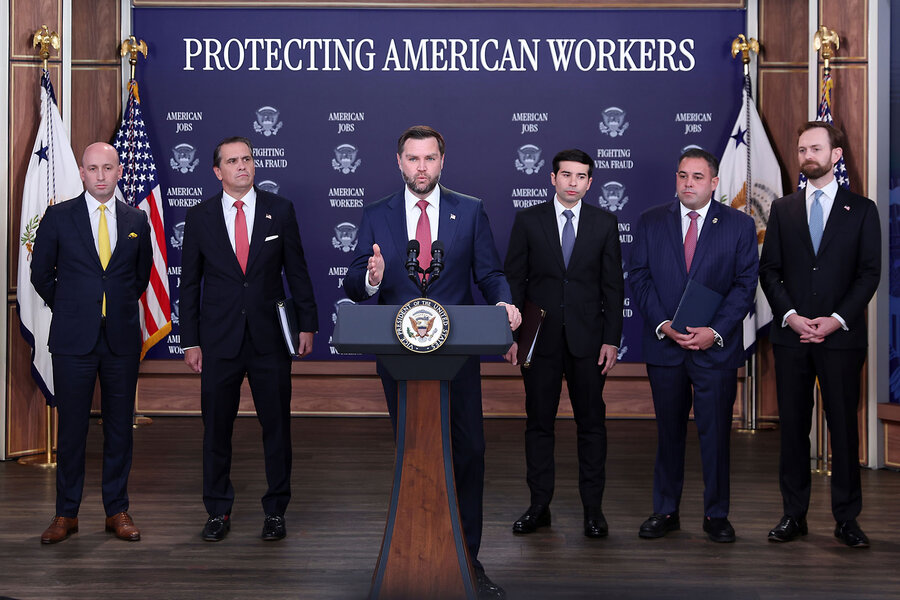
From a high-profile partnership with Elon Musk to a front row of tech executives at his inauguration, President Donald Trump has long presented himself as an ally of the technology industry. But his administration’s recent moves to stifle legal immigration of foreign skilled workers leave his support – and the industry’s workforce – in question.During an Oct. 8 news conference, flanked by officials from the Labor Department, Vice President JD Vance announced the suspension of a green card program he characterized as “rife with fraud” for temporary foreign workers employed at Microsoft, Adobe, and six other technology giants.Mr. Vance said the department had uncovered more than $20 billion in visa fraud. He equated visa holders to “indentured servants,” saying Microsoft and others’ reliance on foreign skilled workers has stolen thousands of jobs from Americans while undercutting wages. This announcement follows “a sequence of measures that the [Trump] administration in 2025 and 2026 has taken to drastically reduce the inflow of highly skilled immigrants in the U.S.,” says Giovanni Peri, a professor of international economics and director of the Migration Research Cluster at the University of California, Davis.Under Mr. Trump, the Labor Department has targeted visa fraud in both the workforce and at universities. However, tech industry leaders such as Mr. Musk, as well as politicians across the aisle, have largely supported the influx of skilled foreign workers for decades, though some have called for system reforms.Mr. Vance’s announcement came hours before the president awarded medals to Microsoft CEO Satya Nadella and other tech leaders, the majority of whom were born overseas.What visa systems are affected, and how do they work?Skilled workers usually start with a temporary nonimmigrant visa, explains Jeff Goldman, a business immigration lawyer and founder of the Goldman & Partners law firm. “Often, it moves to an immigrant visa, which is a green card.” Mr. Vance’s announcement suspends the eight companies from a program known as PERM, in which employers apply to transition their employees’ temporary H-1B visas into green cards. For most workers, after their three- to six-year H-1B visa expires, an employment-based green card through PERM is the only way to stay in the United States.The Labor Department is also targeting universities that sponsor through the J-1 visa system. These short-term, cultural exchange visas are used by scholars, lab researchers, and visiting professors at universities and federal research laboratories.Four of the eight suspended technology firms rank in the top 10 of companies with the most H-1B workers, according to data from U.S. Citizenship and Immigration Services.If the sponsoring company and the worker are willing, it’s relatively easy to transition to green card permanent residency, Dr. Peri says. Jaap Arriens/Sipa USA/AP/FileSpaceX owner Elon Musk answers questions at a conference in Krakow, Poland, Jan. 22, 2024. Despite Mr. Musk's ties with the Trump administration, the tech billionaire has in the past defended the program issuing H-1B visas to foreign workers. There have been bureaucratic bottlenecks for applicants from some high-volume countries, leaving workers vulnerable to deportation, says Daniel Costa, director of immigration law and policy research at the Economic Policy Institute. India is the top nation of birth for H-1B holders, and has received the majority of visa approvals for more than a decade.In a statement, Microsoft said that of the 6,000 H-1B visa applications the company submitted in the last fiscal year, “80% were to extend or change the status of existing Microsoft employees.”Why is the Trump administration going after these programs?The administration’s reasoning for targeting legal immigration, both at universities and in the technology sector, is based on two claims: widespread visa fraud and job opportunity losses for Americans. Reactions to the H-1B program have long been politically charged. Supporters point to consistent growth in America’s technology sector as proof that employing foreign skilled workers spurs overall productivity, and is a net benefit to the American economy. A growing body of research also suggests that the influx of skilled technology workers results in wage gains for college-educated native workers.Opponents of the system, ranging from Mr. Vance to progressive Sen. Bernie Sanders of Vermont, say it allows companies to replace American workers with lower-paid workers from abroad.In a statement provided via email, Matt O’Brien, deputy executive director of the conservative think tank Federation for American Immigration Reform, applauded the vice president.“U.S. companies seeking foreign workers spend significantly more on the immigration process than they would on the process for recruiting U.S. citizen employees at home,” Dr. O’Brien says.Why do American tech companies hire foreign workers?The H-1B system, among other visa types, is intended to fill skilled labor shortages and drive innovation in the U.S.“If you are the country that wants to be the best in innovating in all science and technology, you’re going to hire the best people who are doing these things,” says Dr. Peri. Mr. Musk echoed that idea in 2024, comparing his companies’ use of H-1B workers to American pro sports teams that recruit overseas talent.In a September 2025 Associated Press-NORC poll, more than half of Americans said foreign skilled workers’ expertise in science and technology is a “major benefit” of legal immigration to the economy.What about American workers?To transition temporary workers into permanent residents, employers must show the government that they have posted the job opening for at least two weeks, and no American has applied. They must verify that they will pay the employees at least the occupation’s median salary, as defined by the department.To get around these requirements, some employers outsource to subcontracting firms. Mr. Costa of the Economic Policy Institute says these subcontracting systems exploit a legal loophole.“You’re not supposed to lay off a U.S. worker and then hire an H-1B in their place. But if you do it through a contractor, you can get around those rules essentially because you’re not directly hiring somebody, you’re using a contractor,” Mr. Costa explains.This loophole is also where wage undercutting appears, Mr. Costa says. Because outsourcing firms can create their own job requirements, subcontracted workers are often paid entry-level wages below their skill level. Then, when large technology companies hire talent from the firms, they may continue to pay the lower wage rather than matching the Labor Department-mandated salary level.There are already safeguards to avoid abuse in the H-1B and the program that allows companies to convert foreign workers to permanent certification, says Mr. Goldman. “The problem is a complete lack of enforcement of the current laws.” Deepen your worldviewwith Monitor Highlights.Politics with respectGet political stories with respectful analysis.There‘s a world of new ideas in everyBooks newsletter.There‘s more to life, enrich yours withCulture & Learning weekly.Follow humanity‘s discoveries withScience & Nature stories in your inbox.Gain a spiritual perspectivefrom the stories in your inbox.Want to understand the deeper impact of critical events? Learn the Monitor‘s insight.Already a subscriber? Log in to hide ads. Preventing access to the global talent market could even influence U.S.-based companies such as Microsoft and Adobe to relocate overseas, Dr. Peri says, reducing job opportunities for Americans in the medium and long terms.“These highly skilled scientists and engineers improve the actual ability of the U.S. economy to create new goods, new ideas, new processes,” he adds. “If you isolate science in the U.S., you’re not protecting it. You’re just letting it die.” ALREADY A SUBSCRIBER? LoginReal news can be honest, hopeful, credible, constructive.The Christian Science Monitor was founded in 1908 to lift the standard of journalism and uplift humanity. We aim to “speak the truth in love.” Our goal is not to tell you what to think, but to give you the essential knowledge and understanding to come to your own intelligent conclusions. Join us in this mission by subscribing.
Why the US is tightening the flow of highly skilled foreign workers
Full Article
Original Source
Read the full article at Csmonitor →KhanList aggregates and links to publicly available news content. We do not host full articles from third-party sources. Always verify important information with original sources.