
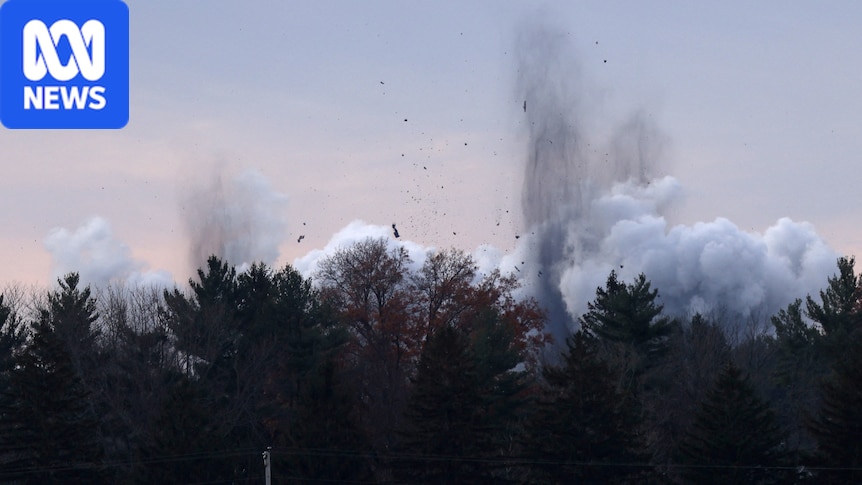
The US Army has destroyed America's entire stockpile of a toxic bomb-making material in a controlled explosion in Iowa.The detonation took place at 9am on Wednesday, local time, in Middletown, Iowa, after a public outcry.Here is what to know about the operation.Why was the stockpile blown up?In 2009, stockpiles of lead azide (an explosive chemical once used to detonate military munitions) were moved from military bases across the country to the Iowa Army Ammunition Plant for long-term storage.The army said in March it had discovered the lead azide had crystallised and become unstable.Officials said the compound would eventually explode on its own if left unaddressed, and chemically neutralising or relocating the storage drums was not possible.With winter approaching, the army said the situation was becoming more urgent, as cold temperatures risked a spontaneous explosion.Leaders decided a controlled detonation of the more than four tonnes of chemical was the safest course of action.Why were people concerned?The detonation was likely to create a plume of lead-laced dust that could travel up to 80 kilometres south-west of the military installation, to the north-east corner of the neighbouring state of Missouri.The detonation occurred at the Iowa Army Ammunition Plant in Middletown, Iowa. (AP: Austin Johnson)Lead is a toxic heavy metal that can cause long-term health problems in humans and animals.There is no safe level of exposure, particularly for children and pregnant people, Patrick O'Shaughnessy, a public health professor at the University of Iowa, said, because lead can inhibit development of the brain and its cognitive abilities.Environmental groups had sued in hopes of blocking the explosion, and while it was temporarily halted by orders from an appeals court and US President Donald Trump, it was ultimately allowed to go ahead.Dr O'Shaughnessy said immediate risks from inhaling the lead particles would likely be mitigated if people sheltered from the dust plume as it passed over them.Nearby towns were voluntarily evacuated ahead of the detonation, and residents in wider affected areas were advised to keep their windows and doors closed for 24-48 hours after the detonation.But Dr O'Shaughnessy said long-term risks could come from lead dust settling on homes, farms and in the environment, where it would not break down further.The blast sent plumes of white smoke into the sky. (Reuters: Jim Urquhart)Iowa is one of the US's biggest farming states, with agriculture estimated to make up about 20 per cent of its economy.Officials estimated about 350 farms could be impacted by the fallout.Farmers and ranchers worried about protecting their crops and herds.While the state's Department of Agriculture and Land Stewardship recommended cattle farmers move their livestock, feed and equipment to alternate locations or indoors to avoid direct exposure, it acknowledged that in some places, that would not be feasible."I don't think lead danger goes away any time soon," said Lucy Giehl, who lives nearby in West Burlington."It seems someone might have thought about all of this a little sooner before it came to this."Was the detonation contained?To contain the blast, earthen barriers were built around a pair of bunkers holding 68 barrels of lead azide.Foam and water were used to tamp down any dust, as witnesses reported two white plumes rolling high into the air before quickly dissipating.The Environmental Protection Agency said in a statement after the detonation that its air monitors were detecting zero airborne lead throughout the region.A NASA research aircraft was seen circling the area after the detonation. (AP: Austin Johnson)But researchers said the final results aren't in yet.Andrew Whelton, an environmental engineering professor at Purdue University, said while the early results were promising, samples still needed to determine whether there were any health risks."This should take days to weeks," he said.The EPA said it would test air, land and water samples in the coming days and deploy remediation efforts "where necessary".But some residents told Reuters they had gathered their own soil samples for independent testing.Doug Seyb, a livestock farmer from Donnellson, was still concerned about the accuracy of EPA air monitors."All of these cows are pregnant, and we just cross our fingers that we don't have deformed calves and stillborns," he said.Iowa governor-elect Rob Sand said he was grateful to experts for limiting the lead dispersal, but the lead-up "should never have been so chaotic and unclear". "Iowans across the state are understandably alarmed and scared," he said. "There must be immediate transparency to understand how and why this situation became what it did."ABC/AP/Reuters
Why the US Army detonated tonnes of toxic chemical near farmland
Full Article
Original Source
Read the full article at Abc →KhanList aggregates and links to publicly available news content. We do not host full articles from third-party sources. Always verify important information with original sources.