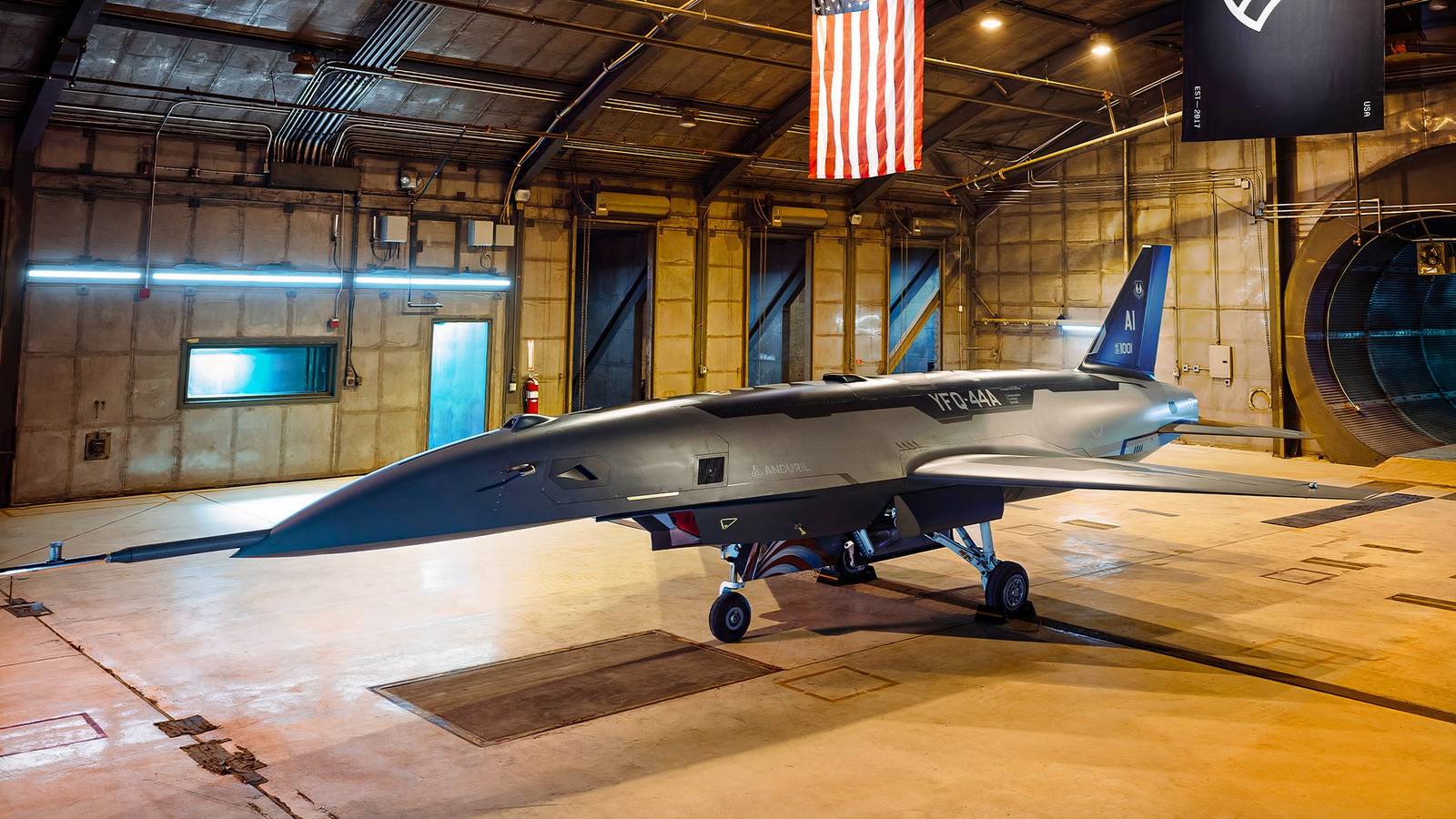
Published Jul 30, 2026, 1:00 AM EDT Chris earned a Master’s degree in Defense and Strategic Studies (Highest Honors) from the University of Texas at El Paso. His graduate work concentrated on Global and National Security, Low-Intensity Conflict, Modern Warfare, and US grand strategy. He also undertook extensive regional studies, analyzing how key regions integrate into the broader US security architecture. This rigorous program provided him with a comprehensive understanding of U.S. military operations, global strategy, and weapons systems. Additionally, he gained a strong appreciation for great power competition.—an increasingly central force shaping international relations and conflict for the foreseeable future. Anduril Industries, in partnership with the United States Air Force (USAF), is making rapid progress toward realizing the Loyal Wingman concept, which is expected to play a significant role in future conflicts. This pivotal advancement in capability is intended to provide fighter pilots with attendant drones that will enhance their effectiveness in combat. Very recently, Anduril's YFQ-44A Fury drone made headlines after successfully launching an advanced air-to-air missile, demonstrating its ability to perform a complex combat-related mission. In the coming years, aircraft such as the Fury are expected to operate alongside manned aircraft in real-world combat missions. While its capabilities are promising, a human operator will remain essential to maintaining oversight of these increasingly autonomous systems. Getting Closer To Deploying "Loyal Wingman" Credit: US Air Force On July 10, 2026, over the hot sands of California's Mojave Desert, the YFQ-44A Fury drone—developed by Anduril Industries—achieved a major milestone in the future of air combat. At a secluded test range at Edwards Air Force Base, the aircraft successfully launched an inert AIM-120 Advanced Medium-Range Air-to-Air Missile (AMRAAM) against a simulated target. The live-fire test, conducted by the Air Dominance Combined Test Force (AD-CTF) under the 412th Test Wing, represents a significant step toward transforming the Collaborative Combat Aircraft (CCA) concept from an experimental capability into an operational combat system. According to the US Air Force, the "...412th Test Wing plans, conducts, analyzes, and reports on all flight and ground testing of aircraft, weapons systems, software and components, as well as modeling and simulation for the USAF." The Test Wing maintains and operates an average of 90 aircraft spanning more than 30 different aircraft designs and conducts more than 7,400 missions annually, including over 1,900 test missions. This end-to-end test involving the Fury ensured that all onboard systems, software, communications, sensors, and weapons operated together as intended under realistic operational conditions. Further, the test demonstrated that the aircraft can detect, identify, track, and strike a target at beyond-line-of-sight ranges, a landmark accomplishment for the Collaborative Combat Aircraft (CCA), or Loyal Wingman, a concept and an important capability for future sixth-generation aircraft. Regarding the test, General Dale White (USAF) stated that moving "...from inert carriage earlier in the year to this weapon release demonstrates program maturity, allowing us to validate our digital integration models with actual data..." White serves as the Department of Defense's Direct Reporting Program Manager for Critical Major Weapon Systems. Regarding funding for the CCA program, the Military Times states that the USAF's FY2027 "...budget request included $996.5 million in procurement funding, $150 million in advanced procurement for the following fiscal year and $1.37 billion in continued research and development, for a total program request of $2.37 billion." The sizable funding request underscores the Air Force's commitment to rapidly fielding Collaborative Combat Aircraft as a core component of its future air superiority strategy. How Will CCA Operate With US Military Aircraft, And What Will They Bring To The Table? Credit: US Air Force CCAs are intended to be semi-autonomous and serve alongside manned aircraft, executing mission-oriented tasks as directed by the pilots they are assigned to. In the near future, the USAF intends to operate a fleet of approximately 1,000 CCAs, which are intended to accompany 300 new NGAD fighter jets and at least 200 Lockheed Martin F-35s. CCAs will add mass to any combat mission, expanding the sensor network and available strike options. This will likely see pilots transform from operators to commanders, directing their assigned drone counterparts to conduct various aspects of their particular missions, particularly in a contested environment. The latter is a distinct possibility, and one that the US Military is currently preparing for as it refocuses its attention on the Indo-Pacific and a potential conflict with China. The need for CCAs is particularly poignant, as any such confrontation will take place within China's carefully constructed Anti-Access/Area Denial envelope. With the entry of CCAs into battlespace, these platforms are being designed to undertake a wide range of tasks that would otherwise be assigned to potentially scarce manned assets. Supplementing human pilots, CCAs will likely serve as Intelligence Surveillance and Reconnaissance (ISR) nodes, expanding situational awareness within contested environments and passing vital information to both in-theater pilots and theater commanders. Additionally, the drones could potentially conduct electronic warfare and act as decoys, drawing enemy assets away from the site of a strike on critical infrastructure or high-value targets and allowing for more effective strikes by US or allied aircraft and missiles. Further, if directed, CCAs could engage in direct strikes, such as suppressing enemy air defenses. Attacks of this nature are designed to destroy sensing assets used to identify, track, and engage aircraft. Taking out these sites creates a path for follow-on strike missions, which could be carried out by less stealthy fourth-generation aircraft. A final defining hallmark of these aircraft will be their modularity. This facet of the program ensures that a single Fury drone will be capable of conducting multiple types of missions by quickly changing its equipment for the desired mission set. In a potential combat scenario, forward-deployed airmen operating in small, dispersed groups could alter the operational configuration of the drone(s) from a strike configuration to reconnaissance or electronic warfare, allowing for a quick mission turnaround. The Importance Of Keeping Humans In The Loop Credit: DVIDS As CCAs move toward entering service with the USAF, maintaining meaningful human oversight will remain a crucial aspect of every operation. Although these autonomous platforms are designed to perform increasingly complex missions with limited direct control, decisions involving the use of lethal force carry consequences that extend beyond the capabilities of any algorithm. Human operators must therefore retain responsibility for critical decisions, particularly when distinguishing between legitimate military targets and potential civilian or friendly forces. This does not mean humans must manually control every movement of their assigned CCA. Rather, military aviation will likely increasingly rely on a human-in-the-loop approach, allowing autonomous systems to engage in mundane mission tasks such as navigation, coordination, target acquisition, electronic warfare and in-flight countermeasures, while human operators retain the authority to intervene when appropriate. This could allow a single fighter pilot or remote operator to oversee multiple CCAs, multiplying combat power without removing human judgment from critical decisions. As the Air Force and other military services introduce autonomous systems, establishing clear boundaries between what machines can decide independently and what requires human authorization will be critical. The success of CCAs will ultimately depend not only on their autonomy but also on how effectively human judgment can be combined with machine speed, ensuring these systems enhance military effectiveness while maintaining human control over the most consequential decisions. AI Has Already Been To War Credit: DVIDS The US military's experience with artificial intelligence on the battlefield is not theoretical. Project Maven, launched by the Department of Defense in 2017, demonstrated how AI could be used to process the enormous volume of intelligence collected during military operations. The initiative initially focused on applying machine learning to full-motion video gathered by unmanned aerial systems, helping analysts process thousands of hours of footage that would otherwise have required personnel to review manually. Specifically, by 2011, drones had captured 327,000 hours (about 80 years) of full-motion video. Maven was prominently used, but not limited to, Iraq and Afghanistan. Maven's algorithms were designed to rapidly identify and categorize objects within imagery, allowing analysts to focus their attention on information deemed potentially relevant rather than manually examining every frame. In doing so, the program helped address one of the major challenges created by modern ISR capabilities: the military could collect far more data than human analysts could reasonably process in a timely manner. The significance of Project Maven extended beyond simply automating image analysis. It demonstrated how artificial intelligence could accelerate the kill chain, reducing the time between collecting intelligence, identifying potential targets, and providing information to commanders and operators. Importantly, AI was used to assist human decision-makers rather than replace them. The technology could rapidly sift through enormous quantities of data and highlight objects of interest, while human personnel remained responsible for interpreting the information and making consequential decisions. Project Maven therefore provides an important precedent for the introduction of autonomous systems such as Collaborative Combat Aircraft. The experience gained from deploying AI in real-world military operations demonstrates both the potential of machine-assisted decision-making and the continued importance of keeping humans involved in the process. Drones And AI, The Way Of The Future Credit: US Air Force The YFQ-44A Fury's successful live-fire test marks a significant step toward the introduction of Collaborative Combat Aircraft into US military operations. As these systems mature, they promise to transform air warfare by adding mass to the battlespace, extending sensor networks, and providing commanders with new options for intelligence, surveillance and reconnaissance, electronic warfare, and strike missions. In a future conflict against a technologically advanced adversary, these capabilities could prove essential to maintaining air superiority while reducing the risks faced by manned aircraft and their pilots. However, the increasing autonomy of these platforms also raises important questions about the role of human decision-making in future warfare. The experience of Project Maven demonstrates how artificial intelligence can dramatically accelerate the processing of battlefield information while keeping humans responsible for consequential decisions. The same principle will likely apply to CCAs. Ultimately, the future of air combat may depend on an effective partnership between human judgment and machine autonomy, with CCAs providing the speed, persistence, and mass needed to prevail in increasingly complex and contested environments while humans remain in control of the most consequential decisions.
Why The US Air Force's New Combat Drone Still Can't Fire Without A Human's Approval
Full Article
Original Source
Read the full article at Simpleflying →KhanList aggregates and links to publicly available news content. We do not host full articles from third-party sources. Always verify important information with original sources.