
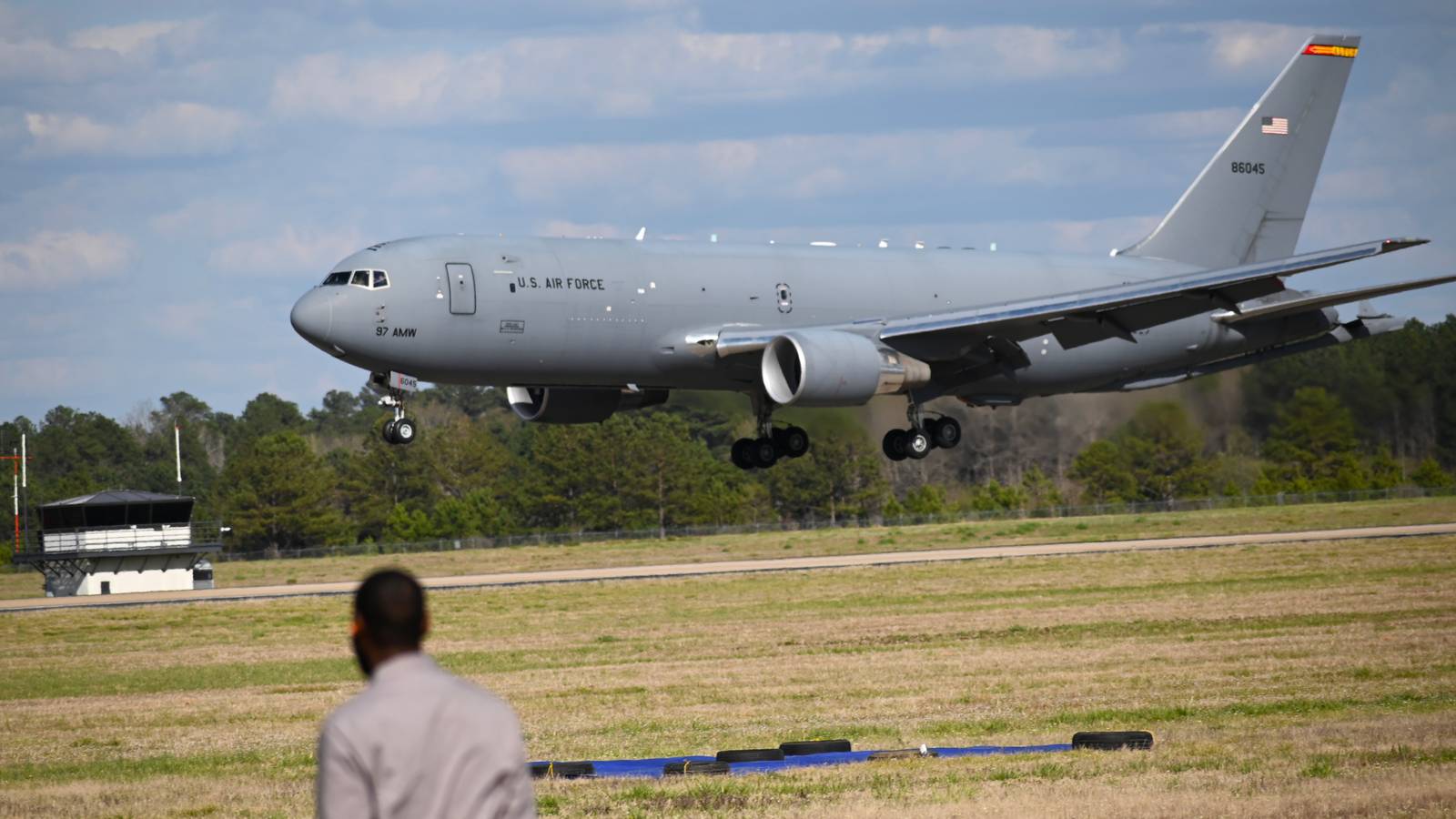
Published Sep 13, 2026, 11:00 AM EDT Aaron is an aviation enthusiast and world traveler with a deep interest in aerospace history and technology. He has traveled around the world numerous times, often incorporating visits to aviation museums and historic aircraft collections into his journeys. A native of New Zealand, he is an expert in aviation and maintains a broad interest in a variety of other subjects. In 2026, much of the Boeing KC-46A Pegasus fleet took part in Operation Epic Fury against Iran, although most of it remains permanently based in the continental United States. The fleet is designed to be mobile and deploy to theaters of operations as required. Various KC-46A units routinely deploy into the Asia-Pacific, even though few are permanently based there. The US announced its 'pivot' to Asia over a decade ago. However, realities elsewhere (such as the Middle East) constantly put pressure on how much it is possible to pivot. As an example, Andersen Air Force Base in Guam is one of the largest and most important air bases in the region and is able to operate all types of United States Air Force (USAF) aircraft. Still, there are no tankers, transport aircraft, or fighter squadrons permanently based there. Let's examine the Air Force's growing fleet of KC-46s and why they are particularly valuable to the Asia-Pacific and to support Navy operations. The KC-46A Was An Interim Tanker Credit: US Air Force The Boeing KC-46A Pegasus tanker is based on the Boeing 767 airliner and offers a generational upgrade over the older and smaller quad-engined KC-135R Stratotanker. It shares a common development with the now-retired Boeing 707 airliner, although the units remaining in service have been upgraded with more modern General Electric CF6 turbofan engines. The oldest of these KC-135s were built in 1957, making them close to 70 years old. The KC-46A's story is long and complicated, with years of legal battles between Boeing and Airbus over its A330 MRTT. While the US Air Force eventually selected the KC-46A, the A330 MRTT has become the more popular aircraft on the export market. With that being said, the massive demand of the US Air Force means more KC-46As have been produced and are on order. The Air Force originally planned the KC-46A to be an interim stopgap measure to bridge the KC-135 with a next-generation tanker. While the KC-46 may still act as a bridge of sorts, it is increasingly becoming a stable backbone of Air Force tanker capabilities. The service had planned to purchase 179 of the aircraft, but this then grew to 183. Now it has announced it will purchase another 75, while also ramping up deliveries. This means it will eventually have a fleet of 258 KC-46s, although this number could grow further. In April 2026, Defense Daily stated that the plan is now 263 after one draft proposal boosted it to 319. The KC-46's Improvements Credit: US Air Force Boeing advertises the KC-46A as being "built to meet the stringent airworthiness and performance requirements of the U.S. Air Force and FAA. Boeing has made... the KC-46A the most advanced multimission aerial refueler in the world." The only tanker that could compete with the KC-46 on capabilities is the Airbus A330 MRTT. Boeing adds that "the KC-46A continues to evolve for the future as we integrate cutting-edge technological capabilities that will benefit generations of service members." The KC-46 offers a range of improvements over the KC-135, including in its core role in delivering greater amounts of fuel at greater ranges. As the tanker is considerably more fuel-efficient, it consumes less of its own fuel during refueling missions, allowing it to offload more. Boeing claims that "the KC-46A’s 212,000 pounds (96,162 kilograms) of fuel capacity enables the full spectrum of refueling missions." Specifications KC-135 Stratotanker KC-46 Pegasus Entry into USAF service 1957 2019 Based on Boeing 707 Boeing 767 Fuel capacity 200,000 lb (90.7 t) 212,299 lb (96.3 t) Maximum take-off weight 322,500 lb (146.3 t) 415,000 lb (188.2 t) Refueling systems Flying boom (drogue via adapter) Fly-by-wire boom + wing hose-and-drogue pods It can operate from shorter runways, which is a very important factor when operating under the Agile Combat Employment doctrine from dispersed airbases in the Asia-Pacific. Other improvements include greater networking, better sensors, and improved self-defense measures. While the tanker may not be survivable in contested airspace, it has a better ability to defend itself than the KC-135. Gleaning From Operation Epic Fury Credit: US Air Force According to open-source tracking, around 140–200+ tankers (KC-135s and KC-46s) were supporting Operation Epic Fury at its peak. KC-135s generally supported refueling efforts over the Mediterranean and Southern Europe, while both KC-46s and KC-135s were stationed in Israel and the Middle East. The KC-46 Pegasus tankers were preferred for mixed Navy and Air Force refueling tracks. The aircraft has a fly-by-wire boom and a permanent hose-and-drogue system. The boom typically refuels US Air Force aircraft, while the probes refuel Navy and Marine F/A-18 Hornets/Super Hornets. The type offers higher flexibility and transfer rates in mixed packages and is better suited for continuous orbits to support carrier wings coming from the Arabian Sea. While Iran's long-range air defense is minimal, they are also more survivable and can fly closer to the area of operations. The KC-135 Stratotanker mostly supports Air Force strike packages. These aircraft are only permanently fitted with boom refueling, although they can be fitted with a drogue adapter for probe-equipped aircraft. However, this has a reduced transfer rate and requires configuration changes. Overall, they overwhelmingly refueled Air Force aircraft and were used across all echelons. KC-46As Are More Useful In The Asia-Pacific Region Credit: DVIDS The longer range, greater fuel payloads, improved self-defense, and dual boom/probe refueling capabilities of the KC-46 make it the tanker of choice for the Asia-Pacific. However, there is a catch. As the maxim says, "beggars can't be choosers." The US Air Force has around 373 KC-135s in inventory, while it now has around 100 or a little more KC-46s in service. Operation Epic Fury likely used about twice as many tankers as the Air Force has KC-46s in service. Put another way, the Air Force has no choice but to continue to use KC-135s in a central capacity, including in the Asia-Pacific in the event of a conflict. Over time, the ratio of KC-46s will increase, but the Air Force will remain dependent on the KC-135s into the 2030s and beyond. Congress has lifted the minimum number of tankers the Air Force must have in service from 466 to 502 (effective Fiscal 2029). The requirement is slowing down KC-135 retirements and boosting KC-46 purchases. The Air Force is now purchasing KC-46s at a rate of around 15 per year (Fiscal 2026 and 2027), rising to 18 per year (Fiscal 2028 to 2031). A high-end conflict in the Asia-Pacific would likely be even more demanding on the tanker fleet than Operation Epic Fury and would require essentially all tankers the US has available. Redeploying KC-46As To The Pacific Credit: DVIDS As of mid-2026, the Air Force may have up to 113 Pegasus tankers in inventory. There is no open-source evidence that it is permanently deploying 33–38 tankers to the Asia-Pacific. However, they do routinely operate in the Indo-Pacific, including Andersen Air Force Base in Guam and at Misawa Air Force Base in Japan. The bulk of the KC-46 tanker fleet remains permanently based in the continental United States (including McConnell, Travis, McGuire, and Pease Air Force bases). Smaller numbers are forward deployed or temporarily staged as needed. During Operation Epic Fury, much of the fleet was deployed to the North Atlantic/Europe/Middle East to support operations. However, the KC-46s are pivotal to projecting power in the Pacific. In 2025, as KC-46s took part in exercises in Japan, Bradford Waldie, 14th FS Director of Operations, stated that "distance is the greatest challenge to projecting power in the Pacific." He added that "seeing the KC-46 successfully launch from Travis [AFB] and meet us on time after a 10-hour sortie builds confidence in our ability to overcome the challenge of distance and deliver combat power anywhere it is required in the area of responsibility." The KC-46's Basing Dilemma Credit: DVIDS The Air Force has dilemmas when it comes to basing in the Asia-Pacific. On the one hand, the Pacific is far from the only area of operations for the Air Force. 2025/2026's Operation Southern Spear against Venezuela and 2026's Operation Epic Fury against Iran are illustrations of that. At the same time, it takes time to forward-deploy forces. Should a conflict break out over Taiwan and the US choose to intervene militarily, then numerous wargames suggest time is of the essence. Having tankers and other aircraft prepositioned can significantly reduce the time it takes to intervene. One line of reasoning is that this could have a powerful deterrent effect in the region. However, there is a risk that forward-based KC-46s and other aircraft could have the opposite effect. They provide targets on the ground when China is modeled as having the advantage of a surprise attack. This could have an enticing effect: the chance to eliminate much of the best of the US Force's tanker fleet in the opening salvo. In 1941, the US Army Air Force experienced exactly this. It forward-deployed its B-17 bombers to Clark Airfield in the Philippines just to see Japan destroy them in a surprise attack concurrently with the raid on Pearl Harbor. While today's bases have hardened shelters, missile defenses, and dispersal plans that did not exist in 1941, the underlying dilemma (greater readiness versus greater vulnerability) remains remarkably similar.
Why The US Air Force Is Sending A Third Of Its KC-46 Tanker Fleet To The Pacific
Full Article
Original Source
Read the full article at Simpleflying →KhanList aggregates and links to publicly available news content. We do not host full articles from third-party sources. Always verify important information with original sources.