
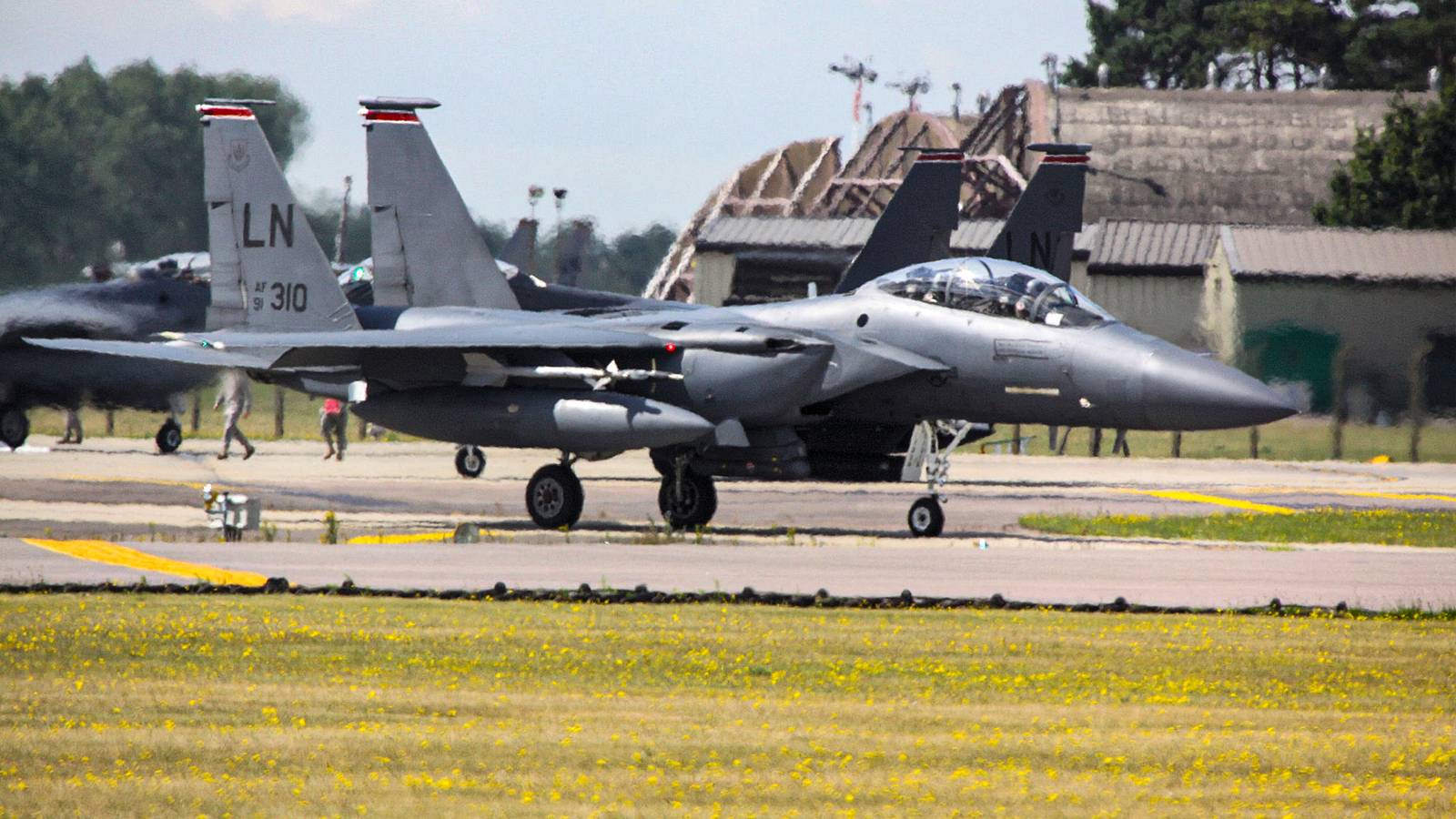
Published Nov 15, 2026, 9:00 PM EST Aaron is an aviation enthusiast and world traveler with a deep interest in aerospace history and technology. He has traveled around the world numerous times, often incorporating visits to aviation museums and historic aircraft collections into his journeys. A native of New Zealand, he is an expert in aviation and maintains a broad interest in a variety of other subjects. This year, the United States Air Force (USAF) saw a number of aircraft destroyed on the ground by Iran in the Middle East. As the year progressed, more reports have emerged of Iran attempting to carry out attacks on US military aircraft parked at bases in England. In October, the USAF hurriedly evacuated its B-1B strategic bombers from RAF Fairford in England. Weeks later (a few days ago as of the time of writing), it quickly evacuated more of its aircraft from other bases in the United Kingdom. Iran is the most capable adversary the US has had in a kinetic conflict for decades. It is adding to and dramatically increasing the many security threats both at home and abroad that the USAF is currently facing. While adversaries like Russia and China may not cross any line that could be an act of war, that line has long been crossed with Iran. Iran is not the US's only threat to its aircraft on the ground; it has plenty of other state and especially non-state adversaries, but Iran is certainly the most capable. Here is why US air bases are on high alert. The 2026 Iran Conflict Credit: DVIDS In 2026, the US launched Operation Epic Fury against Iran, decimating much of the country's leadership and destroying much of its military infrastructure. However, as of the time of writing, the campaign has not resulted in political peace, and Iran has refused to accept US demands. This has resulted in a prolonged, tense standoff and lower-intensity conflict. Iran has been forced to respond asymmetrically to the much more powerful United States Air Force. Iran is perhaps the biggest single reason why many overseas US Air Force bases are on high alert in 2026. In the Middle East, Iran has targeted various US bases across the region and has scored some notable hits on parked US aircraft. This includes damaging some KC-135 tankers in Iran, destroying a valuable E-3 Sentry in Saudi Arabia, and damaging various aircraft at the US's Muwaffaq Salti Air Base in Jordan. The US has been forced to draw down its presence in some forward bases, including at Al Udeid Air Base in Qatar. It would also appear from open-source information available that the US opted to not use its famous Diego Garcia base in the British Indian Ocean Territory for operational use against Iran. It positioned some bombers there as posturing before the conflict, but during the conflict, it appears they operated out of RAF Fairford in England. Reported Planned Iranian Attacks In England Credit: DVIDS On November 9, The War Zone reported, "at least two bases in England hosting U.S. Air Force aircraft are operating under beefed-up security protocols, a U.S. official told us Monday afternoon." This followed the rapid, unexpected withdrawal of roughly a dozen B-1B Lancer bombers that had been stationed at RAF Fairford the month prior, after an apparent (but confusing) tip-off about an impending attack. The War Zone also reported that November's heightened security level related to RAF Lakenheath and RAF Mildenhall. RAF Lakenheath is a major US fighter base hosting four squadrons of F-35A and F-15E fighter jets. RAF Mildenhall is an important aerial refueling airbase for US aircraft in England. It is particularly important for aircraft being ferried from the mainland United States to Europe or the Middle East. The Wall Street Journal reported that the FPCON Charlie (the second-highest level) over the bases was triggered by an unspecified threat from Iran. The Wall Street Journal explicitly writes that this was "in the wake of a threat from Iran." On November 13, US Air Force Security Forces responded to "suspected unauthorized drone activity" over RAF Lakenheath. The Rise In Drone Attacks On Parked Aircraft Credit: Official Defense of Ukraine The conflict in Ukraine has seen a rapid evolution of striking parked warplanes with small drones. The most famous and successful Ukrainian attack on Russian bombers came in 2025 with Operation Spiderweb. According to estimates by some outlets, Russia may have lost as much as 20% of its remaining operational (not basic inventory) bombers in the single incident. By the beginning of November, the noted OSINT analyst, Jakub Janovsky, who runs the Oryx blog, estimated that of Russia's 120 bombers (Tu-160, Tu-95s, Tu-22Ms) listed by FlightGlobal for 2026, only half, or 60, remain operational. This is due to Ukraine destroying examples, mishaps, and general wear and tear with a sustained high tempo of operations. Many other Russian warplanes have also been destroyed on the ground. But the drones destroying high-value warplanes on the ground didn't start with Ukraine. In late 2017, Syrian rebels destroyed Russian aircraft on the ground in Syria at Russia's Hmeimim Air Base (Khmeimim airbase) near Latakia. It has also happened in Sudan, Myanmar (Burma), and elsewhere. None of this is lost on the US. It has experienced many unidentified drones flying over its air bases in recent years and has taken steps to counter them. A State-Backed Drone Threat Is Much More Dangerous Credit: DVIDS The drone scares over airports in 2024 and 2025 were concerning, but concern was also somewhat muted. It was assumed that the drones were being operated either by individual people acting on their own or as part of a state-backed effort to test defenses (or a combination), but during peacetime. An individual person would not likely have the capacity to present a major risk to dozens of aircraft. Even if a foreign state, like China or Iran, was behind some of the drone incursions, this was peacetime, and so such a country would not actually carry out an act of war. But with the conflict in Iran, that calculus has changed. Iran has all the resources of a reasonably large nation-state and is actively attempting to strike the US' military assets being used to strike it. US Air Bases In The UK Permanently Based Aircraft Other aircraft designed to accommodate RAF Lakenheath F-15E, F-35A Other fighters (e.g., F-22, F-16), C-17, C-130J RAF Mildenhall KC-135, CV-22B, MC-130J RC-135, C-5M, C-17, KC-46 RAF Fairford None permanently assigned B-1B, B-52, B-2, U-2S Dragon Lady, KC-135, KC-46A, C-17 Iran also sees the UK as a combatant in this conflict, despite the British refusal to take part in offensive strikes in 2026. It should also be noted that Iran is not the only state threatening aircraft on the ground. In 2026, Germany formally accused Russia of attempting to destroy Ukrainian Antonov An-124 Ruslans parked at its An-124 cargo aircraft in Germany at Leipzig/Halle Airport (LEJ) using small drones. The drones hit the aircraft, but failed to detonate. Russia denies involvement. Forward USAF Air Bases In The Indo-Pacific Credit: DVIDS Across the Indo-Pacific, the United States Air Force is preparing for a very different type of threat. There, the USAF is preparing to counter China and implement its Agile Combat Employment (ACE) doctrine. ACE will see the US disperse its aircraft from Guam's Andersen Air Force Base in the event of a high-end conflict. This does not mean those bases are constantly at a higher state of readiness. This is much more long-term. The USAF is currently rehabilitating various WWII-era airfields on islands in the Second Island Chain from the Northern Mariana Islands to Palau. I visited Yap (part of the Federated States of Micronesia) in October and November. The US has approved funding to enlarge Yap International Airport for military operations, but when I was there, ground had not been broken, and heavy machinery had not yet arrived. The high-end threat from China is not the same sort of FPCON Charlie alert placed on US bases in England. Instead, this is a longer-term and arguably much more consequential type of threat. Few would expect China to carry out attacks in a time of peace and expect that peace to persist afterward. At the same time, the US openly says it is in "Great Power Competition" and repeatedly says it is ready, or will be ready, for conflict. All Aircraft Parked On The Ground Are At Risk Credit: DVIDS In 1942, British Air Marshal Sir Arthur Harris made the famous speech saying, "The Nazis entered this war under the rather childish delusion that they were going to bomb everyone else, and nobody was going to bomb them." This is a mistake many countries make time and time again. At this stage, it may be unwise to apply it too extensively to the United States vis-à-vis Iran. The conflict remains highly one-sided, although Iran is not helpless. But it is hard to miss that, as of the end of 2026, the US is reaching a point where not only are its forward bases in much of the Middle East threatened, but its 'safe' bases in the United Kingdom are as well. Still, it can be noted that no successful attacks have been carried out, potentially pointing to robust US, British, and other allied intelligence. As a sign of the times, the Air Force’s 325th Contracting Squadron at Tyndall Air Force Base in Florida recently posted a request for information for contractors to install small-drone-proofing nets around its aircraft sunshade structures. Those structures are used to protect its F-35A fighter jets. This is one example of where the USAF is taking steps to protect its aircraft on the ground stateside. There is a growing risk of US aircraft being at risk anywhere in the world on the ground. This is not unique to the US; it is true for all countries.
Why The US Air Force Is On High Alert Over Security Levels At Overseas Bases
Full Article
Original Source
Read the full article at Simpleflying →KhanList aggregates and links to publicly available news content. We do not host full articles from third-party sources. Always verify important information with original sources.