
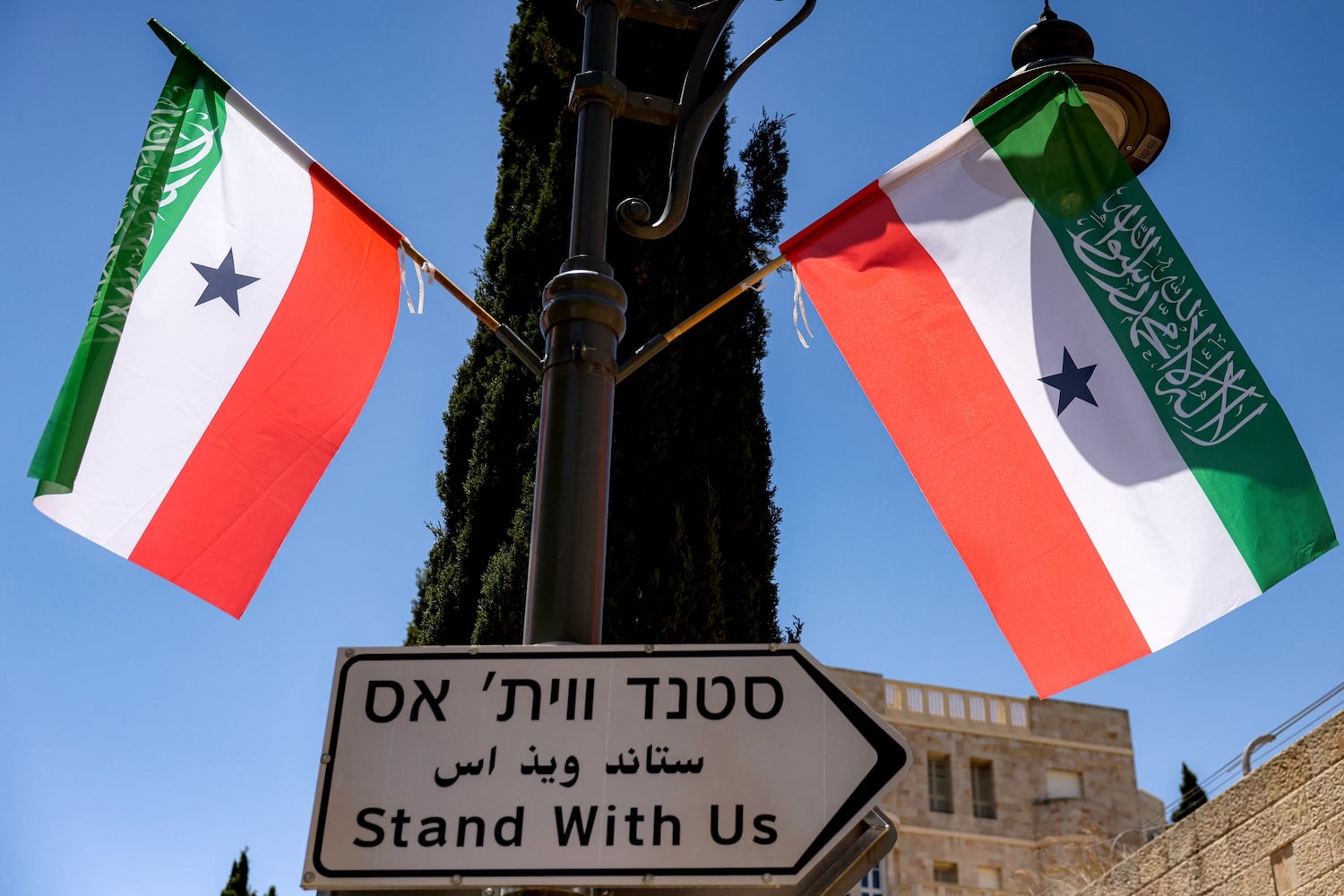
U.S. allies won’t love it, but American interests come first. By Steven A. Cook, a columnist at Foreign Policy and the Eni Enrico Mattei senior fellow for Middle East and Africa studies at the Council on Foreign Relations. Flags of Somalia’s breakaway region of Somaliland fly along a street in western Jerusalem on June 14. Flags of Somalia’s breakaway region of Somaliland fly along a street in western Jerusalem on June 14. HAZEM BADER / AFP via Getty Images September 4, 2026, 11:44 AM When Israel recognized Somaliland in late December 2025, it caused an international kerfuffle. The Arab League called it “illegal” and a threat to regional stability. The African Union “reject[ed] any initiative or action aimed at recognizing Somaliland as an independent entity.” Saudi Arabia’s Ministry of Foreign Affairs described it as a “unilateral secessionist move that violates international law.” The Qataris, Egyptians, Turks, Algerians, Yemenis, Omanis, Sudanese, Iraqis, and others echoed these sentiments. The European Union also chimed in, declaring that it “reaffirms the importance of respecting the unity, the sovereignty and the territorial integrity of the Federal Republic of Somalia.” Territorial integrity is of course important. The crackup of other countries in the region—say Syria or Iraq—would be catastrophic to the security and stability of the Middle East. But staking opposition on Somalia’s territorial integrity was transparently disingenuous. Somaliland voluntarily agreed to be a part of Somalia after its independence in 1960, decided to secede in 1991 after a decade of war within the country, and has been basically independent ever since. The Saudis lived with two Yemens between 1967 and 1990; the Qataris and Turks supported Idlib, a breakaway province of Syria, until President Bashar al-Assad fell; and Turkey is the only country in the world that recognizes the Turkish Republic of Northern Cyprus, which Ankara sliced out of the northern third of the Republic of Cyprus—now a member of the EU. The opposition to Israel’s move is not rooted in principle, but rather in geopolitics, which underlines the importance of Somaliland, especially now. When Israel recognized Somaliland in late December 2025, it caused an international kerfuffle. The Arab League called it “illegal” and a threat to regional stability. The African Union “reject[ed] any initiative or action aimed at recognizing Somaliland as an independent entity.” Saudi Arabia’s Ministry of Foreign Affairs described it as a “unilateral secessionist move that violates international law.” The Qataris, Egyptians, Turks, Algerians, Yemenis, Omanis, Sudanese, Iraqis, and others echoed these sentiments. The European Union also chimed in, declaring that it “reaffirms the importance of respecting the unity, the sovereignty and the territorial integrity of the Federal Republic of Somalia.” Territorial integrity is of course important. The crackup of other countries in the region—say Syria or Iraq—would be catastrophic to the security and stability of the Middle East. But staking opposition on Somalia’s territorial integrity was transparently disingenuous. Somaliland voluntarily agreed to be a part of Somalia after its independence in 1960, decided to secede in 1991 after a decade of war within the country, and has been basically independent ever since. The Saudis lived with two Yemens between 1967 and 1990; the Qataris and Turks supported Idlib, a breakaway province of Syria, until President Bashar al-Assad fell; and Turkey is the only country in the world that recognizes the Turkish Republic of Northern Cyprus, which Ankara sliced out of the northern third of the Republic of Cyprus—now a member of the EU. The opposition to Israel’s move is not rooted in principle, but rather in geopolitics, which underlines the importance of Somaliland, especially now. Americans brought up on Mercator projection maps—which inflate the size of lands far from the equator—might not fully grasp the geographic and thus strategic, political, economic, and cultural connections between the Middle East and the Horn of Africa. Saudis, Emiratis, and Qataris are multibillion-dollar investors in Africa. Egypt has a vital strategic interest in East Africa given its dependence on the Nile River (which originates in Ethiopia, Burundi, Rwanda, Tanzania, and Uganda) for the country’s survival. Turkey has among the largest contingent of embassies on the African continent and has focused on Somalia as a Turkish beachhead in the region with anywhere from 800 to 2,500 troops in the country. The Israelis currently enjoy strong relations with Uganda, Kenya, Ethiopia, and now Somaliland. The Horn of Africa has become part of the great game among Middle Eastern powers. Somaliland has a pretty good story to tell. Like Somalia, it has benefited from Emirati and some Qatari as well as Turkish investment. But unlike many African states, Somaliland has eschewed a relationship with the Chinese government. Its diplomats and spokespeople emphasize that they want a partnership with the United States, including military bases and access to minerals, and they have vowed to join the Abraham Accords. Somaliland has functioning political institutions. In 2024, there was a peaceful transition of power to the political opposition when Abdirahman Mohamed Abdullahi (aka Irro) won the presidential election. Things are hardly perfect. There are accusations that the authorities constrain civil liberties and there is opposition to the government among some clans, especially in the east, where sentiment runs in favor of ties with Mogadishu rather than Hargeisa—Somaliland’s capital. This raises the possibility of violent inter-clan conflict in Somaliland. It is a legitimate concern. The good news is that Irro says he is committed to peaceful dialogue. Even taking into account this problem, Somaliland stands in contrast to Somalia itself, which has been a fount of terrorism, piracy, and extremism in the Horn of Africa for decades. The Turks, Qataris, and Saudis argue that part of what they are doing is helping the Somali government overcome that instability, but it is hard to see progress. In fact, recent reporting points to ties between Somalia’s al Qaeda affiliate, al-Shabab, and Yemen’s Houthis. The United States has so far resisted recognizing Somaliland’s independence, but senior officers from U.S. Africa Command have visited Hargeisa. The visit makes sense given that Washington’s security interests are connected to Somaliland. Iran’s muscle flex in the Strait of Hormuz highlights the equally important Red Sea. Before the U.S. and Israeli war with Iran, about 15 percent of global trade passed through the Red Sea, and it is now an important escape route for Saudi oil that otherwise would have transited Hormuz. In recent months, that shipping has been targeted by Iran’s allies, the Houthis, in yet another challenge to Washington’s commitment to freedom of navigation. What country sits on the African shore of the Gulf of Aden? Somaliland. With the deep-water Berbera port that is undergoing modernization, plus a large adjacent airstrip, a desire to be on Team America, and strong ties with some of Washington’s other regional friends (Israel, Ethiopia, and the United Arab Emirates), Hargeisa seems like a fine candidate to be a new partner in the Horn of Africa. It would be hard to find a better staging area the United States could use to monitor the Houthis, and when necessary, apply pressure on them and the Islamic Revolutionary Guard Corps (IRGC). Some Somalilander commentators have argued that it would be shortsighted of the United States and Israel as well as risky for Somaliland if the totality of relations with Hargeisa involved military bases. They want a broader and less security-specific relationship. That sounds about right, though with Washington’s hands full almost everywhere and a State Department that is a mere shadow of itself, it is hard to imagine the United States has the ability to do much more than securitize a relationship with Somaliland. U.S. recognition of Somaliland would risk the ire of other American friends, notably Turkey, Egypt, and Saudi Arabia. It may be worth the hard conversations and anger, though. Turkish, Egyptian, and Saudi leaders should not have a veto over U.S. policy, especially when high-stakes issues like confronting the IRGC and the Houthis as well as shoring up freedom of navigation are in play. They far outweigh Saudi Arabia’s pique with Israel and the UAE, Turkey’s regional ambitions, and Egypt’s spat with Ethiopia—for which one can imagine a diplomatic resolution. The United States has good reason to recognize Somaliland. In the Middle East and Horn of Africa, where it is hard to find a good opportunity, upgrading relations with Hargeisa represents one. Somalilander officials want Washington as a partner, and importantly, they have something to offer. For the sake of both Somaliland and U.S. interests, it is time to give up the pretense of Somalia’s territorial integrity. United States Iran Steven A. Cook Steven A. Cook is a columnist at Foreign Policy and the Eni Enrico Mattei senior fellow for Middle East and Africa studies at the Council on Foreign Relations. His latest book is The End of Ambition: America’s Past, Present, and Future in the Middle East. X: @stevenacook Read More Women queue to vote at a polling station in Gabiley, Somaliland, on May 31. Somaliland’s Strategic Case for Independence Lacking formal international recognition, the territory is seeking to make its mark through infrastructure deals and bilateral ties with key global powers. Three soldiers are shown on a street from behind, while pedestrians stand near them. Somalia’s Fragile Government May Be on the Verge of Collapse After disputes culminated in fighting last week, the country’s political system is in doubt. OTHER SUBSCRIPTION OPTIONS Stories Readers Liked Go to slide 1 Go to slide 2 Go to slide 3 Go to slide 4 Go to slide 5 Go to slide 6 Go to slide 7 Go to slide 8 Go to slide 9 Go to slide 10 A statue of a seated, bearded man with a bare torso and draped cloth around his waist, holding a scroll in one hand, positioned in front of a row of large classical columns. An illustration of Donald Trump in a blue suit and long red tie gesturing with open hands in front of a grid patterned background with jagged red, blue, and black line graphs diving downward. Five people sit in folding chairs pushed up against a wall, all of them on their phones and several looking board. Text on the wall behind them says "AI for Real" with images of robotic arms and household appliances printed around it. An illustration depicting a man submerged up to his nose in water. The wavy water is divided horizontally into three color bands that mimic a flag: white foam at the very top peaks, a deep blue middle section filled with bubbles, and a red lower section covering his neck and suit jacket. His blue eyes look upward with a wide, strained expression. As the Tide Turns Against Putin, Beware the Drowning Man By Peter Frankopan Negotiators from the United States, Canada, and five European countries converse after finishing the draft of the North Atlantic Treaty in Washington on March 18, 1949. Trans-Atlanticism Isn’t Dead—It’s Being Renegotiated By Alexandra de Hoop Scheffer A woman crosses a road in front of a mural depicting Russian President Vladimir Putin in Kashira, Russia, southeast of Moscow, on Oct. 16, 2017. The Western Myth of Russian Greatness By Christian Caryl An illustration of a vintage-style map featuring North America and parts of Europe and Africa. Overlaid on the map are 3D red brick walls shaped exactly like the borders of the contiguous United States and Alaska, casting long shadows to the right. America, the Once Global Nation By Odd Arne Westad A creative illustration against a pale yellow background showing a garden planter containing a dense green hedge. Five human arms emerge from the hedge, with four of the hands holding small flags of China, Russia, the United States, and the European Union, while the fifth hand holds the flag of India. An illustration showing a pair of hands tightly wringing out an American flag. Water droplets shaped like missiles squeeze out of the twisted fabric and fall toward a puddle shaped like the map of Iran on a red background. An aerial photo shows Doha in the booming petrostate of Qatar. Back to School An illustration shows the back of a person wearing a graduation cap with a globe motif on it. A hand reaches in to move a locator pin on the top of the cap/map. So You Want to Work in International Affairs A veteran practitioner’s 12 tips to land that first job. An illustration of hands tossing graduation caps into the air against a blue sky and lines of a chart for a ranking of international relations schools. A teacher interacts with students at a UNRWA school. Students graduate during a ceremony at Tsinghua University in Beijing on July 18, 2007.
Why the United States Should Recognize Somaliland
Full Article
Original Source
Read the full article at Foreignpolicy →KhanList aggregates and links to publicly available news content. We do not host full articles from third-party sources. Always verify important information with original sources.