
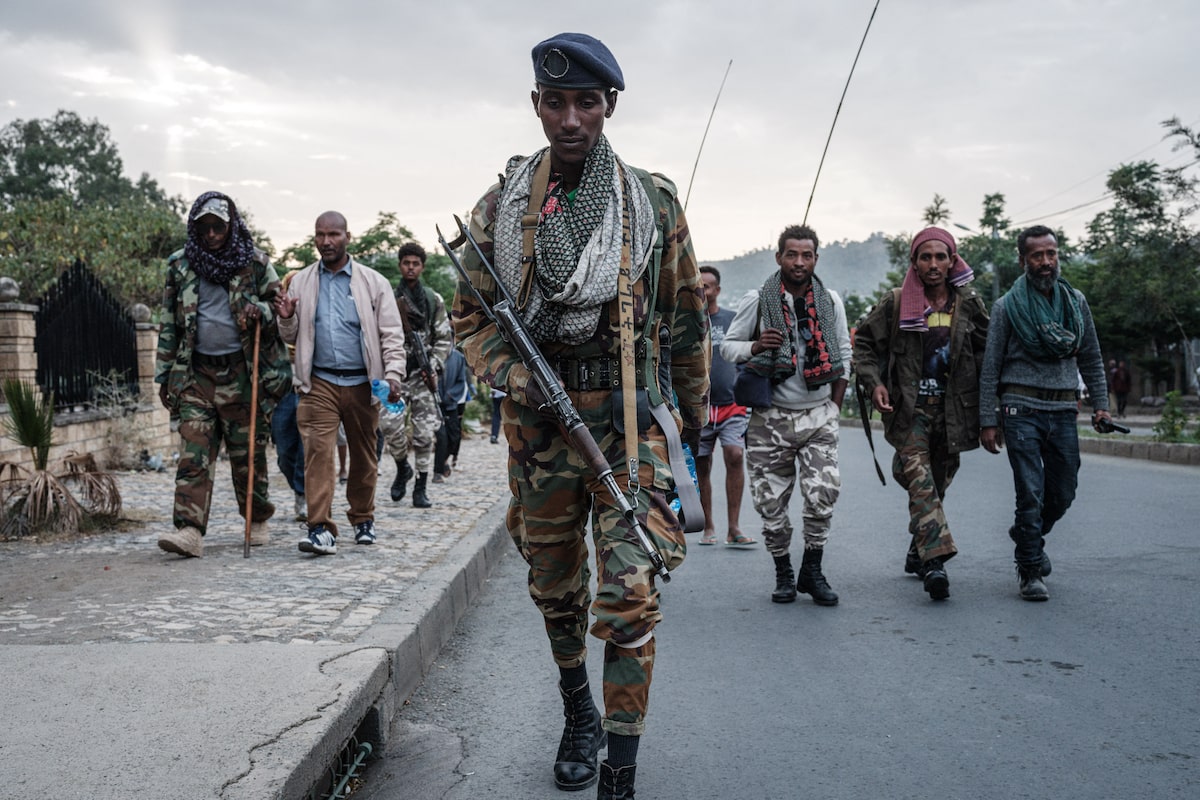
Open this photo in gallery:Tigray People's Liberation Front fighters in Mekele, the capital of Tigray region, Ethiopia, in June, 2021.YASUYOSHI CHIBA/AFP/Getty ImagesLarge-scale fighting has erupted in northern Ethiopia, sparking fears of a wider conflict that could spill across borders, just four years after the end of a war that killed an estimated 600,000 people in the same region.The Tigray People’s Liberation Front (TPLF) seized control of three airports in the Tigray region of northern Ethiopia on Wednesday, triggering a suspension of flights by state-owned Ethiopian Airlines.A new alliance of seven armed groups, including the TPLF, spearheaded the latest fighting. One group helped the TPLF capture a town in the Afar region, near the Tigray border, while others clashed with federal forces in the Amhara region. This followed months of tension and military mobilization across the region, including Ethiopian military drone strikes on targets in Tigray and Amhara.Tigrayan leaders confirmed the outbreak of fighting, calling it a “defensive” war against a “genocidal invasion” by Ethiopian forces. The federal government accused the TPLF of igniting the war.What’s at stake? What are the global implications? And who are the main figures involved? Here’s what to know about the crisis:Why is there global anxiety about the escalating conflict?The United States and the African Union reacted swiftly, expressing deep concern about the renewed fighting in Ethiopia. Both called for political dialogue to resolve the conflict.One reason for the worry: The impact of the catastrophic war in Tigray from 2020 to 2022 is still being felt. An estimated 600,000 civilians died from violence, starvation and disease in that conflict, and about a million people are still displaced from their homes. It still ranks as one of the most devastating wars of the 21st century.Another concern is the mounting volatility within Ethiopia. The country is traditionally seen as a bulwark of stability in the Horn of Africa, but it is now struggling with rebellions by insurgent groups, including those in the new alliance.In photos: Behind the lines with the Fano insurgency battling Ethiopia’s governmentThere are fears the war in neighbouring Sudan, which began in 2023, could merge with the Ethiopian conflict in a wider conflagration across the Horn of Africa. “Hard to overstate how ugly this could get for the region, barring unexpected de-escalation,” said Alan Boswell, the Horn of Africa director of the International Crisis Group, in a social media post.Ethiopia is reportedly providing bases and weapons for the Rapid Support Forces (RSF), the paramilitary group that is battling Sudan’s military, while the TPLF is believed to have links to the Sudanese army.What were the triggers for the renewed fighting?A peace agreement was signed in Pretoria in 2022 to end the previous war in northern Ethiopia, but Tigrayan leaders have repeatedly complained that the Ethiopian government never fulfilled its promises under the deal. The unresolved grievances are among the factors stoking the new clashes.Large-scale displacement in the region has aggravated the tensions. Tigrayans were forced to flee their homes in a territorial dispute with the Amhara region, and the dispute has never been settled.Ethiopia election disrupted in three key regions where rebels activeAnalysts have cited the lack of high-level intervention from international leaders as another factor. Tensions and clashes have escalated for months without much diplomatic attention.International attempts to resolve the Sudan war, meanwhile, have badly faltered in recent weeks, with both sides seeming ready to launch new offensives, potentially dragging Ethiopia further into the conflict.Who are the other potential players? The big unknown factor is Eritrea, the small authoritarian country with a large military. Eritrea played a major role in the Tigray war from 2020 to 2022, sending troops across the border to help the Ethiopian military. But this time Eritrea has switched sides, forging connections to the TPLF, while the Ethiopian government has hinted it may use force to gain control of an Eritrean port on the Red Sea.The new rebel alliance, meanwhile, will be a key factor in the renewed fighting. The group, known as the Alliance for Survival, has vowed to topple the government of Prime Minister Abiy Ahmed. The government has accused Eritrea of funding the alliance.The West is courting favour with Eritrea, putting aside human-rights concernsThe alliance said Wednesday that it was involved in co-ordinating the latest attacks. One of its members, a militia in the Afar region, joined the TPLF to capture the town of Abala and other sites in Afar.Another member of the alliance is the Fano militia, a powerful group in Amhara that was once allied with the federal government but is now in a coalition with the TPLF. Armed groups in the Oromia and Somali regions are also key members of the alliance.What are the humanitarian concerns?The surge of fighting in northern Ethiopia is more bad news for a devastated region where millions are vulnerable. Food and energy shortages are already a serious problem, and the latest combat could jeopardize the flow of humanitarian aid.In an example of the dangers, a drone strike Sunday destroyed an aid vehicle in a Catholic Relief Services convoy. The truck, with 41 tonnes of food, was bringing assistance to displaced people in northern Tigray.“The new hostilities in northern Ethiopia raise fears that civilians will face further abuses given the warring parties’ past atrocities and ongoing impunity,” said Laetitia Bader, deputy Africa director at Human Rights Watch, in a statement.
Why the surging conflict in northern Ethiopia could spill across borders
Full Article
Original Source
Read the full article at Theglobeandmail →KhanList aggregates and links to publicly available news content. We do not host full articles from third-party sources. Always verify important information with original sources.