
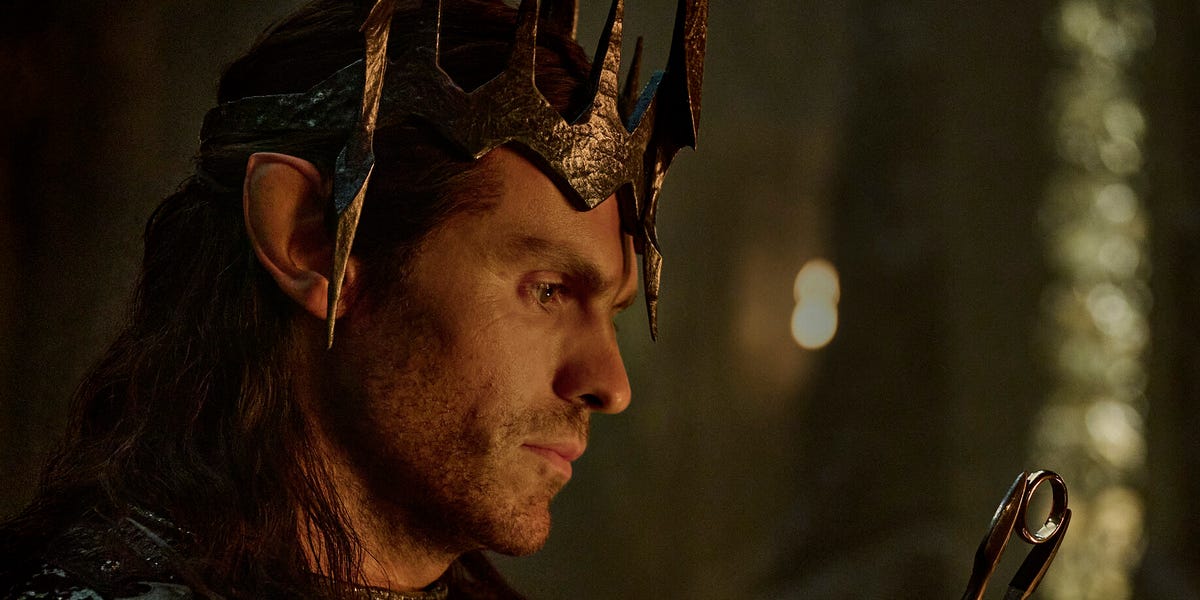
Ben Rothstein/Prime7 min readWhen the creators and showrunners of The Lord of the Rings: The Rings of Power embarked on season 3, they knew the endgame from the start: The forging of the One Ring. After two seasons in the Second Age of Middle-earth, which saw almost all the other Rings of Power forged—three for Elves, seven for Dwarves, and nine for Men—it was time for Sauron to forge the one to rule them all.“We wanted a tighter, tauter, more profound season,” says co-showrunner Patrick McKay, in an interview with Esquire. “We wanted to start with a bang and never let up. We wanted to deepen our characters psychologically, and challenge them in new ways. You’re seeing the end of one part of the story, and the beginning of another.”“We had to have Sauron forge the One Ring,” adds J.D. Payne, who also created and serves as co-showrunner with McKay. “To do that, all the storylines in some way are connected to Sauron’s attempts at world domination. That was the one that so much of our attention and focus went into getting right, and it took all of our departments working together at the top of their games to create.”On Wednesday, just in time for Thanksgiving, Prime Video gave Tolkien fans a feast with the final two episodes of The Rings of Power season 3: episode 7, “Orodruin,” and episode 8, “The Doom of Men.”In the penultimate episode, Sauron (Charlie Vickers) learns from the Balrog—who talks, apparently!—how to use the fires of Mount Doom to forge the One Ring. Then, with the power of the One Ring literally in his hands, Sauron mobilizes his army for battle against Pharazôn (Trystan Gravelle), the king of Númenor. But instead of a big, violent bloodbath in the spirit of, say, Game of Thrones, Sauron simply... surrenders. Or does he? We’re talking about a master deceiver, after all.In a spoiler-filled interview with Esquire, McKay and Payne unpack a few of our biggest questions about season 3, including how and why the Balrog speaks (with actor Simon Pegg lending his voice) to why Pharazôn is actually one of the most consequential figures in the series.This interview has been edited for clarity.Ben Rothstein/PrimeCharlie Vickers continues his role as Sauron in The Rings of Power season 3.ESQUIRE: So, wait, the Balrog can talk?PATRICK MCKAY: One of the things we're constantly trying to do is go deeper into Tolkien’s life's work. He did not just create The Lord of the Rings, he wrote all this other stuff. He envisioned an entire world. It's his legendarium. When you do the deep dive, you find there are surprising things if you only know the book and film trilogy. The Balrog Gandalf faces down in Moria is part of this level of “super being” that is equal to Gandalf and Sauron. They’re Maiar. In prior ages, Balrogs could cast spells and command troops. They’re intelligent. They can talk, you just don’t see that one talk in that circumstance.The idea of walking out onto a diving board and doing something risky, to show a different side of that being, was something that we felt compelled to do this season. It’s certainly unexpected. We’re always looking to do that. We don’t want to be familiar. We want to show you things in this world that you haven’t seen before.Talk to me about designing a new One Ring. Granted, it’s a gold ring; there’s not much you can really deviate. But in what ways did you want to create a One Ring that belongs to The Rings of Power?MCKAY: The books are pretty specific about the way it looks. It’s a plain gold band. If you’re gonna do that, it’s going to look like the One Ring you’ve seen in other adaptations. We did make a few modifications, just for camera. We broadened it to give it more chunkiness. But it is what it says on the tin.How is season 3 a culmination of everything that’s happened before, and how is it setting up the rest of the show?J.D. PAYNE: It pulls together everything we’ve been doing with Sauron and Galadriel from the first two seasons. In season 1, he befriended her and deceived her in the guise of Halbrand. In season 3, you see Celebrimbor tormenting him: “You’re never gonna be able to make a ring capable of dominating all the other rings—or dominating her.” Part of Sauron’s ambition to forge the One Ring, as a character motivation, is being able to dominate the person who said “no” to him over the last few seasons. You understand how crazy that must have driven him.MCKAY: The show’s called Rings of Power, because the creation is the throughline of this entire era of Tolkien’s mythology. At the end of season 3, you’ve now seen the creation of all of them. That’s now the world we live in. Everyone in Middle-earth is a nuclear power, so to speak. Now we’re setting up for the next part of the story, which is, “What are the consequences going to be?” One thing in season 3 we really invested in was Númenor to set Sauron up as the bowling ball crashing into those pins. That’s sort of the beginning of the end of the Second Age. It’s a tragic story. The Rings have an impact on Middle-earth that is felt for thousands of years. Now they are in this world.The finale is literally titled “The Doom of Men,” and it ends with Sauron “surrendering” to Pharazôn. Or so that’s what he wants them to think. Can you break down this moment? How is this Sauron’s big chess move?PAYNE: Everything builds up to that. You’ve seen Gandalf getting through to the Dark Wizard and take out a massive portion of Sauron’s army at the last moment. So the game changes right from underneath him, and he has to make a calculation. Is he going to put all his chips on the table and lose his army in a stalemate? Or is there another way? The great thing about Sauron is that he’s amazing at constructing scenarios that are lose-lose. If he can’t beat Pharazôn on the field of battle, he reasons maybe there’s another way. That’s why the final moment is filled with tension. It’s not simply a surrender. Our Elves, particularly Galadriel, know Sauron so well. She knows this is not a defeat for Sauron, and he’s going to find a way to make this into a play for exactly what he wants. Those who know the lore know what happens when Sauron is taken prisoner to Númenor. We wanted that feeling of dread, watching Charlie Vickers have a hint of a smile.Ben Rothstein/PrimeTrystan Gravelle returns as Pharazôn, the king of Númenor, whose “victory” over Sauron may actually be his undoing in season 4.One of the most consequential characters this season has been Pharazôn. In what ways does Pharazôn represent the downfall of man?MCKAY: This is a major character in the mythology. We introduced him in season 1, he’s been sort of a politician gathering power. In season 3, he’s been king for five days, and he’s in his heyday. He’s in his golden era. But he’s driven by insecurity. There was this blacksmith we empowered, who got away, who’s now marching around saying he’s “Lord.” No, I’m the guy! There’s professional jealousy there.We talk sometimes about how he’s Stalin to Sauron’s Hitler. You’ve got two characters who are quite full of themselves, and have a high opinion of themselves, which puts them on a trajectory. Pharazôn’s goal is, “I want to take on Sauron.” That makes him a compelling character because you watch the way he greases the wheels and maneuvers to bring about that end. We give a lot of credit to our actor, Trystan Gravelle. He leaps off the screen in season 3.Speaking of showdowns, one of the biggest confrontations you stage in season 3 is between Sauron and Gandalf, which Tolkien never wrote in the books. What did you hope to discover by pitting these characters together?MCKAY: The journey of Gandalf and his involvement with Ciaran Hinds’ character, Pollando, has real deep roots in some Tolkien deep cuts where he talked about wizards who went east and that their activities probably prevented the east from joining Sauron. The story comes from that. We wanted to dramatize that through some of the most iconic characters in the legendarium coming face to face.PAYNE: Seeing the contrast between them felt like too delicious an opportunity to pass up. Sauron is seeking power at all costs, and Gandalf has been told by the Secret Fire, “To access the greatest power in the universe, you have to give up all other power.” So when Gandalf is offered the world by Sauron, he turns it down. If you demand power, it’s going to destroy you. Ultimately, having the One Ring, and forging it and trying to keep power, sets up the weaknesses of the Third Age that the heroes exploit to finally destroy Sauron.One of my favorite hobbies is Magic: The Gathering, which has had both Lord of the Rings and The Hobbit as crossover sets. Are there any possibilities for a Rings of Power collaboration?MCKAY: [Laughs.] No. This is the first we’ve heard about it.PAYNE: We actually wrote a draft of a Magic: The Gathering script in the before times. It was one of the last scripts we worked on before turning to Rings of Power. But it was right before the Disney-Fox merger, and it kinda got lost there. But we love that universe.
Why The Rings of Power Will Never Be the Same After the Season 3 Finale
Full Article
Original Source
Read the full article at Esquire →KhanList aggregates and links to publicly available news content. We do not host full articles from third-party sources. Always verify important information with original sources.