
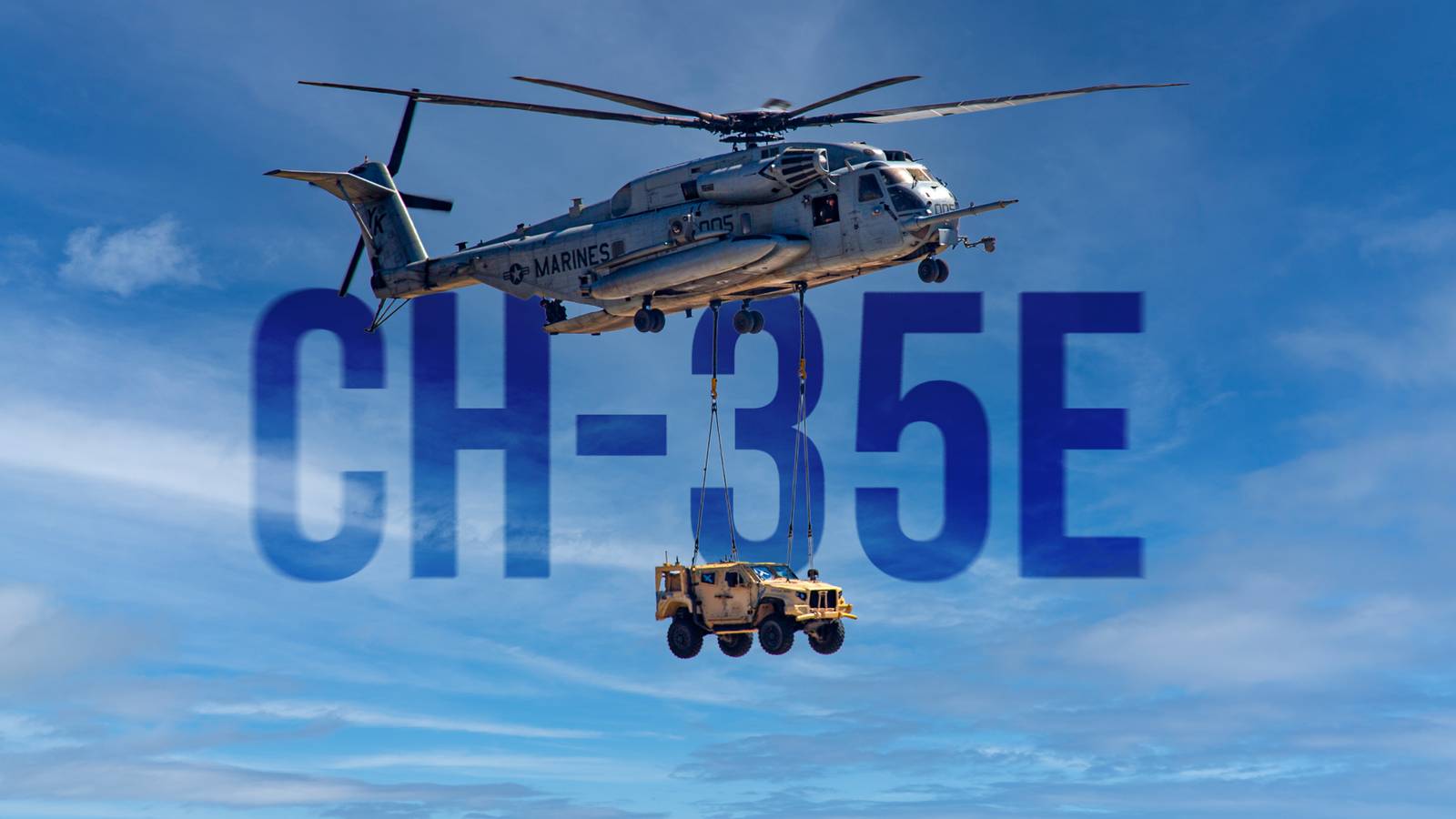
Published Sep 20, 2026, 11:00 AM EDT Luke Diaz is a freelance military writer with experience with active duty experience in the US Navy as well as defense and industrial engineering. He is a former Naval Flight Officer who performed tactical air control on the carrier-based E-2 Hawkeye. The US Marine Corps heaviest-lift helicopter first flew in the Reagan administration. Sikorsky's legendary CH-53 Stallion series has evolved to the K-model today. The preceding E-variant is facing a rapidly oncoming sunset with the new arrival. The urgent fleet modernization is largely driven by the fact that the legacy helos are only available for missions barely a third of the time they are needed. Some airframes in the CH-53E Super Stallion fleet have logged more than four decades of service. Then there is the history of fatal crashes over the past decade which has turned an ongoing maintenance battle into a clear and present matter of life and death. The Marines answered with a firm deadline. The full replacement of the Super Stallion by the King Stallion is expected to be completed before 2032. The plan sounds simple on paper, yet the King Stallion arrives trailing its own history of schedule slips and a ballooning flyaway that even exceeds stealth fighter price tags. The challenge is not whether the Marine Corps wants to retire the CH-53E, but whether the aircraft meant to replace it will get there on time. An Aging Fleet Running Out Of Time Credit: US Marines The CH-53E entered Marine Corps service in 1981, and the last example rolled off the line in 2003. That means at least some active Super Stallions in the operational fleet are approaching 45 years of age. Congress mandated in 2016 that the Marine Corps maintain 200 CH-53Es, but mishaps, fatal accidents and other losses have whittled the inventory down to 147 aircraft. Of those 147, only an estimated 37% are available for operations at any given time. That illustrates just how much of the fleet sits grounded for depot work, parts shortages or obsolescence issues tied to an airframe design that predates the internet. More importantly, the safety record underlying that maintenance burden is bleak. The USMC counts more than ten total loss events involving the CH-53E between September 2015 and December 2024. The most recent fatal incident came in February 2024, when a Super Stallion assigned to Marine Heavy Helicopter Squadron 361 crashed in mountainous terrain near Pine Valley, California, during a nighttime flight through a winter storm. The Navy's counterpart is also notorious for having a fatal accident rate roughly twice as high as other helos. Five Marines, including three pilots, died in the last mishap to claim lives, according to a report from Fox 5 New York. That accident followed a 2018 crash near El Centro, California, that killed four Marines and, before that, a 2016 midair collision off Oahu, Hawaii, killed twelve. Such a safety record has become as central to the retirement argument as the readiness numbers. So why is the successor airframe basically a refreshed model of the same airframe? A Heavy Lift Helo Built To Outperform Credit: US Marines The answer is the CH-53K King Stallion is not just a simple reskin of its predecessor. For starters, the King Stallion carries a payload of roughly 13.5 tons. That is nearly three times the CH-53E's capacity, which was already the highest of any western-made, combat helo. The K-model also brings fly-by-wire flight controls with a composite airframe, composite rotor blades and an external cargo system that lets a single sortie sling load three separate outsize cargo pieces underneath it. Beyond raw lift, the King Stallion was designed around the maintenance headaches that have hollowed out the Super Stallion fleet. Naval Technology reported that the aircraft is powered by three General Electric T408 turboshaft engines producing more than 7,300 shaft horsepower each, managed by a dual redundant digital engine control system. The cabin can carry 34 passengers or 24 litters for medical evacuation. The new aircraft has 57% more horsepower than the CH-53E while using 63% fewer parts. That combination boosts both capability and the kind of reliability that translates into higher availability rates on the flight line. Real-time, predictive diagnostic software can catch problems before they ground an aircraft, addressing precisely the failures that have kept the Super Stallion fleet's availability rate so low. A History Of Cost Growth & Technical Trouble Credit: US Marines The CH-53K program has not had an easy road. A Government Accountability Office report released in March 2021 found that total program costs had grown by nearly $15.3 billion since the effort began in 2005, driven by technical problems and a decision to increase the planned fleet from 156 to 200 aircraft. That has caused the flyaway cost to balloon to epic proportions. As of now, a CH-53K King Stallion costs roughly $39 million more than a Lockheed Martin F-35A Lightning II. Sikorsky and the USMC pushed the full rate production decision back nearly seven years, but it still reached a 21% overrun against the 2006 baseline. The program nearly forced the kind of formal Nunn-McCurdy breach that would have triggered a Pentagon review of the program's viability, like the ongoing Boeing B-52J Stratofortress upgrade series suffered. The Marine Corps only plans to buy 200 CH-53K helicopters in total, so the factory builds fewer units and cannot lower production costs as easily. The F-35A currently costs about $92 million per unit, which includes the jet frame, engine, and radar systems. The CH-53K has a production cost of about $131 million per helicopter, making it the most expensive heavy-lift helicopter in the world. The price difference comes down to manufacturing scale and complexity. The CH-53K is a massive and complex machine that uses three high-power engines, lightweight composite rotor blades, and a digital FBW flight system that is fully protected against harsh salt-water environments on Navy ships. Israel is the first and only official international customer and plans to buy just 12, which hardly helps the Marines' costs battle. From Test Squadron To Fleet Credit: US Marines The operational record has improved markedly since the GAO's warnings. Seapower Magazine reported that the first fleet squadron, Marine Heavy Helicopter Squadron 461, reached initial operational capability in April 2022. The unit flew more than 3,000 mishap free hours during operational testing. Yet, Breaking Defense reported in April that the CH-53K's first operational deployment has been pushed to fiscal year 2027. The scale of that buildup remains modest relative to the eventual goal. The Marine Corps had 25 King Stallions in its fleet as of April. That fleet only passed 10,000 flight hours during shipboard training evolutions ahead of the 26th MEU deployment earlier this Spring. Eventually, the Marines want six active squadrons of 16 aircraft each, one reserve squadron, and one fleet replacement squadron of 17 aircraft. The plan also includes a small operational and developmental test detachment. The fleet structure depends on sustained annual production to stand up to all of these units by 2032. Then, last year, the Marine Corps began reviewing whether it would even go through with procuring the full 200 K-models it had long planned for. The Budget Variable That Could Reshape The Timeline Credit: US Marines Marine Corps aviation leadership has already been trimmed once, from an original requirement of about 220 aircraft down to 200. The cut was largely due to affordability grounds. It was also tied to a reduction in active duty squadron strength. The cut to heavy lift squadrons brought the total number of units down from eight to five. Top brass at the time argued that any further reduction would likely come from the tail end of the production run. The Marine Corps has staked its distributed aviation operations concept largely on the King Stallion's independent range and lift capacity, as described in the 2026 Marine Corps Aviation Plan. The 'Pivot to the Pacific' air plan is intended to reduce reliance on tanker support and allow heavy equipment to move across a dispersed battlefield without staging through vulnerable hubs first, such as Okinawa and Guam. Cutting the buy would undercut that vision even as it saves money under the constraints of a tightening budget. With King Stallion deliveries running at the pace needed to retire the Super Stallion fleet by 2032, and with the newest squadron only now working toward its first operational deployment in fiscal year 2027, a capability looms on the horizon. Thus, several CH-53E squadrons will keep flying an airframe that is only incurring greater risk with every sortie. What The Transition Leaves Unresolved Credit: US Marines The Marine Corps is undergoing its biggest strategic shift in decades, moving away from land wars in the Middle East and focusing on a potential conflict in the Indo-Pacific region. This new strategy is called Expeditionary Advanced Base Operations, or EABO. Under EABO, Marines will not fight from massive, permanent bases. The revived 'Raider' philosophy is organized around small, highly mobile groups of Marines that will leapfrog across tiny, remote islands. They will set up temporary bases, launch missiles at enemy ships, and quickly pack up and move before the enemy can find them. The old CH-53E simply cannot support this strategy because it lacks the necessary range and power. The K-model is the only helicopter capable of lifting the Marine Corps' heaviest armored vehicles, artillery pieces, and massive supply loads from Navy ships to shore. Without the CH-53K, the Marine Corps' entire island-hopping strategy in the Pacific fails because they would have no way to move their heavy equipment across the rugged, remote islands of the expansive theater.
Why The Marine Corps Plans To Retire The CH-53E Super Stallion By 2032
Full Article
Original Source
Read the full article at Simpleflying →KhanList aggregates and links to publicly available news content. We do not host full articles from third-party sources. Always verify important information with original sources.