
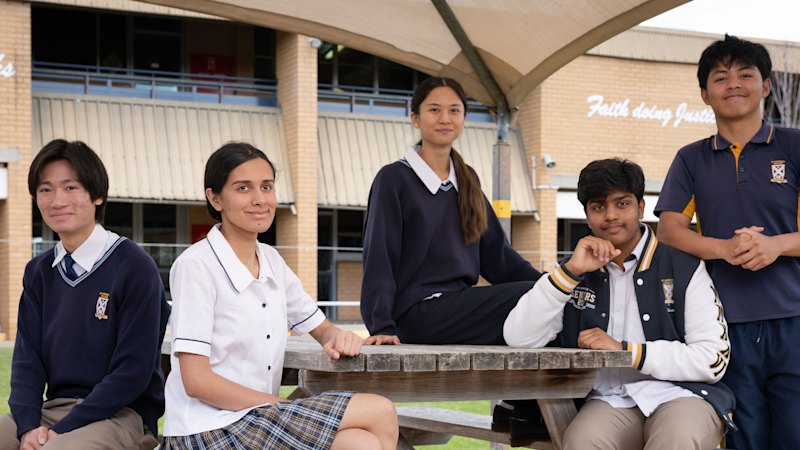
October 21, 2026 — 5:30pmWhen Abhinav Kondapavuloori opened the HSC biology exam, he found the exact topics he had been revising just a few hours earlier. “I was almost laughing,” he said.“I think NESA [NSW Education Standards Authority] was being particularly nice to us,” said the 17-year-old, who hopes to study either engineering or medicine, with a side of filmmaking. “The questions weren’t as mean or overcomplicated or wordy … sometimes NESA twists the question around even if it is a simple concept.”HSC biology students from St Andrews College, Marayong, praised the test for being easy. Wolter PeetersNot in this exam. Bouncing out of the hall at St Andrews College Marayong, students praised the test, which 18-year-old Calvin Mediana described as “the easiest bio exam ever”.Over three hours, more than 20,500 students enrolled in HSC biology were grilled on topics including infectious diseases, reproduction and biotechnology. There were many animal-themed questions, including about 21 bacteria-riddled dead lizards, gene-modified super salmon, koala IVF, bat-transmitted horse viruses and rabbit breeding.Biology teacher Rohan Isaac said the examination was a “pretty good paper”, noting the questions pushed students to think critically.“They are going away from recite and regurgitate to analyse and evaluate,” Isaac sad. He pointed to a question about genetically modified “super salmon” that asked students to analyse how social, economic and cultural factors might influence public attitudes about eating the super-sized fish.Isaac said a good response would go beyond the recommended writing space, get to the point and not waffle.He said students could examine the question from a religious angle – “are you playing God, by manipulating nature?” – or discuss how gene-modification is expensive and out of scope for many countries.Mediana said he blitzed through the test. “I felt really prepared. I knew how to adapt the information I had,” he said.He particularly enjoyed a question about how artificial insemination and artificial pollination could be used to improve the long-term survival rate of koalas. “It was a topic I really struggled with in trials, but I think I did really well smoothing up on that section. It was easy,” Mediana said.He wrote about how using semen from multiple male koalas would lead to an increase in genetic diversity. Overall, he left the test buzzing. “I enjoyed the test a lot, it was a weird feeling. I’ve never felt that before,” he said.Year 11 students Angela Pilayre and Bhavrit Sidhu also sat the exam as part of an accelerated version of the HSC. By completing biology in years 10 and 11, they will have one fewer exam in their final year.The 16-year-olds said they were relieved to sit the exam early. “Since we have experience going through one exam already as like only a 16-year-old, then we’ll have a kind of understanding of how we can approach other exams in the future,” Angela said.Bhavrit said: “It’s not as stressful as you think it is.”HSC exams continue until November 5.Start the day with a summary of the day’s most important and interesting stories, analysis and insights. Sign up for our Morning Edition newsletter.Emily Kowal is a Walkley award-winning education reporter for The Sydney Morning Herald.Connect via email.From our partners
Why the HSC biology exam about koala sperm, dead lizards and super salmon had students cheering
Full Article
Original Source
Read the full article at Smh →KhanList aggregates and links to publicly available news content. We do not host full articles from third-party sources. Always verify important information with original sources.