
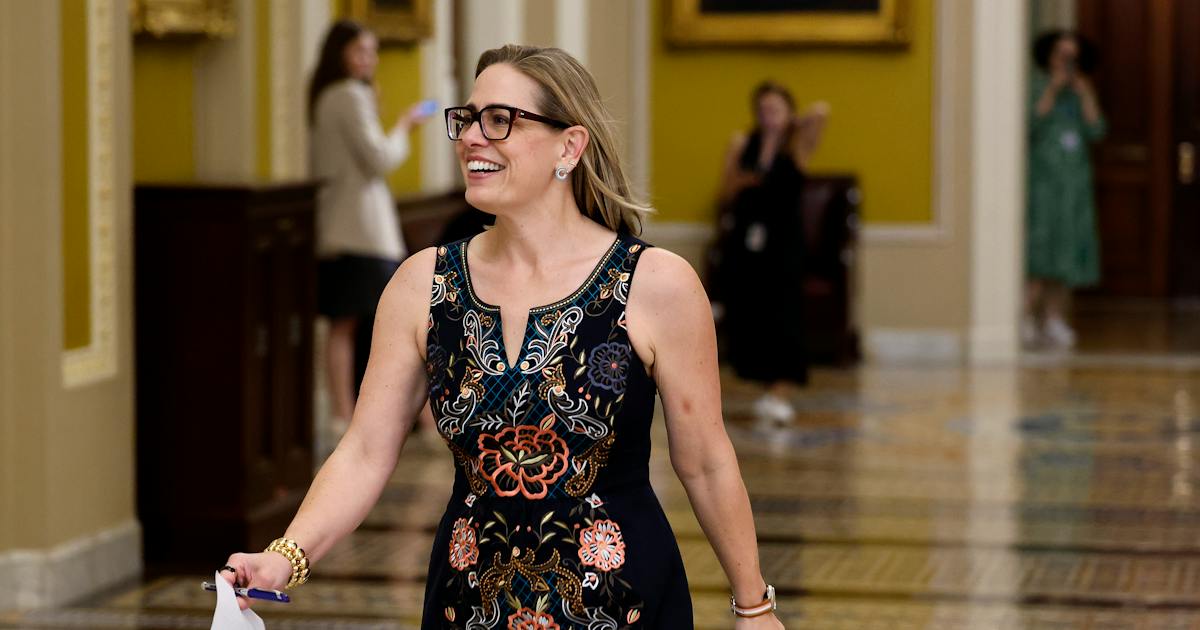
Former Arizona Senator Kyrsten Sinema is back on Capitol Hill urging her former colleagues to support a dangerous permitting reform bill, The Washington Sun reported Thursday.The Bipartisan American Affordability and Jobs Act, or BAAJA, would fast-track approvals for the construction of energy, mining, and infrastructure projects by severely limiting environmental challenges, radically altering transmission approvals, and even allowing the fossil fuel companies to sue the government if they can show they were discriminated against based on fuel type. The bill has been fiercely opposed by environmental groups and tribal organizations.Sinema is not a registered lobbyist, but she co-chairs the Artificial Intelligence Infrastructure Coalition, a group of tech companies advocating on behalf of energy-hungry data centers. A spokesperson for the group told the Sun that Sinema was “not doing any work on behalf of us.”A spokesperson for Sinema told the Sun that Sinema had stepped in at the request of her former colleagues.“She is not helping on behalf of any person, and has no client or compensation here. She cares about her friends and is happy to help,” the spokesperson said.Dylan Hedtler-Gaudette, the Project on Government Oversight’s director of government affairs, raised concerns about Sinema’s involvement.“Maybe she’s just passionate about permitting reform, but I would suspect that’s not what’s happening,” Hedtler-Gaudette told the Sun. “She probably has a vested interest in this bill for a client or someone else.”Before this, Sinema was most known for her “independent” heel turn, voting against workers’ rights and health care advances after campaigning as a next-generation progressive. More recently, she was sued under a North Carolina law for “home-wrecking” her bodyguard’s marriage.Attorney General Todd Blanche’s wife Kristine Blanche was appointed in April to an advisory board for the National Center for Complementary and Integrative Health and tasked with supporting research on alternative medicines. But as it turns out, she was profiting from unproven supplements and treatments all along.A Guardian investigation published Thursday revealed that Blanche has been selling herbal compounds on a page of her website titled “Dr Blanche’s Dispensary.” Some of Blanche’s tinctures claim to help people recover from Epstein-Barr virus, more commonly known as mono, though she misspelled the name of the disease as “Epstien.” There are no Food and Drug Administration–approved medications that treat the disease.Other listings on the page claim to treat human papillomavirus, or HPV, though those run about $63 a bottle through Blanche’s website. Another one of Blanche’s offerings purports to “boost” men’s testosterone for a measly $595 a pop.As a member of the health board, Blanche oversees a $170 million annual budget.Blanche told The Guardian that she has “a PhD and an MD degree,” and said she complies “with all mandatory FDA guidelines. Any publication to the contrary is false and defamatory.” She made note of her medical degree from a university in the British Caribbean territory of Montserrat and her previous work experience as a physician’s assistant, but added that she had never actually been a licensed physician in the U.S.Yet those qualifications simply are not enough to be eligible for one of the government’s top public health positions, according to public health researchers.“It absolutely concerns me,” Peter Lurie, the executive director of the Center for Science in the Public Interest, told The Guardian, reacting to Blanche’s appointment. “I have no confidence that the attorney general’s wife, with a financial interest in the kind of products this advisory committee concerns itself with, would be appropriate on the committee.”Notably, the products to treat Epstein-Barr and HPV vanished from Blanche’s website the day after The Guardian sent her questions about them. Instead, the store now carries a disclaimer that “these statements have not been evaluated by the Food and Drug Administration. These products are not intended to diagnose, treat, cure, or prevent any disease.”After years of trying to destroy New York City’s congestion pricing system, the Trump administration is now offering grants to take similar policies nationwide.The Federal Highway Administration announced Thursday that it would invest $100 million to target and eliminate congestion, including funds to implement “HOV toll lanes, as well as congestion, cordon and parking pricing programs,” Gothamist reported.Just hours after the announcement was made, that specific language was removed from the official online press release, according to Streetsblog NYC. Similar language describing congestion pricing can still be found in the description of the federal Congestion Relief Program.Trump first announced that he would challenge New York City’s new congestion pricing program in February 2025 by declaring himself king. In March, a federal judge ruled that the Trump administration did not have the authority to revoke the city’s pricing policy. The Department of Transportation appealed that decision in June, arguing that it was the judge who had overstepped the bounds of their authority, and that the FHWA officials could revoke policies whenever it pleased them. The appeals court has yet to rule on the matter.In August 2026, Trump again mocked congestion pricing, claiming that the program was being run by “Radical Left Jihadists,” referring to New York City Mayor Zohran Mamdani, who was elected after the policy was already in place.In a statement to Gothamist, DOT spokesperson Danna Almeida denied that the grants would possibly fund congestion pricing programs like the one in Manhattan.“As the statute is written, the grant program is nothing like New York City’s illegal cordon pricing program, nor does it impact the ongoing litigation,” Almeida said. “The Secretary has been clear, dollars collected from tolling should be reinvested back into roads and drivers should have access to free alternative routes.”Since the city first began charging drivers $9 during peak periods to drive south of 60th Street in Manhattan, New York’s Metropolitan Transportation Authority reports that traffic is down 15 percent.Thought that President Donald Trump’s so-called “Anti-Weaponization” slush fund was dead? Not quite.Trump administration officials intervened to secure a $2.5 million payout for five plaintiffs in a class-action lawsuit against the IRS, with each plaintiff getting half a million, ProPublica reported Thursday.The Department of Justice initially sought to dismiss the case, but in August it intervened before the final fact-finding period with a proposal that would pay 250 times the legal limit of $1,000 for such cases.The five plaintiffs included Shelby Lowman, a golf pro at Trump National Golf Club Hudson Valley, as well as Safe Harbor, a company connected to the president’s media business without a website or public presence. These plaintiffs alleged that the IRS and government contractor Booz Allen Hamilton had failed to securely safeguard their financial information—the same charges that Trump had levied against the IRS in his own $10 million lawsuit.That lawsuit had resulted in the creation of the president’s $1.776 billion slush fund, paving the way for government payouts to anyone the administration saw fit. The fund was supposed to have been killed by court order months ago.After these latest settlements, two more people connected to Trump businesses came forward to continue the litigation. Critics are concerned that even more plaintiffs could join in a backdoor attempt for Trump allies to receive massive payouts from the government. The president’s latest nominees aren’t even willing to describe what happened on January 6, 2021.Michael LoSapio, who currently heads security for the software company Palantir, has been tapped to run the Cybersecurity and Infrastructure Security Agency. He shocked lawmakers during his confirmation hearing on Capitol Hill Thursday when he refused to answer a straightfoward question about the MAGA-stoked insurrection.“Was there an attack on the Capitol on January 6, 2021?” asked Connecticut Democratic Senator Richard Blumenthal.“I—I don’t know,” LoSapio said.“You don’t know?” Blumenthal repeated, apparently stunned by LoSapio’s response. “I don’t know how you would classify—” LoSapio stuttered, when Blumenthal interjected to press him.“Really?” the senator asked.But by that point, LoSapio had decided to double down.“No, I don’t believe it was an attack, no,” he said.There was a long silence, and then Blumenthal—who was one of the many lawmakers in the Senate chamber when Donald Trump’s sycophantic followers attempted to break in that day—asked: “You’re giving us that answer?”“I wasn’t involved in politics,” LoSapio deflected.“You weren’t involved in politics? Were you alive on the planet?” asked Blumenthal.“I was,” LoSapio said.“Let me ask you again. I’ll give you another chance. January 6, 2021, was the Capitol attack—” Blumenthal said, to which LoSapio simply responded: “No, sir.”Then Blumenthal decided to ask the man seated beside LoSapio: Trump’s nominee for director of the Office of Government Ethics, Michael Chamberlain.“Mr. Chamberlain, January 6, was the Capitol attacked?” asked Blumenthal.“There were certainly some people who engaged in behavior they shouldn’t have,” Chamberlain said.“How do you expect to be the chief arbiter and adjudicator of ethics in the U.S. government when you cannot answer a simple, factual question? Do you really want this job?” asked the senator.But Chamberlain could barely muster a response about fairness and impartiality, ignoring the enormous political leverage that his and LoSapio’s revisionary answers had afforded the president.BLUMENTHAL: Was there an attack on the Capitol on January 6? LoSAPIO: I don't know BLUMENTHAL: You don't know? LoSAPIO: No, I don't believe there was an attack. No. BLUMENTHAL: Mr. Chamberlain, January 6, was the Capitol attacked? CHAMBERLAIN: There were certainly some people who engaged in behavior they shouldn't have BLUMENTHAL: How do you expect to be the chief arbitrator and adjudicator of ethics in the US government when you cannot answer a simple factual question? Do you really want this job?— Aaron Rupar (@atrupar) November 19, 2026 It has been nearly six years since Trump supporters rioted on the U.S. Capitol in an attempt to block the certification of what Trump claimed was a “stolen” election. In the time since, Trump has invariably tried to brush the events of the day under the rug or rewrite them entirely. Hours after his second inauguration, he granted clemency to nearly 1,600 individuals who faced criminal charges for storming the Capitol, and later tried to create a $1.776 billion slush fund to reward them for their participation.Read more about Trump’s nominees:
Why the Heck Is Kyrsten Sinema at the Senate Right Now?
Full Article
Original Source
Read the full article at Newrepublic →KhanList aggregates and links to publicly available news content. We do not host full articles from third-party sources. Always verify important information with original sources.