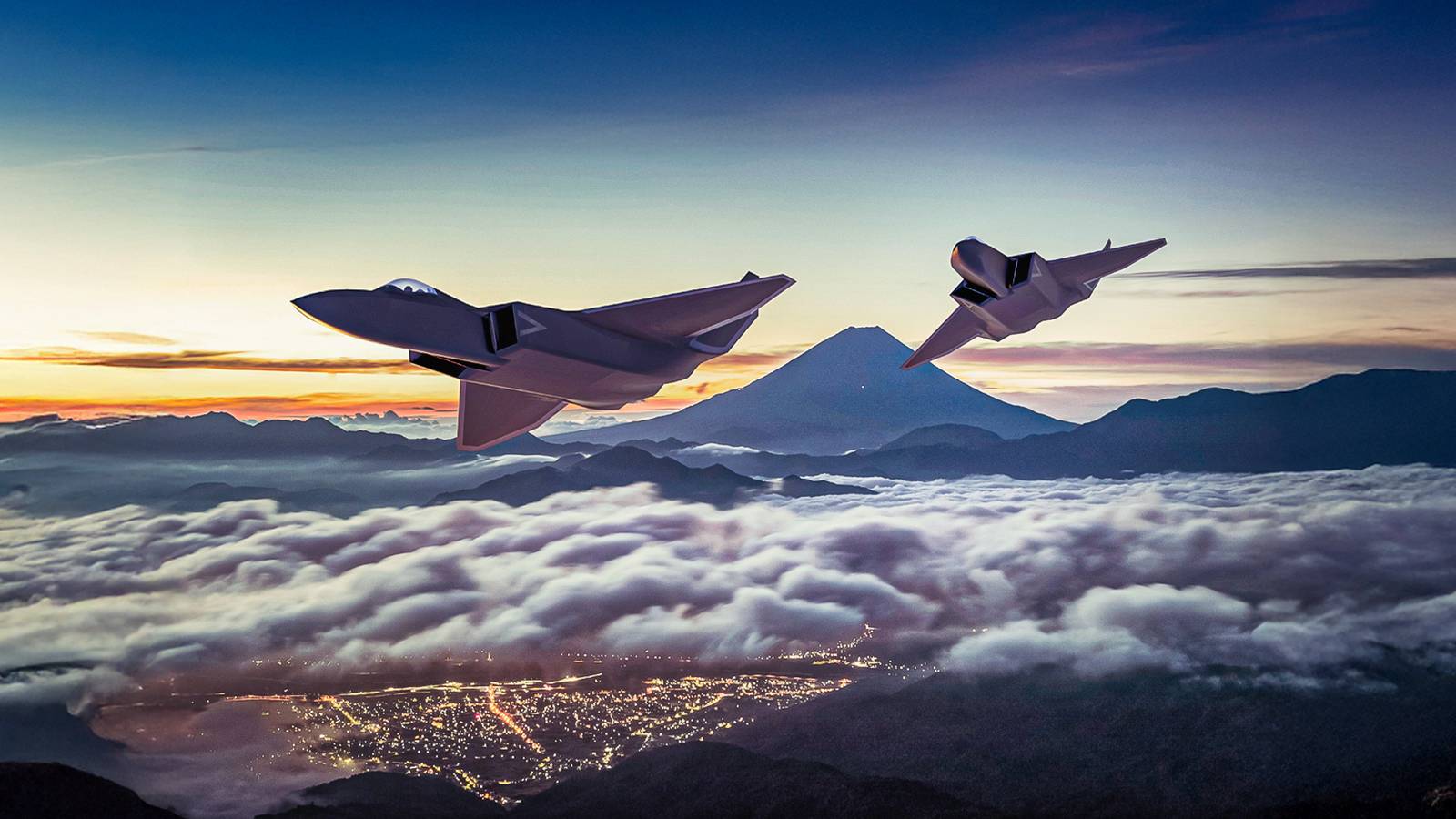
Published Jul 24, 2026, 7:00 PM EDT Luke Diaz is a freelance military writer with experience with active duty experience in the US Navy as well as defense and industrial engineering. He is a former Naval Flight Officer who performed tactical air control on the carrier-based E-2 Hawkeye. The Japanese Self-Defense Forces are one of the founding partners under the trilateral Global Combat Air Program. Managed collectively through the EdgeWing Consortium, Japan has partnered with the United Kingdom and Italy to build a sixth-generation stealth fighter jet based on the template of the BAE Systems 'Tempest.' This aircraft will be the first fighter jet airframe in the nation's history developed independently of any of the aerospace manufacturers of the United States. This stands in stark contrast to the high investment that Japan has made in the Lockheed Martin F-35 Lightning II fifth-generation fighter jet. Japan is the second-largest operator aside from the United States, with its program of records stated to stand at 147 airframes split between the F-35A and the F-35B. While these aircraft are vital for the land-based squadrons of the JASDF and carrier-based JMSDF units, they are merely assembled at a factory in Nagoya, with primary production authority resting in the US. GCAP will allow the Japanese MOD to hold sovereign control over the incredibly complex software that makes next-gen fighter jets exponentially lethal compared to their legacy predecessors. Although the US is still the closest ally of Japan and provides a vital supply chain of defense material, the technology bottlenecks that have afflicted the F-35 fleet have persistently endured since its debut. The Tempest would give Japan independent authority over every detail of its planes and allow it to independently resolve issues like those affecting the F-35 Joint Strike Fighter. Why Japanese Fighter Jets Are Made In The US Credit: Department of Defense Since the end of WWII, when the Japanese Constitution was rewritten to include a non-aggression clause that limited its military power, many of the most sophisticated systems, such as aircraft, have come from US suppliers. Over the years, the Japanese defense industrial base has increased its portfolio of domestic platforms or licensed unique versions of American airplanes. A good example is the Mitsubishi F-2, which is a much larger, longer-range jet optimized for maritime use based on the General Dynamics F-16 Fighting Falcon. The F-35 JSF program is the most significant advancement of collaboration between aerospace makers in Japan and the US. Mitsubishi Heavy Industries and other industrial giants operate a final assembly and check-out plant in Nagoya through a partnership with Lockheed Martin. It is one of only three facilities of its kind in the world, including the bomber plant in Fort Worth, Texas. Italy operates the only other international location at Cameri Air Base. The issue with this arrangement is that Lockheed and the Department of Defense maintain final authority over software changes and 'hold the keys' to the supply chain of many of the most sensitive classified components. This has led to widespread doubt over the reliability of support and sustainment for the F-35 fleet, made more acute under the administration of Donald Trump, with rumors that a kind of 'kill switch' exists which could digitally cripple any F-35 in the world. The Problem With America's Joint Strike Fighter Credit: Department of Defense Putting aside speculation and rumors stoked by political discourse, there was a very real problem with the JSF. The aircraft has suffered deficiencies since it debuted in 2006. After the release of Technology Refresh Three Block Four last year, the Department of Operational Testing and Evaluation gave a severely negative report regarding the fleet's combat capability. The Pentagon assessed that the latest upgrades from Lockheed delivered zero new combat capability and actually dropped global fleet readiness to as low as 25% at times. In response, they have drastically slashed the number of upgrades expected in the package, which was intended to deliver a long list of new capabilities, including electronic warfare, weapon system capability, and engine management. The short list is hoped to be brought online in the next year or two, but many more will not be available until 2029. The full scope of the 66 items included in TR-3 is now expected to be delivered in 2031 when Pratt & Whitney can resolve the issues with the F135 engine upgrade. The US Air Force has even reduced its deliveries this year of F-35 aircraft by 50% due to the severe capability crisis. The Navy has allocated an additional $1 billion to remedy systems issues for its fleet of F-35B jump jets that serve the US Marines and F-35C carrier-capable planes in service with the USN and USMC's 'tail hook' squadrons embarked on super carriers. Meanwhile, foreign military sales customers, like Japan, have watched their bill climb higher and higher while the schedule for deliveries runs later and later. Expanding Defense Industrial Sharing For Joint Security Credit: BAE Systems Entry into the GCAP Consortium has offered a new path forward to modernize the fighter jet fleet of the JASDF. In fact, progress has been hastened in the face of rapid advances by the People's Republic of China, which flew not one but two prototype sixth-generation aircraft in 2024. As an equal-share venture through EdgeWing, GCAP gives Japan full co-ownership of all the intellectual property produced through collective research and development. This will not only yield an advanced airplane but also significantly improve domestic defense capacity in the long term. The GCAP will be an open system for Japan so that it can operate the plane in any manner of its choosing with full autonomy, unlike the F-35, which is a closed system that has so-called 'black boxes.' These modules are locked out due to the classification of their technology, which is restricted under FMS terms dictated by the Pentagon. The freedom and independence that the Tempest offers will be fundamental in developing the 'system of systems' that supports a true next-gen air superiority fighter. The GCAP will go far beyond what the F-35 is capable of in terms of performance, payload, weapons capability, data networking, and autonomy. The aircraft will have a massive combat radius and arsenal to patrol the vast expanse of the Pacific Ocean. Looking beyond the superior combat capability of the plane itself, Tempest will be fully integrated into the 'combat cloud' to control advanced 'loyal wingman' drones and interoperate with virtually any data link-capable unit in the joint 'kill web' between coalition allies. The SDF Upgrades To 21st-century Command And Control Credit: BAE Systems The SDF has only recently begun to implement deeper integration between its own branches of air, sea, and land forces with the Permanent Japan Joint Operations Command in 2025. The GCAP will serve as a major catalyst to strengthen strategic and tactical interoperability, but greatly extend it to international collaboration. When it arrives in the 2030s, a JASDF GCAP fighter will organically process data and act as a target-routing node. It feeds real-time targeting telemetry directly to a JMSDF Aegis destroyer's vertical launch systems or a JGSDF mobile anti-ship missile battery. In 2022, the joint leaders of the GCAP Consortium issued a statement expressing the importance of the initiative. "As leaders of Japan, Italy, and the UK, we are committed to upholding the rules-based, free and open international order, which is more important than ever at a time when these principles are contested, and threats and aggression are increasing... "Our three nations have longstanding, close relationships based on the shared values of freedom, democracy, human rights, and the rule of law... We are taking the next step in our deepening trilateral partnership... an ambitious endeavor to develop a next-generation fighter aircraft by 2035. Through the GCAP, we will build on our longstanding defense relationships. The GCAP will accelerate our advanced military capability and technological advantage. It will deepen our defense cooperation, science and technology collaboration, integrated supply chains, and further strengthen our defense industrial base." Considering that two of the three founding members of GCAP are founding members of the North Atlantic Treaty Organization, international cooperation is also a critical requirement. One of the important goals of the GCAP system is also to have full interoperability with allied forces and systems to integrate all of the data into a single shared 'picture' of the battlespace for all allies. This makes every platform more lethal and survivable thanks to information dominance over the enemy, which empowers air superiority. Investing In Alliance: Pivot To The Pacific Credit: BAE Systems GCAP will allow Tokyo to build an independent defense-industrial hedge against US overreliance while simultaneously creating a critical plug-and-play capability to support the American forces and other regional partners like the Republic of Korea and Australia. Aside from Japan's fleet, the F-35 is a prolific fighter jet in the Pacific, serving with the US Air Force, Navy, Marines, as well as the ROKAF, RAAF, Singapore, and even Royal Navy carrier groups from the United Kingdom. The Tempest will be a 'quarterback' on the battlefield that supports all of these jets. The US issued this statement in 2022, complementing the sentiments expressed by the joint leaders of the GCAP Consortium: "The United States supports Japan’s security and defense cooperation with likeminded allies and partners... The United States and Japan are bolstering our defense cooperation in a number of promising areas, particularly in advancing opportunities for joint research, development, testing, and evaluation.... Such efforts between the United States and Japan greatly strengthen the U.S.-Japan alliance and build on our cooperation with likeminded partners, further enabling joint responses to future threats in the Indo-Pacific region and beyond." The Tempest's advanced stealth, performance, and ability to command drone swarms can be utilized to scout vast ocean areas, identify hostile naval vessels, and provide early warning protection for JMSDF surface groups. Leveraging multispectral stealth and advanced electronic warfare, it will be able to penetrate the best integrated air defense systems of any near-peer adversary. GCAP's full integration into the new combat cloud will allow it to not only feed data to every connected platform regardless of nation or service branch but also interchangeably hand off control of advanced drones in development by international allies, known as collaborative combat aircraft.
Why The GCAP Fighter Gives This Country Something The F-35 Never Could
Full Article
Original Source
Read the full article at Simpleflying →KhanList aggregates and links to publicly available news content. We do not host full articles from third-party sources. Always verify important information with original sources.