
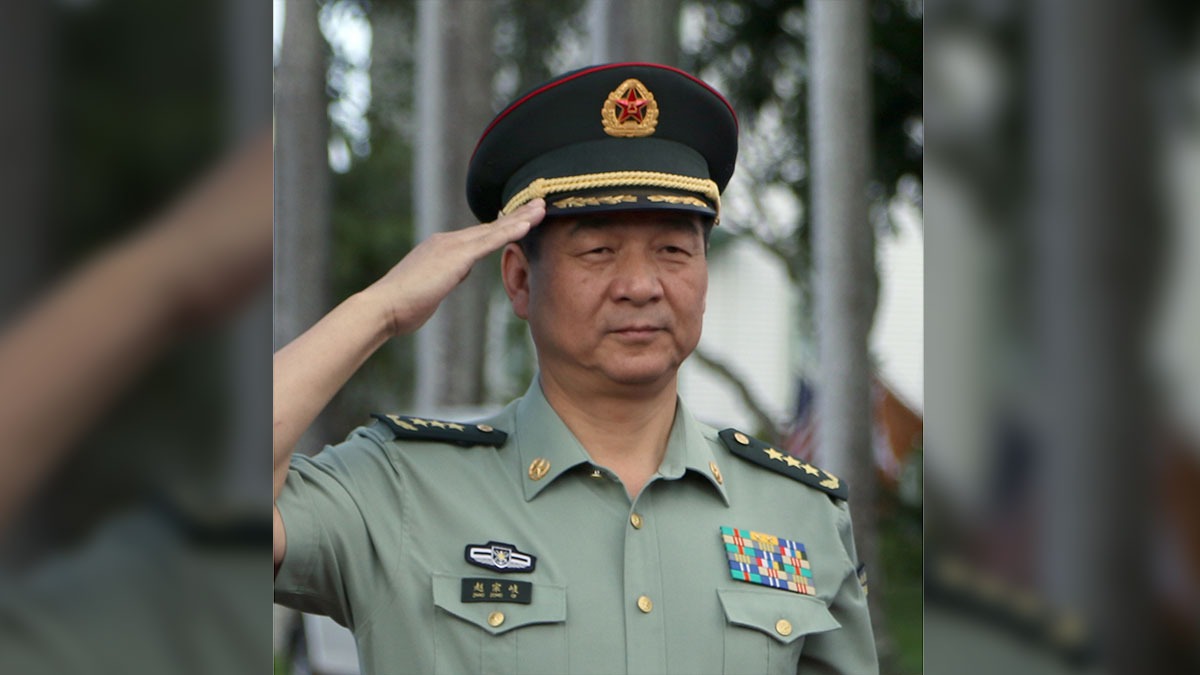
Gen Zhao Zongqi built his career as one of the most important Chinese commanders in recent Sino-Indian military historyChina’s military purge has reached back into the command structure that shaped some of its most consequential confrontations with India. On August 28, General Zhao Zongqi, one of the most important Chinese commanders in recent Sino-Indian military history, was removed from the Chinese People’s Political Consultative Conference (CPPCC) and two other senior positions.Zhao’s removal from the CPPCC, one of China’s key political institutions, matters because it goes beyond the end of his military career. Zhao is not just a military general. He was the first commander of China’s newly created western theatre command, the military formation responsible for the country’s western borders, including the frontier with India.Under his command, the People’s Liberation Army (PLA) confronted India during the 2017 Doklam standoff. He was part of the military leadership overseeing the period that culminated in the deadly 2020 Galwan Valley clash in eastern Ladakh.The western theatre, however, is only one piece of a much larger military shake-up. Since 2022, more than 100 senior PLA officers across different branches have reportedly been removed, investigated or disappeared. The crackdown has now reached the highest levels of the military establishment Zhao’s removal therefore raises an uncomfortable question for Beijing: how far back does the current purge of China’s military establishment really go?According to China watchers, Zhao was the commander who shaped China’s India strategy. His career mirrors the rise of a generation of PLA officers shaped by combat, foreign deployments and years of service along China’s western frontier. Born in Heilongjiang province in 1955, Zhao joined the PLA at just 16. He fought during the 1979 Sino-Vietnamese War, seeing action around Lao Cai, Cam Duong and Sa Pa. His subsequent career took him far beyond the battlefield. He received Arabic-language training, served in a diplomatic posting in Tanzania and held a series of command positions in the Tibet Military Region and the PLA’s 13th and 14th Group Armies.In 2016, his career reached its defining point when he became the inaugural commander of the western theatre command. The appointment was strategically important. The new command placed under one military structure the forces responsible for China’s western borders, making Zhao one of the key Chinese commanders watched closely by India.The Doklam standoff brought that command into the spotlight. Indian and Chinese troops faced each other for more than two months after Indian forces moved to stop Chinese road construction in the disputed Doklam area near the India-Bhutan-China trijunction. Then came 2020, producing the June 2020 clash in the Galwan Valley, where soldiers from both sides were killed.That Zhao has now been removed years after leaving active command is what makes the development particularly significant. Military analysts maintained that it suggests that China’s current investigations may not be limited to officers serving at the height of the purge. They may be reaching backwards into the institutional history of the PLA itself, including the western theatre’s leadership, which is under a cloud.While analysing further, military observers found that Zhao’s removal also fits into a broader pattern. His successor’s successor, General Wang Haijiang, who assumed command of the western theatre in 2021, has been missing since 2025 and is widely believed to be under investigation, although Beijing has not officially confirmed this.Wang was notable for being the last actively serving PLA general known to have fought in the Sino-Vietnamese War. His disappearance, followed by Zhao’s removal, highlights the extent to which a generation of combat-experienced commanders has been swept from China’s senior military ranks. The reported disappearances extend further down the western theatre’s leadership chain. Wang’s political commissar, Li Fengbiao, along with subordinate commanders Liu Lin and Wang Kai of the Xinjiang and Tibet Military Districts, and political commissar Yang Cheng, have all been linked to the wider wave of disappearances since 2025.If these developments are viewed together, the picture is striking: the command structure responsible for China’s military posture towards India has seen extraordinary disruption across both its past and present leadership, according to a key China watcher.While looking at the purge that has reached the top, the developments are not confined to the western theatre. Since 2022, more than 100 senior PLA officers across different branches have reportedly been swept aside or disappeared. The most dramatic developments came with the removal of Central Military Commission (CMC) vice-chairman Zhang Youxia and CMC member and Joint Staff Department chief Liu Zhenli following investigations into suspected serious violations of discipline and law.The consequences are enormous. The CMC is the apex body overseeing China’s armed forces, and the removal of two of its senior members demonstrates how deeply Chinese president Xi Jinping’s military crackdown has penetrated the PLA hierarchy.For India, Zhao’s removal carries an additional layer of significance. “If a commander associated with the Doklam and Galwan eras is now judged compromised, questions inevitably arise about the reliability of the institutional record surrounding China’s handling of those confrontations,” said a China watcher, adding that it also raises concerns about continuity.The western theatre command has already seen successive senior commanders disappear or come under scrutiny. If commanders from different stages of its history are removed, the PLA’s western command is losing not only personnel but potentially institutional memory.Yet the purge does not automatically rewrite history. There is an important caveat. Removal from a political advisory body or senior position is not itself proof of criminal guilt. China’s opaque military personnel system makes it difficult to establish the precise allegations against individual officers unless Beijing formally announces them. Past cases have also shown that disappearance does not necessarily mean permanent disgrace. Former Central Theatre Commander Wang Qiang, for instance, disappeared amidst speculation that he was under investigation, before reappearing and being reassigned.That caution matters. But Zhao’s fall remains significant because of who he is and what he represented. He commanded the PLA’s western theatre at a crucial moment in China’s military relationship with India. His career was built around the very frontier that has become one of the most sensitive fault lines in Asian geopolitics.The message from Beijing is therefore larger than the fate of one general. It suggests that China’s military reckoning is still expanding—and that even the commanders who once stood at the centre of the PLA’s most important border confrontations are not beyond its reach.Subscribe to India Today Magazine- EndsPublished By: Shyam BalasubramanianPublished On: Aug 31, 2026 19:54 IST
Why the fall of Chinese general linked to Doklam, Galwan is so consequential
Full Article
Original Source
Read the full article at Indiatoday →KhanList aggregates and links to publicly available news content. We do not host full articles from third-party sources. Always verify important information with original sources.