
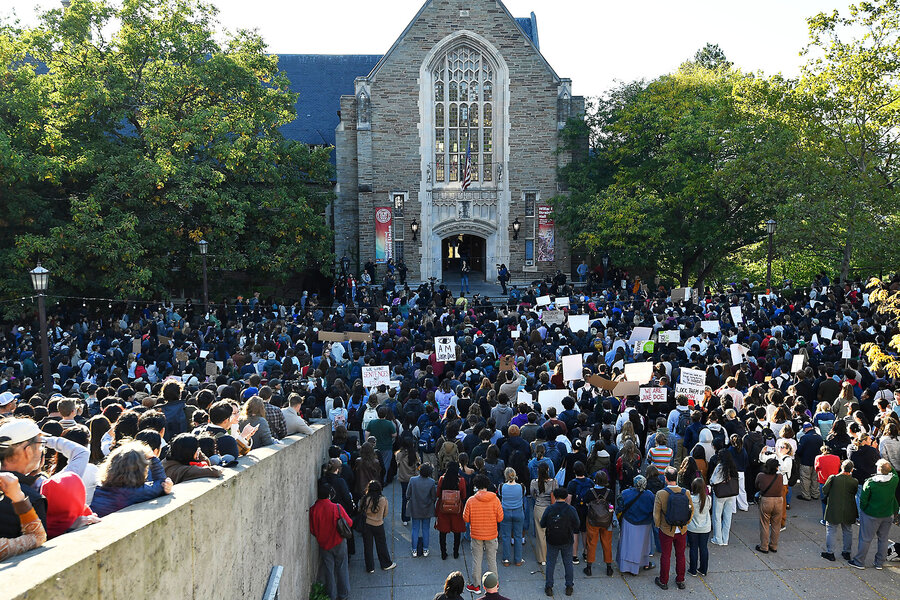
On Sept. 16, a former Cornell University student filed a civil lawsuit alleging that she was gang-raped at a fraternity house in 2024. Within days, her complaint – which names fraternity members and others, and blames Cornell and its police department for failure to act on her original report – became a focus of intense public attention.The story’s details are one reason: The woman says she was “incapacitated” by alcohol and drugs during a sexual encounter that escalated to involve multiple men.But there’s another reason, experts say, for the firestorm. A broad set of issues is woven into the Cornell rape story. These include ongoing debates over the trustworthiness of police and institutions. Perhaps equally prominent is fallout from the #MeToo movement spotlighting sexual harassment and assault of women, and the apparent lack of accountability for well-connected men accused of sexual crimes in the Jeffrey Epstein case. Erik Nisbet, a communications professor at Northwestern University, says the Cornell case has hit a cultural nerve that was already “exposed and vulnerable” in the wake of the controversy involving Mr. Epstein, who was convicted of soliciting a minor for prostitution and who died in prison of what was determined to be suicide. His case is believed to be connected to many high-profile people, and some believe evidence such as a “client list” has been suppressed.“I think most importantly, from the public’s perspective and linking back to Epstein and #MeToo as well, is the idea of the institution failing that victim,” Professor Nisbet says. Lauren Petracca/ReutersA student wears a Jane Doe name tag during a Justice for Survivors rally at Cornell University in Ithaca, New York, Oct. 5, 2026. The Cornell case is perfectly calibrated for platform amplification on social media. It’s a narrative that’s emotionally charged, provokes outrage, and drives engagement, he says.“You know, what type of content goes viral? Highly emotional content, that social media algorithms tend to reward within the attention economy.” That attention, says Omar Wasow, assistant professor of political science at the University of California, Berkeley, is boosted by the nature of the case: “There is a clear good guy and a bad guy. The fact that this is seven against one gives this story a certain quality: There is a bully and a victim.”But people might get information from outlets that reinforce their opinions about an event, meaning that in this case, they will have different definitions about who the “good guy” and “bad guy” are. The United States’ political divisions are at play, as well, says Abigail Saguy, a professor of sociology at the University of California, Los Angeles.Sexual assault cases on college campuses tend to reinvigorate debates that have been around for decades, Professor Saguy says, such as the presence of rape culture in fraternity houses, or whether Title IX standards go too far in accusing and punishing young men.In the Cornell case, students protested this week, calling for school President Michael Kotlikoff to resign for what they say is his mishandling of the case. Two students were expelled, and two received lengthy suspensions. Others were asked to write “reflection papers” about their actions (one, who says he was briefly in the room but did nothing wrong, is now suing Cornell). Former U.S. Deputy Attorney General Sally Yates is reviewing Cornell’s actions. No criminal charges were filed by the local district attorney, although New York Attorney General Letitia James is leading a new criminal investigation. Yuki Iwamura/APNew York Gov. Kathy Hochul speaks during a news conference with New York Attorney General Letitia James, Oct. 2, 2026, in New York. Meanwhile, conservative writers have questioned the motives of Jane Doe, noting that her description of events seemed to change from the original report, and challenging the strength of the evidence. Jane Doe’s attorney has told reporters that his client has received death threats.People are identifying with different actors in this drama, Professor Saguy says. Many young women see this case as a confirmation of conversations about rape culture entrenched in campus life, especially in fraternities. About 1 in 5 women say they have experienced sexual assault while in college, according to the National Sexual Violence Resource Center, and a growing body of academic research examines how people process trauma and why they might change their stories or delay reporting assaults.Others see this case as an example of the political left’s failure to distinguish between immoral and illegal acts, and its confusing of consent in the moment with regret after the fact. They also say it points to issues with Title IX enforcement. Title IX is a federal civil rights law that prohibits sexual harassment, assault, rape, and stalking, and it requires schools that receive federal funding to investigate all allegations of sexual misconduct and respond.Rachel Vogelstein, a Columbia University professor and director of the Ann F. Kaplan Women’s Initiative, says that the Cornell case shows how the #MeToo movement is evolving. It emerged as a precursor to the criminal prosecution of Hollywood producer Harvey Weinstein and raised awareness about widespread sexual assault and sexual violence. Now, women are posting on social media “I am Jane Doe” in solidarity with the alleged victim.“Women are saying, ‘You can’t isolate this woman,’ right? ‘You can’t make her bear the cost of coming forward alone,’” Professor Vogelstein says. “And so that’s a shift from the kind of individual testimony we saw in the #MeToo era, to kind of collective protection and solidarity.”Aldon Morris, professor emeritus of sociology at Northwestern University, says even Americans who don’t take part in protests have some broad understanding of the issues underlying the Cornell case. He credits the work by activists in previous movements like #MeToo, which, he says, created “the context for the issues that make this case unignorable.” Deepen your worldviewwith Monitor Highlights.Politics with respectGet political stories with respectful analysis.There‘s a world of new ideas in everyBooks newsletter.There‘s more to life, enrich yours withCulture & Learning weekly.Follow humanity‘s discoveries withScience & Nature stories in your inbox.Gain a spiritual perspectivefrom the stories in your inbox.Want to understand the deeper impact of critical events? Learn the Monitor‘s insight.Already a subscriber? Log in to hide ads. He says he remains hopeful that student activism will keep up the pressure to ensure that society gets better at dealing with sexual assault. Watching student protesters at Cornell, he notes that they were both men and women, whom he describes as “children” of #MeToo and other movements.“They know the context for these issues,” he says. ALREADY A SUBSCRIBER? LoginReal news can be honest, hopeful, credible, constructive.The Christian Science Monitor was founded in 1908 to lift the standard of journalism and uplift humanity. We aim to “speak the truth in love.” Our goal is not to tell you what to think, but to give you the essential knowledge and understanding to come to your own intelligent conclusions. Join us in this mission by subscribing.
Why the Cornell case ignited a cultural firestorm
Full Article
Original Source
Read the full article at Csmonitor →KhanList aggregates and links to publicly available news content. We do not host full articles from third-party sources. Always verify important information with original sources.