
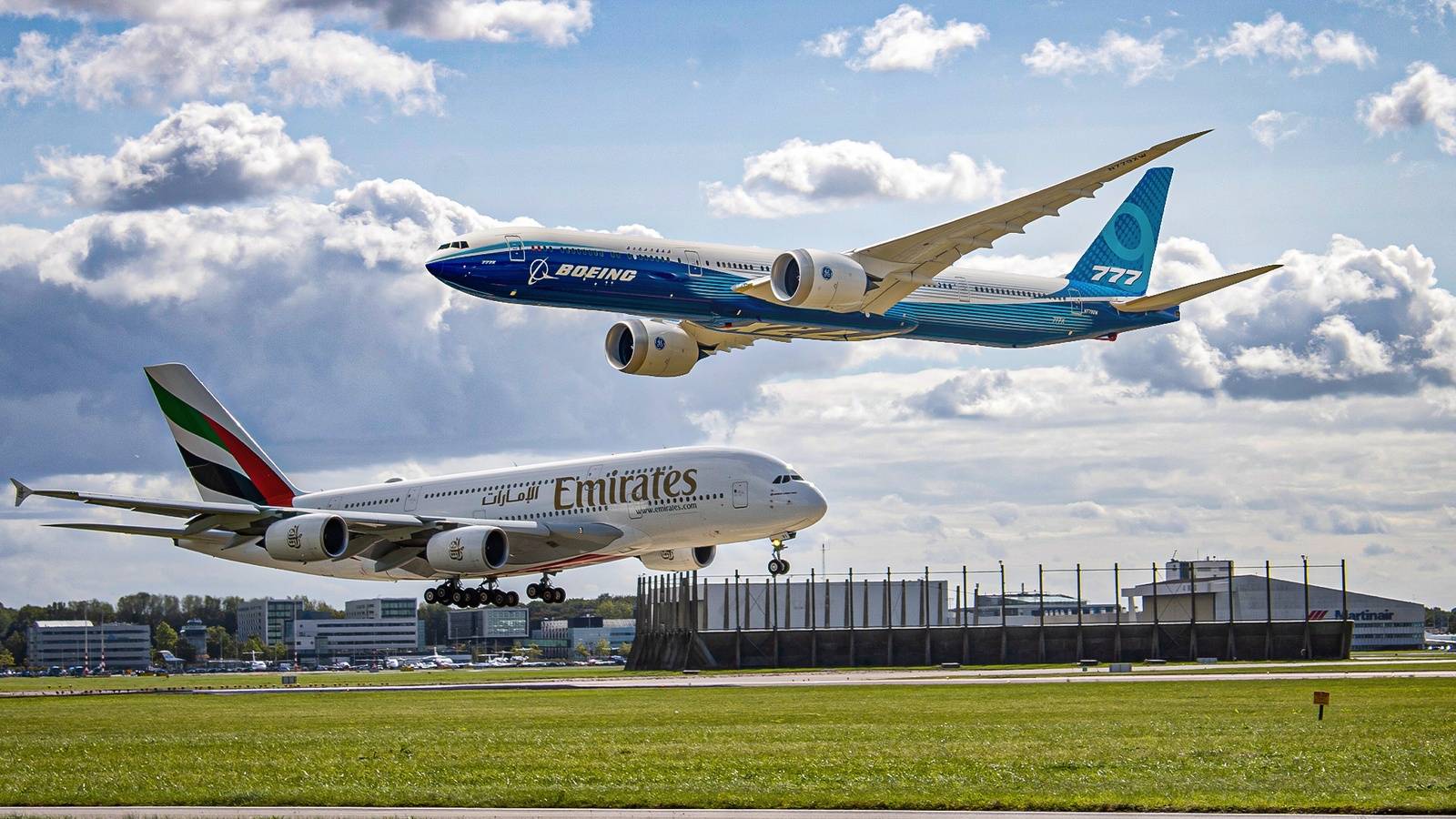
Published Nov 7, 2026, 4:00 PM EST Ethan is an aviation professional with a degree in Aviation Management with Flight from the Florida Institute of Technology. He previously wrote aviation and tourism features for Florida Tech’s student newspaper, The Crimson, where he developed a clear, reader‑focused reporting style. Aviation journalism has remained a consistent priority throughout his career. He currently holds a Restricted ATP and Commercial Multi‑Engine Pilot certificate and works in aviation supply chain and aircraft component repair. Alongside his industry role, he is pursuing his Certified Flight Instructor rating and actively building flight experience. A lifelong aviation enthusiast, Ethan spent countless hours at Raleigh–Durham International Airport’s observation deck studying air traffic and practicing amateur photography and videography. Having been manufactured from 2003 until 2021, the Airbus A380 currently does not have a direct replacement available on the open market. The program itself was designed as a competitive option to a similar, superjumbo aircraft, the Boeing 747. The A380 has the distinction of being the highest capacity commercial jet ever produced, with its most dense example operated by Emirates, at 615 seats. Due to a shift in a broader market trend of lower capacity, with less dense aircraft being prioritized by airlines, the A380 and 747 are left without a direct replacement. The closest possible successors to this type of jet include both the Airbus A350 and Boeing 777 families, both with high-capacity variants that approach, but do not exceed 500 seats. Some companies that opted for a purchase of the A380 during its production run made the unit a significant part of the network and fleet strategy; sourcing a direct replacement to fill the exact same niche has proven to be difficult for many. By Seating Capacity Credit: Ian Dewar Photography | Shutterstock On seat count alone, typical A380 layouts contain 500–600 seats, a window that no aircraft currently in production can comfortably touch with a multi-class layout. Airbus' official product page outlines that the A380 has a whopping maximum certified capacity of 853 seats, a figure that has not been touched by any airline in its operating history. Emirates' previous 615-seat configuration included the signature onboard experience that its customers are used to, at 32 inches (81.28 cm) of legroom. Mathematically speaking, an 843-seat A380 solicits significantly less legroom onboard. Comfort is not the goal with such a layout, but rather maximum capacity at the minimum legal threshold. Typical 777-9 layouts are around 400–430 seats, with more than one cabin onboard. Flight Global reported back in 2018 that Korean Air once configured an A380 at 407 seats, in an all-business class layout, marking the lowest density example known to have flown. However, this example was exceptional, as it was primarily geared toward select missions as a charter. Real-world seating differences by airline are of note. Regardless of an airline's configuration, whether it is a premium heavy model like France's La Compagnie, or an all economy 777 layout aboard IndiGo, the A380 simply has more square footage and a higher rated maximum capacity than the 777-9. While an airline can utilize a consistent ratio of economy seats to premium seats onboard, the total number of seats once available on an A380 route cannot be evenly transferred to the 777-9. By Fuel Efficiency Credit: Parkdolly | Shutterstock Why would an airline ever willingly choose fewer seats? Several different factors are involved, relating back to the four forces of flight: weight, lift, thrust, and drag. A smaller aircraft generally weighs less, requiring less lift to stay airborne and less thrust to maintain cruise speed. Generating that thrust requires burning fuel, while producing additional lift inevitably creates drag that must also be overcome. Engine count alone does not explain the fuel-burn gap. According to Aero Corner, the 777-9's two General Electric GE9X engines each generate roughly 110,000 pounds of thrust, making them among the most powerful commercial jet engines ever developed. By comparison, the A380's Rolls-Royce Trent 900 and Engine Alliance GP7200 engines are typically rated between 70,000 and 84,000 pounds of thrust each. Combined with advances in bypass ratio, materials, and wing design, the 777-9 can achieve similar mission capabilities while relying on only two engines rather than four. The A380's maximum takeoff weight (MTOW) is 1.27 million lb (575,000 kg), whereas the 777-9's MTOW is 775,000 lb (351,500 kg). The A380's MTOW is nearly double that of the Boeing, thus requiring nearly double the thrust to lift off and maintain flight. Further, the 777-9 offers a very high aspect-ratio composite wing, folding wingtips, improved lift-to-drag ratio, and fewer engine nacelles to provide an aerodynamic edge over the A380. With a larger wing span, at 235 feet, 5 inches (71.80 meters), it also benefits from an improved lift-to-drag ratio and lower induced drag. Capacity Combined With Efficiency: Who Wins? Credit: Wirestock Creators | Shutterstock If the objective is moving the maximum possible number of passengers through a slot-constrained airport such as London Heathrow Airport (LHR) or Tokyo Narita Airport (NRT), the A380 remains unmatched. On a high-demand route backed up by the high capacity of a full A380, the choice becomes economical for the operator. However, airlines besides the A380 giants of Emirates, Qatar Airways, or British Airways do not optimize their fleets around a handful of peak-demand routes. Instead, such companies seek aircraft that can generate profits across a dynamic variety of markets, seasons, and demand conditions. This is where the 777-9's lower fuel consumption, reduced maintenance burden, and greater operational flexibility begin to outweigh its lower seating capacity. An aircraft that burns approximately 2,000 fewer gallons (7570.82 liters) of fuel per hour than an A380 can often produce a stronger financial result even while transporting fewer passengers. This conclusion is only augmented during times of economic uncertainty and high fuel costs. Now more than ever, due to the Iran conflict, fuel efficiency is undeniably important. With an aviation marketplace that increasingly renders the A380 more and more difficult to operate profitably, where does its niche lie today? The A380 Was Built For A Different Vision Of Air Travel Credit: ILya Oslyakov | Shutterstock In practice, airlines often use the 777-9 not as a replacement for an individual A380 flight but as a replacement for the role the A380 once played within a network. That distinction is important. Network planners evaluate total market demand, connecting traffic flows, slot availability, and seasonal variation rather than focusing exclusively on aircraft size. Consider Emirates, Lufthansa, or Qatar Airways. Their largest hubs feed passengers from dozens or even hundreds of routes into long-haul banks. During peak periods, an A380's enormous capacity can be valuable. A380s are typically deployed on routes from Dubai International Airport (DXB), Frankfurt Airport (FRA), and Doha International Airport (DOH) respectively, to global hubs worldwide, like London and John F. Kennedy International Airport (JFK). The 777 family can still reliably operate such routes, just not at the same scale as the A380. A380s Are Currently Deployed in Many Corners of the Globe A 777-9 gives airlines greater flexibility. During off seasons or weaker demand cycles, those same seats on the A380 become harder to sell profitably. Routes that may support 550 passengers in July might only support 400 in February. Rather than maintaining year-round A380 service, carriers can better match capacity to demand while preserving network connectivity. How Boeing's Twin-Engine Strategy Changed The Industry Credit: Aerospace Trek | Shutterstock The results of the 777 among other twin engine widebodies are visible throughout the industry. While Airbus ended A380 production in 2021 after delivering 251 aircraft, the Boeing 777X program accumulated hundreds of orders before entering commercial service. Emirates alone ordered more than 200 aircraft from the 777X family, despite remaining the world's largest A380 operator, serving as a strong signal that A380 operators are looking at the 777X program as a makeshift replacement. Even airlines that continue to fly the superjumbo, including Lufthansa and British Airways, increasingly rely on twin-engine widebodies such as the 777, Boeing 787, and Airbus A350 families for the majority of their long-haul operations. Rather than replacing the A380 route-for-route, modern twinjets have largely replaced the network strategy the aircraft was designed around. The success of aircraft such as the 777-300ER and later the 787 demonstrated that airlines often preferred operating more frequent flights with smaller aircraft rather than concentrating hundreds of passengers onto a single departure. The 777-9 represents the latest evolution of that philosophy, combining near-A380 range and premium-cabin capability with significantly lower fuel consumption and maintenance requirements. The 777-9 Is Replacing The A380's Business Case, Not The Aircraft Itself Credit: Robin Guess | Shutterstock By default, the end of the A380's production has forced customers to look elsewhere for an ideal replacement. With no commercial quad-jets currently available for purchase from either Airbus or Boeing, the market has pivoted to the highest capacity airframes in production. Fuel efficiency has become not only an added benefit of modern airliners, but also a reason for airlines today to continue the operation and, in some cases, as with Ethiopian Airlines, upgrade its orders. The market response to each aircraft highlights the industry's shift toward efficient twin-engine widebodies. Airbus reports that it ultimately secured 251 firm orders for the A380 before ending production, while Boeing's 777-9 had accumulated 546 firm orders as of September despite not yet entering commercial service. Using each manufacturer's published list prices, those order totals equate to approximately $111.9 billion in potential A380 sales revenue and roughly $241.4 billion for the 777-9 alone. While airlines rarely pay published list prices, the disparity nevertheless illustrates how strongly carriers have favored Boeing's large twin-engine strategy over Airbus' superjumbo approach. Boeing has already beaten the A380 in total production revenue, prior to the 777-9's first delivery. This is a solid indication of the program's success that is yet to come, and the broader market trend shifting to highly efficient twinjets in lieu of superjumbos.
Why The Boeing 777-9 Is Not A Straight Replacement For Every Airbus A380
Full Article
Original Source
Read the full article at Simpleflying →KhanList aggregates and links to publicly available news content. We do not host full articles from third-party sources. Always verify important information with original sources.