
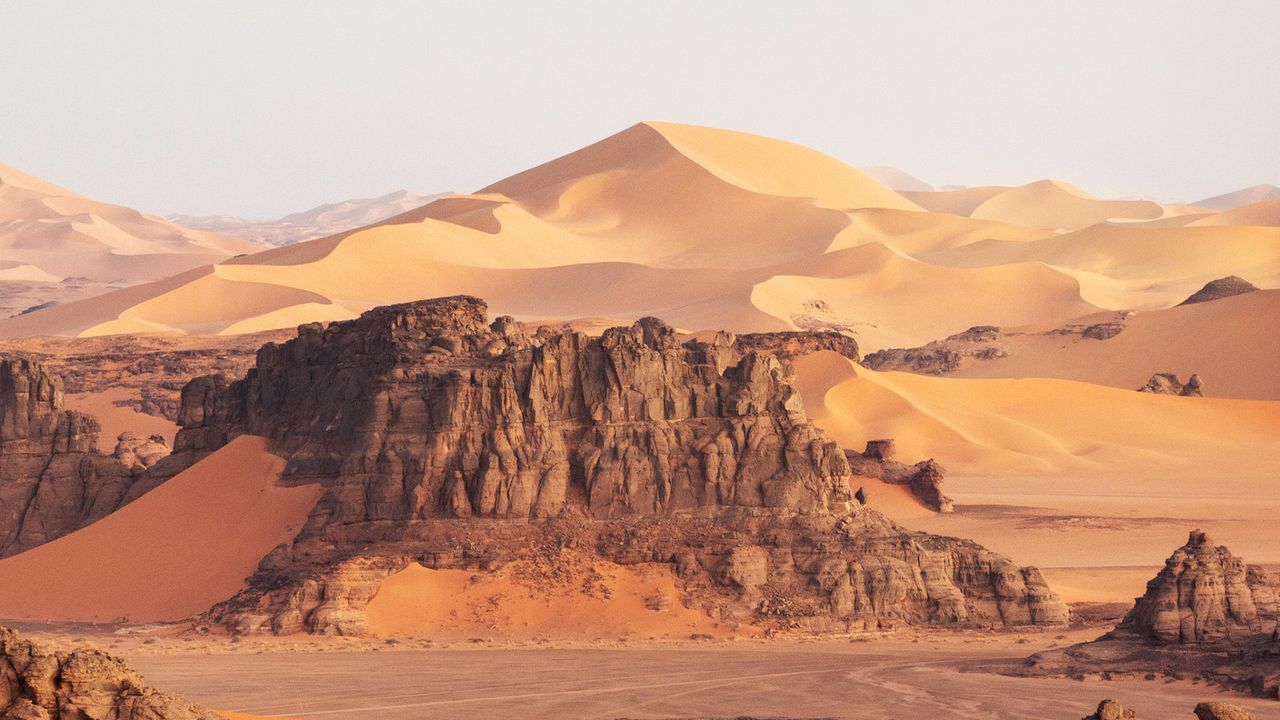
Once one of the most closed-off nations in the world, Algeria is beckoning travelers at last. The vast Sahara offers an unforgettable introduction.GettyI woke up in the small hours of the night. Orion’s Belt was directly above where I lay on a thin roll-up mattress, zipped into a canvas sleeping bag. The hunter’s three luminous studs stood out in a canopy awash with stars from horizon to horizon, the Milky Way a glittery paint stroke across the scene. Aside from an occasional shuffle or snuffle from my fellow campers, the night was draped in a thick blanket of stress-shrinking quiet. It’d been days since I had cell reception. I could practically hear my nervous system thanking me.A breathtaking canopy of stars illuminates the vast Algerian Sahara. Heather RichardsonYou don’t need to sleep al fresco while camping in the Sahara Desert—I could crawl back inside my own pop-up dome tent at any time—but I’d certainly recommend it. It was a highlight of my trip to Algeria’s tranche of this continent-spanning desert.I was in the Sahara on a nine-day tour with Explore Worldwide, a UK-based small-group tour company, which began running trips to Algeria earlier this year, partly as a reaction to the country’s new, albeit cautious, encouragement of tourism. I wanted to find out what that development looked like on the ground and experience the desert region that hopes to attract new visitors.Africa’s largest country is hard to miss on a map, but all but one of the 10 well-traveled people in my group (mostly British and 60-years-plus) were first-timers in Algeria. Traditionally, the economy here has been driven by the oil and gas sector, and the development of tourism has been of little interest to the government. This has led to a fraction of the arriving tourists received by other North African countries such as Morocco or Egypt; roughly a third of its visitors are members of the diaspora coming to visit and stay with family. But recently, a push to diversify the economy has led to the launch of an ambitious “master plan” to increase arrivals four-fold by 2030, with a special focus on desert tourism.Although the majority of projects (such as much-needed new hotels) remain in-progress, the government has introduced visas on arrival for people spending the majority of their time in the Sahara—an option taken by nearly 39,000 visitors since 2023, contributing to an uptick in arrivals. I took advantage of the scheme myself. After an hour or so in the capital Algiers’ Houari Boumediene International Airport—queuing, waiting, and nervously watching an official wander around with my passport—I paid my fee in cash ($150 for 10 days), my passport was stamped, and I was warmly welcomed to Algeria.Algiers' iconic Casbah is the most ancient quarter of the city—and well worth exploring for its winding alleys and traditional Ottoman-style architecture. saad bakhoucheThe trip kicked off with an Algiers city tour, giving us a brief but necessary taste of the country’s culture and history before we flew into the desert. I arrived early for a little solo exploration, allowing me to wander the cool, peaceful paths of the lush Hamma Botanical Garden, and enjoy a bowl of rechta (thin noodles with chicken in a clear broth) in the intimate lounge of El Walima Restaurant.With our tour guide Wassim Messgo, we walked through the narrow lanes of the Casbah—the UNESCO-listed historic center—past a smattering of souvenir stalls, and visited the hard-hitting National Museum of the Mujahid—dedicated to the bloody war for independence from France between 1954 and 1962. I could’ve spent longer in Algiers and want to return to see other cities in the north. Messgo recommended Constantine: “You get Roman ruins in other parts of the region,” he said, “but not in a city like this.”But my focus for this trip was the Sahara.The Algerian government has introduced visas on arrival for people spending the majority of their time in the Sahara. GettyAlgiers to Djanet—a little oasis town in Algeria’s southeast near the Libya and Niger borders—is a two-hour flight, usually scheduled in the middle of the night (to avoid desert winds during the day, so I was told). On arrival, I was reminded of Algeria’s high levels of security, partly due to fluctuating tensions with neighboring countries, particularly Morocco at present. Our passports were collected and our names ticked off against a list that linked us with our guide: Aissa Khirani, a Djanet native who’s spent the past 20 years leading tours locally and across Africa. Khirani told me that guides have to submit their plans to the military, including the identities of guests and staff, along with car registration numbers.In addition to being a military hub, Djanet is the tourism gateway to this swathe of the Sahara. Our flight was perhaps half tourists—but for the five days we were in the desert, we encountered only six other vehicles. This was a benefit of traveling with a guide who knew his way around, while having a flexible itinerary so we could avoid other travelers—and account for unexpected weather events.Djanet is a little oasis town in Algeria’s southeast near the Libya and Niger borders, and a gateway to the Sahara. Heather RichardsonAs we drove around the Tassili n'Ajjer plateau over the following five days, the landscape varied with surprising frequency—Mars-like rocky flats; sandy canyons edged by colossal rock formations; sweeping seas of peachy dunes with crisp ridgelines and wind-rippled faces. Camels, many belonging to Touareg nomads, grazed on sparse patches of vegetation. Caves and overhangs here have protected at least 15,000 examples of rock art, some thought to be 10,000 years old, depicting people hunting or dancing, giraffes, cattle, and jars possibly for carrying water as the region dried up.We eased into desert life with two nights at something close to a glamping site—shared with a couple of other guests—which had tents you could stand up in, thick mattresses, even charging units. For the following three nights, we camped among the dunes and at the base of hulking rockfaces that resembled elephant skin. Our mobile set-up consisted of basic tents, a dining table by the campfire, and a “bathroom”—a chair with a cut-out seat in a canvas cubicle.Camping at the base of the hulking rockfaces of the Algerian Sahara Heather RichardsonTents come with comfortable mattresses, extra seating, even charging units Heather RichardsonAfter breakfast—typically, baguette, soft-cheese triangles, a hard-boiled egg, and cookies—we’d pack up camp and head out to explore on foot or in the cars. Around midday, we stopped for lunch (usually salad and chunks of juicy melon) at a shady spot and took a siesta on our camping mattresses, before driving to the next campsite in the late afternoon. Our cook, Khaled Hamaoui, prepared dinner—grain-based soups and couscous or chunky vegetable stews—while we clambered dunes as the sun set, chatted around the fire, and watched Moussa Hemaya start the hour-long process of stewing Maghrebi mint tea on the embers, then high-pouring the earthy, sugar-laced brew to give it a frothy top. We seemed to be the only people for miles. Khirani hopes it stays that way.“To be honest, I don't want Algeria to be like Morocco or Tunisia or Egypt,” Khirani told me, as we drove out of Djanet in a convoy of four Toyota four-wheel-drives, echoing sentiments Messgo had also shared. Both guides spoke about how relaxed Algeria currently feels for visitors; when I visited Djanet’s market, for example, we’d been greeted but otherwise left alone to browse the stalls of jewelry and fabrics.As for the desert, Khirani continued, it still feels remote. “The desert to me means peace of mind,” he said. “It’s a sensation like emptiness, but with it a kind of happiness that you cannot describe.” He hopes to protect that experience, while encouraging tourism “in a smart way.”The shifting shades and surfaces of the desert dunes Heather RichardsonCaves and overhangs in the region have protected at least 15,000 examples of rock art, some thought to be 10,000 years old. Heather RichardsonWhile I had precious moments of solitude—sitting on a dune at sunrise, submerged in quietness as the sand turned cool beige to warm caramel—many of my favorite memories are of people: Hemaya baking bread in the sand under hot coals; driver Ali Lazghem playing the same four songs on repeat and letting other drivers know exactly how he felt when they stalled at the top of a dune he was powering up; the whole team excited to see a locally famous and yet unnamed rock formation that features on the cover of Lonely Planet’s latest Algeria guide for the first time.Back in Djanet, at the end of our off-grid adventure, I was finally able to shower again. I knew one wash wouldn’t be enough to fully de-grit my hair—at that stage, almost solid with desert debris—and that I’d be tapping out orange sand from my shoes for days. But that’s the thing about time in the desert. It tends to stick with you, in more ways than one.How to do itI traveled with Explore Worldwide on their nine-day Algeria’s Sahara Desert Adventure tour, which begins and ends in the capital Algiers. Prices start at $2,410 (excluding international flights, which are typically via hubs such as Paris or London). The package includes accommodation, most meals and activities, including a day-tour of Algiers and five nights camping in the Sahara Desert; don’t expect guides to keep strictly to the itinerary, but you’ll certainly spend plenty of time in scenic parts of the Sahara, see several examples of rock art, and be treated to warm hospitality and tasty food throughout. If you want to explore the northern cities too, you can do Explore’s two-week Ancient Algeria and the Sahara Desert tour. In Algiers, the comfortable El Aurassi is considered one of the best hotels, though service and style fall short of a standard five-star experience. For a visa on arrival, tour operators will provide the required authorization letter—otherwise you can apply for a visa from your nearest Algerian embassy. Bring dollars to exchange for Algerian dinars when you arrive (ATMs are unreliable), as cards aren’t commonly accepted. Exporting dinars is prohibited. Also note that it’s illegal to carry binoculars and drones into Algeria.
Why the Algerian Sahara Should Be Your Next Off-Grid Adventure
Full Article
Original Source
Read the full article at Cntraveler →KhanList aggregates and links to publicly available news content. We do not host full articles from third-party sources. Always verify important information with original sources.