
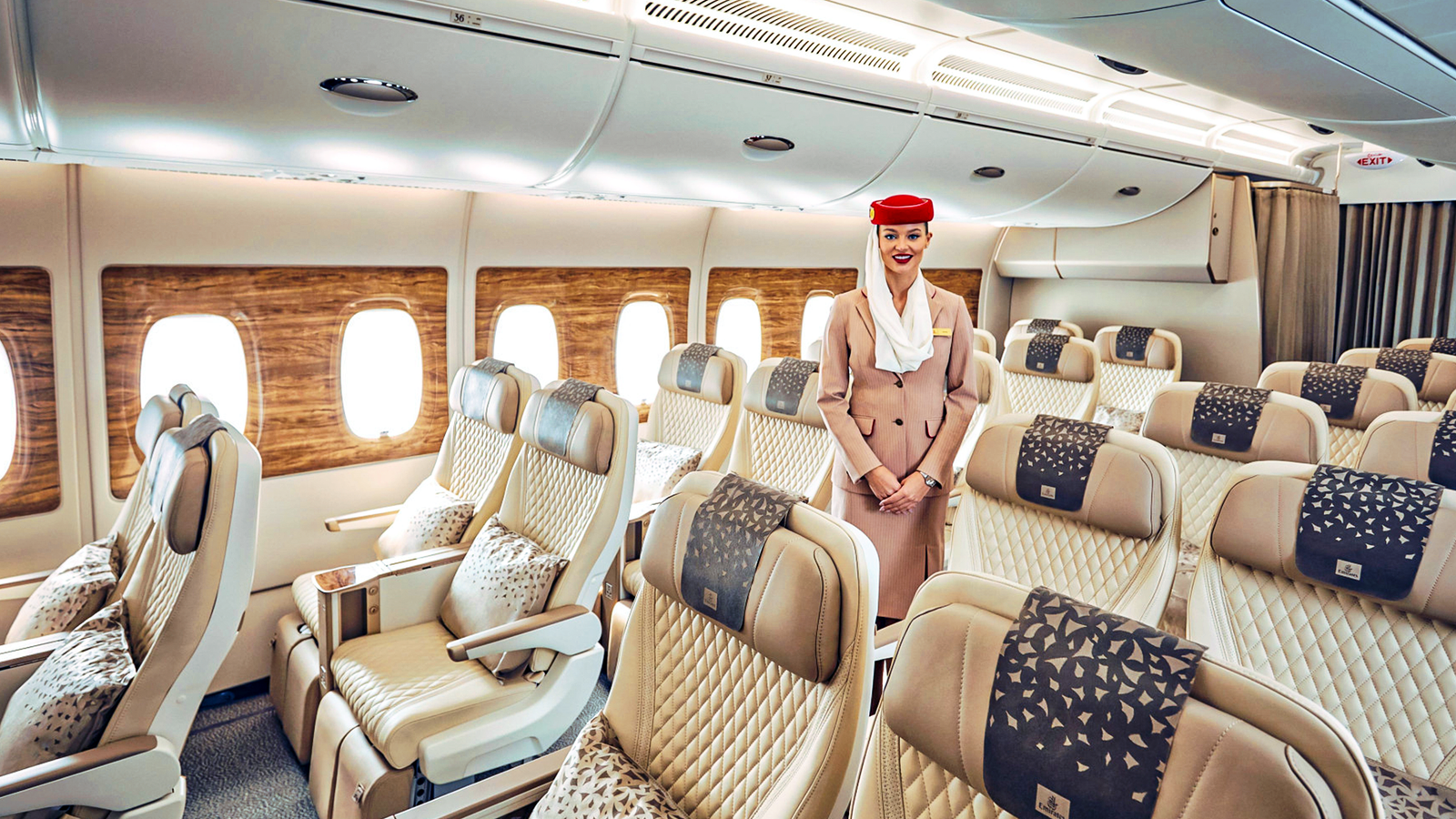
Published Sep 21, 2026, 9:00 AM EDT Aaron is an aviation enthusiast and world traveler with a deep interest in aerospace history and technology. He has traveled around the world numerous times, often incorporating visits to aviation museums and historic aircraft collections into his journeys. A native of New Zealand, he is an expert in aviation and maintains a broad interest in a variety of other subjects. It is often noted that while passengers love to fly on the Airbus A380 , airlines don't like operating it. Qatar Airways has gone as far as to say that purchasing it was the biggest mistake the company made. Air France, Thai Airways, and China Southern were among the airlines that rid themselves of their fleets during COVID-19. A few airlines, like British Airways, appear mostly content with their fleets, but the outlier is Emirates. Emirates has made the A380 a part of its brand identity and part of its luxury image. For years, Emirates was concerned that adding premium economy would tarnish its luxury image. However, after adding the class, the opposite proved true, and now Emirates is completing the efforts to retrofit its superjumbo fleet to add a premium economy class. Fortunately for Emirates, the width of the A380 fits neatly with premium economy. Let's examine how Emirates is transforming its A380s into the perfect premium economy airliner. Emirates' Fleet Of A380s Credit: AV8 Photos l Shutterstock With 116 examples listed by Planespotters.net as in inventory, Emirates has around half of all the world's superjumbos. Emirates originally purchased 123, or almost exactly half of the total produced by Airbus. However, a significant number of Emirates' fleet (29) are listed as parked, including some that have been parked for years. Emirates had planned to increase the number of superjumbos it had flying through 2026, but the conflict in the Middle East with the ensuing flight disruptions has complicated these efforts. Around 87 Emirates A380s are currently active. While other airlines have wanted to rid themselves of the massive and expensive aircraft, Emirates is seemingly enamored with the aircraft. In 2025, Emirates was the world's most profitable airline, and it has even floated the idea with Airbus of putting a re-engineered version of the superjumbo back into production called the A380neo. This almost certainly will not happen. Instead, Emirates has said it will keep its A380 flying for as long as possible, and it is the world's largest customer for the next-largest aircraft on the market, the Boeing 777X. However, the A380 is unique in terms of prestige and its cabin width. The World's Widest Passenger Cabins Credit: Flickr The A380 has the widest passenger cabin of any airliner ever built. It is also the first airliner purpose-built from the ground up with an upper deck for premium passengers. Boeing initially envisioned the Boeing 747-100's upper deck more as a first-class lounge than a first-class cabin. Airlines soon added first-class seating there, and Boeing subsequently enlarged the upper deck to hold more passengers. However, the lengthened Jumbo's upper deck was always constrained by the fact that it was much narrower than the main deck. The Boeing 747's main deck floor width is around 19 feet (5.9 meters), while the upper deck is around 12 feet four inches (3.76 meters). Some passengers describe the upper deck as feeling like a Boeing 737's fuselage. This makes both of its decks considerably narrower than its A380 counterparts. Emirates Fleet Number in service Number on order Number of premium economy seats installed Airbus A350-900 27 46 21-29 Airbus A380 116 (87 active) None 56 (final high-density examples being retrofitted) Boeing 777-200LR 10 None 24 Boeing 777-300ER 117 None 0-24 (109 being retrofitted with 24 premium economy seats) Boeing 777-9 None 235 Unclear Boeing 777-8 None 35 Unclear Boeing 787-8 Dreamliner None 20 Unclear Boeing 787-10 Dreamliner None 15 Unclear Meanwhile, the main deck of the A380 is around 21.4 feet (6.54 meters), and the upper deck is around 19 feet (5.8 meters) wide. For the purposes of this article, the main deck is of the most interest, as that is where most airlines place the premium economy seats. The main deck is around two feet and three inches (0.71 meters) wider than the Boeing 777-300ER/777-9 and around three feet (about a meter) wider than the A350-900/-1000. Credit: Markus Mainka l Shutterstock Emirates configures its premium economy layout the same as other airlines (width-wise). Emirates, British Airways, Singapore Airlines, Qantas, Lufthansa, and Etihad all configure their premium economy as 2-4-2 for a total of eight seats across. Emirates' arch rival, Qatar Airways, doesn't have premium economy seats configured in its A380s. Interestingly, the typical premium economy configuration with the A350 and Boeing 777 is also 2-4-2 or eight abreast. So while the A380 doesn't permit Emirates to add more seats, the greater fuselage width gives it much more freedom in designing wider seats and aisles. Airlines are typically able to install premium economy seats with a width of 19.5 to 20 inches. Put another way, Emirates' A380 premium economy seats are more spacious than those on its 777s. That said, there may be good room for premium economy passengers on Emirates' Airbus A350s as those are configured 2-3-2 or seven abreast. Highlighting how much room there is in the A380 fuselage, in 2017, Airbus offered its A380plus, which would have increased its efficiency and lowered cost per seat. It also suggested "nine-abreast Premium Economy on the main deck [for] 11 more passengers [in] Premium Economy." This never happened. Retrofitting Premium Economy Seats To A380s Credit: Soos Jozsef l Shutterstock Emirates is working through its $5 billion effort to retrofit its A380s and most of its Boeing 777s with new interiors. By July 2026, Emirates announced it had completed work on 100 aircraft, which include 47 Airbus A380s and 53 Boeing 777s. Together, these represent more than a third of Emirates' current fleet. Over 3,800 premium economy seats have been installed fleet-wide. The retrofit program covers 219 aircraft (110 A380s and 109 Boeing 777s). Emirates' decision to retrofit premium economy into its A380 fleet is considered one of the most ambitious cabin modification programs ever carried out by an airline. The first retrofitted four-class A380 entered service in 2024 with 56 premium economy seats. The cabin was placed at the front of the main deck, immediately behind first class. Emirates says that "the new Premium Economy cabin has arrived on the latest A380. Sink into wider, cream leather seats, stretch out on raised leg rests and relax into a greater recline." Meanwhile, Emirates' A350-900s are being delivered with the modernized configuration that includes 21 (regional configuration) or 28 (ultra-long-haul configuration) premium economy seats. Deliveries of Boeing 777Xs are expected to commence in 2027. Retrofitting Upper Decks Of High-Density A380s Credit: AV8 Photos l Shutterstock By 2026, Emirates still operated 15 high-density two-class A380s, which had no business-class cabin on the upper deck. These aircraft were mostly configured for leisure routes and only had business and economy class seating. However, instead of just refreshing the interiors, Emirates has fundamentally changed the layout, transforming the upper deck to include 56 premium economy seats as well as another 18 business class seats. Some 120 economy seats were removed. This required engineers to relocate galleys, overhead bins, partitions, electrical wiring, and plumbing. On these aircraft, the premium economy layout became 2-3-2, or seven abreast, instead of the main deck's eight-abreast layout. This was the first time that premium economy had been introduced on the upper deck of an Emirates A380. In May 2026, Emirates announced that: "Emirates has reached a defining milestone in its ambitious multi-billion dollar retrofit programme with the successful reconfiguration of its first two-class A380 aircraft. The newly refurbished aircraft (A6-EUX) has taken to the skies operating as EK 39/40 between Dubai and Birmingham, featuring sparkling new interiors with Emirates’ latest products in three cabin classes: 76 Business Class seats, 56 Premium Economy Seats, and 437 Economy Class seats." Continuing Emirates' Luxury Brand Credit: MihailC95 | Shutterstock One of the most important aspects for Emirates is to protect its luxury image. For a while, Emirates was concerned that premium economy would harm its luxury brand, but then decided that it would enhance the brand. Emirates has embraced the product wholeheartedly. Tim Clark, the President of Emirates, said that "the Emirates retrofit programme revolves around the central premise that we will offer our customers a truly elevated experience every time they choose to travel with us." He added that "the reconfiguration of our two-class A380 into a three-class layout that brings our popular Premium Economy seating onto the upper deck illustrates the extensive capabilities of our team." Tim Clark has previously spoken about how surprised the airline has been by demand for premium economy. With that being said, time is starting to run down for the Airbus A380 and its extra-widebody fuselage. After the 777X enters service, there is expected to be a wave of A380 retirements around the world. Emirates has said it wants to keep its A380s operating until at least 2040, but they will likely be thinning out over the 2030s. The first Emirates A380 entered service in 2008, or 18 years ago. Many are likely to be phased out over the next ten years. With the new retrofit program, Emirates intends to offer a very wide-cabin premium economy product for as long as it can, but beyond that, there is no direct replacement, with the twin-engined 777-9 being the largest airliner on the horizon.
Why The Airbus A380's Fuselage Width Gives Emirates A Premium Economy Seat Geometry No Twinjet Can Copy
Full Article
Original Source
Read the full article at Simpleflying →KhanList aggregates and links to publicly available news content. We do not host full articles from third-party sources. Always verify important information with original sources.