
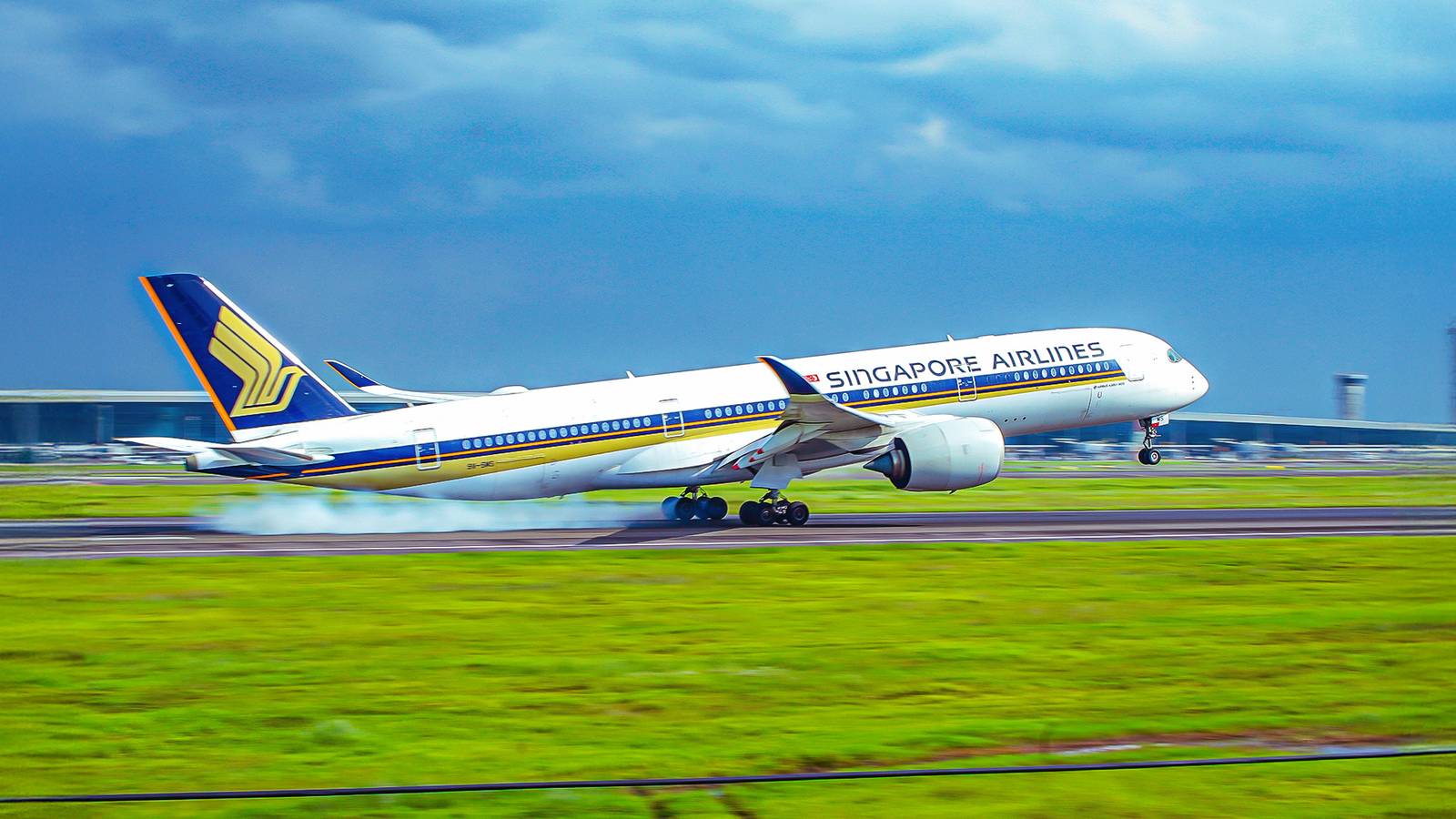
Published Sep 20, 2026, 5:49 PM EDT Jasper Yu-Dawidowicz is a New York City-based aviation journalist with over seven years of journalism experience across different publications. Currently a student at Purdue University, Jasper is pursuing dual degrees in Professional Flight and Aviation management, completing his flight training as part of Purdue's part 141 R-ATP eligible program. Airbus built the A350XWB with approximately 53% composite materials by weight, allowing airlines like Delta Air Lines, Qatar Airways, and Singapore Airlines to reduce fuel burn by roughly 25% compared to previous-generation widebodies. However, the A350's carbon fiber fuselage makes severe hard-landing repairs significantly more difficult than on older aluminum airliners. The key reason behind this is due to the ability of the A350’s carbon fiber skin to distribute high loads throughout the fuselage, meaning that while the exterior does not show any visible damage, hidden structural damage inside the composite skin can remain invisible even after major impact loads. This phenomenon, known as Barely Visible Impact Damage (BVID), forces airlines to perform ultrasonic inspections after hard landings and can pose significant difficulties if repairs are needed. The Airbus A350 Was Built Around Composite Materials Credit: Airbus As one of the newest widebody aircraft on the market, the Airbus A350 continues the trend set by the Boeing 787 Dreamliner in terms of construction. Earlier Airbus widebodies like the A330 and A340, relied heavily on aluminum alloy structures. Rather than continuing the aluminum design that dominated for decades, the A350 was built with approximately 53% composite materials. This includes large portions of the A350’s fuselage, wing structures, empennage, center wing box, and tail cone. Overall, the A350 uses roughly 70% advanced materials by weight, making it one of the most composite-intensive commercial aircraft ever produced. The decision to use a majority of carbon fiber materials in the A350’s construction boils down to the advantages it offers over traditional metallic construction. Composite materials offer an exceptional strength-to-weight ratio, enabling engineers to reduce aircraft weight while maintaining the airframe's critical structural rigidity. The A350's lower weight directly translates to improved fuel efficiency, range, and payload capacity, with the aircraft offering up to 25% lower fuel burn and up to 1,500 nautical miles (2,780 km) more range than the A330. In addition to fuel savings, composite fiber-reinforced plastic structures are highly resistant to corrosion and fatigue cracking, two major long-term problems that have historically impacted aluminum airframes. It also reduces the number of parts needed by fabricating large sections at once, lowering the number of individual nuts and bolts required. However, despite the numerous advantages composite construction offers, carbon fiber composites also pose challenges, with the difficulty of visually detecting structural damage among the most significant. The Invisible Damage Problem: Barely Visible Impact Damage Barely Visible Impact Damage, also known as BVID, is one of the biggest issues in composite aircraft structures, according to Detecting Barely Visible Impact Damage Detection On Aircraft Composites Structures written by U. Polimeno and Michele Meo. This type of damage happens when a strong impact with the ground, most commonly during a landing, can cause significant internal structural damage without leaving evidence on the surface of the aircraft. Aluminum tends to deform visibly when overloaded, creating dents or cracks that clearly indicate damage, but carbon fiber composites do not fail the same way. Composite materials behave differently because they can flex and rebound while sustaining hidden damage beneath the outer skin layer. BVID is especially dangerous on larger composite aircraft like the A350 and 787 because they depend on the integrity of layered carbon fiber laminates bonded together during manufacturing. When strong forces are applied to the airplane, like during heavy hailstorms or drought landings, the forces travel through the entire airframe simultaneously. Even if the outer fuselage appears intact, the internal layers can separate and the resin can crack, causing severe structural damage that is invisible from the outside. This hidden-damage characteristic of the A350 and similar composite-focused aircraft changes how airlines and engineers must respond to hard landings. Aluminum aircraft will more often than not provide visual clues of damage. It deforms permanently and visibly, showing maintenance workers exactly what is broken and needs to be fixed. Because composite airframes absorb energy internally and show few visible warning signs, maintenance personnel cannot rely on simple visual inspections to determine whether an aircraft is safe for flight. Why The A350 Requires An Ultrasonic Inspection After Hard Landings Because impact damage can be barely visible, Airbus requires extensive inspection procedures after hard landings or other impact events. The A350's primary inspection method is ultrasonic testing. This technology sends high-frequency sound waves through the composite structure and analyzes how they reflect from internal layers. Variations in the reflected signals can indicate hidden defects, crushed core material, or separation between bonded components. The problem is that ultrasonic inspections are labor-intensive and time-consuming, especially after major hard-landing incidents, when engineers may not initially know which areas absorbed the highest stress loads. Maintenance teams may need to scan extensive sections of the lower fuselage, wing attachment points, and other critical areas before determining if the aircraft is safe to return to service. According to Aerospace Testing International, airlines can use portable ultrasonic inspection units that provide quick, automated diagnoses. When damage is observed, these inspections can keep an A350 grounded for days, costing airlines revenue and capacity. The A350, however, does have systems in place to avoid or mitigate hard landings, most notably through its landing gear system. The A350 is designed to handle a vertical descent rate of up to 600 feet (183 meters) per minute at the A350’s maximum landing weight without requiring structural inspections. This is made possible by the air-oleo shock absorber strut, which compresses to distribute the aircraft’s landing force. Additionally, the A350’s carbon fiber wings are designed to flex on landing, dispersing landing forces across the entire airframe. Repairing composite aircraft like the A350 is a lot more complicated than repairing older aluminum airframes. This is because the A350 is built with large integrated structural sections rather than the smaller aluminum panels used on older aircraft. According to industry discussions surrounding modern composite airframes, including Simple Flying's analysis, these large one-piece structures improve efficiency and reduce weight, but they also complicate repairs because damaged areas cannot always be removed and replaced individually. In many cases, repairs must be carried out directly on the aircraft using highly controlled bonding and curing procedures. While aluminum aircraft can be repaired in almost any standard hangar, regardless of the weather, composite materials are very sensitive to their surroundings. This means technicians have to control the temperature and humidity in the repair area to ensure proper bonding between layers. Technicians may also have to sand away damaged laminate layers resulting from the hard landings, then rebuild composite piles one section at a time, carefully curing the prepared area to restore the aircraft’s structural integrity. Another major challenge is that composite materials are directional, meaning their strength depends heavily on the orientation of the fibers within the structure. Aluminum behaves relatively uniformly regardless of direction, making repairs more difficult. For carbon fiber, however, even small mistakes during repair can dramatically weaken the structure. As a result, airlines must provide technicians with specialized training and repair procedures for the A350. Altogether, even minor repairs on an A350’s fuselage can take over 15 hours of constant maintenance, representing a significant time and labor investment for airlines in the event of fuselage damage. The Multi-Level Repair System Developed For The A350 Credit: Airbus Because composite repairs are so complex, Airbus created a three-level repair system for the A350 based on damage severity. The first category covers non-structural or cosmetic repairs, including scratches, paint damage, and surface defects that do not affect the aircraft’s structural strength. In some cases, technicians can even perform temporary fixes using high-speed repair tape before repairing the aircraft in a maintenance shop. The second category involves standard structural repairs, where the damage affects load-bearing composite sections but remains within the predefined repair limits set by Airbus. Depending on the location and severity of the damage, technicians could use temporary aluminum bolted repairs or permanent bonded and bolted composite repairs. These procedures usually require specially trained technicians because composite drilling and bonding processes are more complicated than aluminum repairs. The final category covers major structural repairs caused by incidents like severe hard landings, ground equipment strikes, bird strikes, or landing gear incidents. For these situations, Airbus developed Pre-Defined Repair Solution (PDRS) kits that include repair instructions, replacement parts, tools, and support equipment to speed up repairs. In the most extreme scenarios, Airbus engineering teams may directly assist airlines with repairs, underscoring how difficult it is to repair a heavily damaged composite airframe. The Qatar Airways Dispute: A Warning For Composite Repair Challenges The limits of carbon fiber reinforced plastic (CFRP) repairability became highly visible in the 2021 Qatar Airways grounding dispute. The Doha-based carrier raised concerns about deterioration affecting portions of its A350 fleet, including paint cracking and exposure of the lightning protection mesh embedded within the composite fuselage structure. This resulted in regulators ordering 13 of the airline’s A350s to be removed from service over concerns about accelerating deterioration of the CFRP fuselage skin beneath the paint layer. This disagreement highlighted how composite fuselage problems differ from those in traditional aluminum or metallic airframes. On aluminum aircraft, surface degradation and corrosion are generally well understood, backed by decades of operational experience. Composite fuselages, however, are still relatively new and feature entirely different inspection and repair processes. The Qatar Airways dispute highlighted how even surface-level composite damage can pose significant assessment and repair challenges. Ultimately, the A350 highlights both the advantages and hidden complications of modern composite aircraft construction. Its carbon fiber fuselage allows airlines to operate longer routes with lower fuel burn than older aluminum widebodies, but those same materials can become a major liability after severe hard landings. Complex ultrasonic inspections and specialized repair procedures can quickly turn these events into major engineering and financial challenges. Importantly, the A350 is not alone in facing these issues, as the Boeing 787 Dreamliner shares many of the same repair and maintenance complications due to its heavy use of composite materials. As airlines continue shifting toward next-generation carbon fiber aircraft, the industry is discovering that while composites deliver major efficiency in the air, they are far more difficult to repair on the ground than traditional aluminum airframes.
Why The Airbus A350's Carbon Fiber Fuselage Makes It Nearly Impossible To Repair After A Hard Landing
Full Article
Original Source
Read the full article at Simpleflying →KhanList aggregates and links to publicly available news content. We do not host full articles from third-party sources. Always verify important information with original sources.