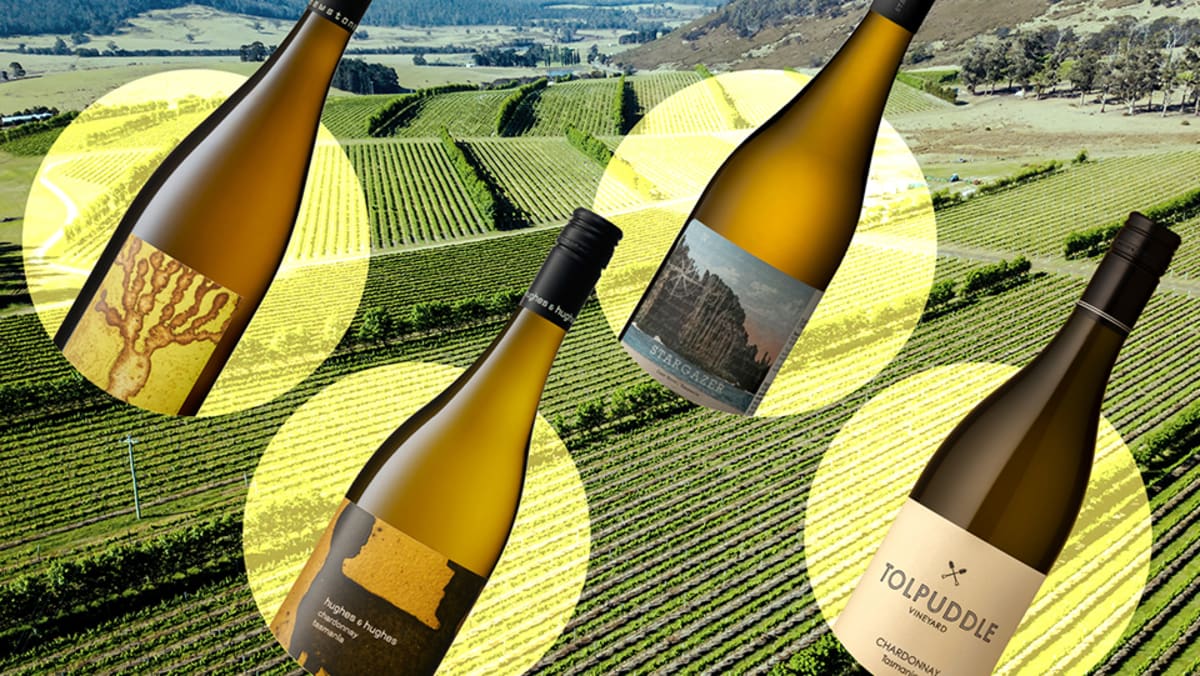
Experiences Often compared with Burgundy, the Australian island’s wines are winning praise for their vivid fruit, bright acidity and distinctive cool-climate character. Tasmanian Chardonnay is drawing attention for its bright acidity, vivid fruit and distinctive cool-climate character. (Photos: Courtesy of respective brands; Art: CNA/Chern Ling) New: You can now listen to articles. This audio is generated by an AI tool. 28 Jul 2026 06:09AM (Updated: 28 Jul 2026 06:17AM) Few cities wear their geography as naturally as Hobart, the capital of Tasmania, Australia’s smallest and southernmost state. The port city is framed by the River Derwent on one side and kunanyi/Mount Wellington on the other. Beyond Tasmania’s southern coast lies the cold expanse of the Southern Ocean, with Antarctica farther beyond.It is about as far from Burgundy as one can get. Yet when its wines are discussed, Burgundy is precisely the comparison that keeps surfacing. “A lot of people are comparing Tasmania to Burgundy and Champagne, but we are different,” said Jeremy Dineen, an award-winning Tasmanian winemaker whom I met during my first visit to Hobart. Dineen is the co-founder of Haddow + Dineen and a former chief winemaker at Josef Chromy Wines. “Tasmania has some of the most ancient soils in the world. We have a long ripening season, and we don’t get extremes of low and high. We get flavour without having massive sugar because we are cold.” “We have sunshine that is not the same as northern hemisphere sunshine. But the key difference is the sunlight UV radiation,” he added. Together, he said, these conditions can produce particularly vivid fruit and acidity.Over the following week, that acidity and clarity of fruit helped explain why the wines of this small island are increasingly compared with some of the world’s best. TASMANIA’S WINES FIND A GLOBAL AUDIENCE About 20 minutes from Hobart, Tolpuddle Vineyard occupies a 31-hectare site in Tasmania’s Coal River Valley. (Photo: Adam Gibson) Tasmania is Australia’s coolest wine region, on an island that made its name first for apples and later for grapes. Its cool maritime climate is particularly suited to Pinot Noir, Chardonnay and Riesling. Producers such as Jansz, Josef Chromy Wines and House of Arras helped put Tasmania on the map with sparkling wines that ranked among Australia’s finest.While much of the Chardonnay grown on the island goes into sparkling wine, Tasmania’s still Chardonnays are also attracting international attention. Tolpuddle Vineyard’s 2018 and 2023 Chardonnays were named Champion White Wine at the International Wine Challenge in 2020 and 2025 respectively – a rare feat for a single producer. At the 2026 London Wine Fair, the 2023 Tolpuddle Vineyard Chardonnay also emerged top in a blind tasting of 27 premium Chardonnays from around the world.Tucked in the Coal River Valley, 20 minutes from Hobart, Tolpuddle Vineyard sits on sandstone soils with only two grapes: Chardonnay and Pinot Noir. Tolpuddle Vineyard Chardonnay NV (Photo: Tolpuddle Vineyard) Michael Hill Smith MW and his business partner, Martin Shaw, the duo behind the acclaimed South Australian estate Shaw + Smith, came across the 31-hectare vineyard during what Hill Smith describes as an impulsive road trip around Tasmania in 2011. “When we first saw the vineyard in 2011, we were convinced it had the potential to become one of the great single vineyards, single site – so everything we have done in the vineyard, in the cellar or in the market has been to this end,” he said.Hill Smith is also candid about the foundations laid before he and Shaw arrived. “Much of the heavy lifting has been done by other Tasmanian winemakers when we invested in Tasmania,” he said. Shaw + Smith’s established distribution network brought Tolpuddle’s wines to sommeliers, critics and consumers around the world, and international recognition followed. Hill Smith distils Tolpuddle’s success into “a great site, hard work and some good luck along the way.”A DISTINCTLY TASMANIAN CHARDONNAY Stargazer Wines founder Samantha Connew. (Photo: Stargazer Wines) About 10 minutes away, Stargazer Wines founder Samantha Connew regards Tolpuddle as a natural benchmark for Tasmanian Chardonnay. “They’ve done such a magnificent job, not just in creating their own category, but in elevating how good Tasmanian Chardonnay can be.”New Zealand-born Connew is one of Australia’s most respected winemakers. In 2014, she became the first woman – and the youngest judge – to chair the Sydney Royal Wine Show. Her winemaking career took her from Oregon to Sicily and Spain, followed by Australia’s Hunter Valley, McLaren Vale and Margaret River, before she settled in Tasmania in 2016.“Tasmania is the only state that does all three grapes I love: Riesling, Chardonnay and Pinot Noir, to the level I demand, and that’s because the fruit quality is just so good,” she said. Stargazer Wines Chardonnay. (Photo: Stargazer Wines) Fruit from Connew’s five hectares of vines is hand-picked and fermented with indigenous yeasts. The vineyard is surrounded by another six hectares managed for biodiversity, and sustainability and holistic vineyard management shape her approach. Grape pressings are composted, while a worm farm supports soil microbes. Bees, sheep and chickens also play a role in the wider vineyard ecosystem. “I spend more time in the vineyard than in the winery. Get the fruit right, get it into the winery and don’t stuff it up. That’s the real attraction of making wine down here,” she added.Connew produces seven wines, including a Chardonnay, and is unequivocal about what sets Tasmanian Chardonnay apart. “The wines sit on your palate in a very light fashion. There’s generosity in the riper years, but there’s none of that plumpness. They hit a little bit differently from other regions in Australia.”DIVERSITY ON A SMALL ISLANDFarther south lies Mewstone Wines. Matthew and Jonny Hughes set up their 5.3-hectare vineyard in 2011 on a site Jonny describes as a happy accident. The brothers discovered the block while visiting a neighbouring vineyard, just 300m along the coast. “There’s not really a scope of large-scale viticulture in this part of the world,” said Hughes. “Five or six hectares is about as big as anyone could probably plant before the land runs out.” Mewstone’s vineyard sits beside Tasmania’s D’Entrecasteaux Channel, where maritime conditions help shape the character of its Chardonnay. (Photo: Mewstone) Standing beside him, I could see exactly what he meant. The vines tumbled towards the D’Entrecasteaux Channel, a steel-grey stretch of water separating us from the outline of Bruny Island.The vineyard’s proximity to the channel plays an important role. “The airflow reduces disease pressure and mitigates frost risk, the temperature cools off early as the sea breeze kicks up and the quality of light is amplified,” said Hughes. That maritime influence gives Mewstone’s wines a saline, sea-spray character that evokes their coastal setting. “Our corner of southern Tasmania is among the latest-ripening Chardonnay regions in Australia and one of the lowest-yielding. This combination of a long growing season and naturally low yields produces wines with remarkable intensity without sacrificing freshness or acidity.” Mewstone Chardonnay. (Photo: Mewstone) The Hughes brothers practise minimal-intervention viticulture and favour wines that express their site. They produce just 1,000 bottles of their mineral-driven Chardonnay, allocated entirely through the cellar door and wine club. Demand, Hughes says, comfortably exceeds supply. Despite its size, Tasmania encompasses several distinct wine-growing areas, each capable of producing a different expression of Chardonnay. At Delamere Vineyards in Pipers River in the northeast, the wine is pithy, citrusy and flinty. Small Wonder in the Tamar Valley shows ripe fruit, creamy texture and bright acidity, while Spring Vale on the East Coast leans towards floral, saline and stone-fruit notes. Tolpuddle Vineyard in the Coal River Valley brings together orchard and stone fruit, citrus, ginger and oatmeal, underpinned by a taut line of acidity and crushed-stone minerality. Hughes & Hughes Chardonnay. (Photo: Mewstone) Almost 95 per cent of Tasmanian wines are consumed at home, by the island itself and mainland Australia. A mere 5 per cent reaches export markets. For those who find them in Singapore, the wines sit at prices far below what Burgundy commands. “Tasmania is still a very young and small wine region. A lot of those sub-regional differences are yet to be fully explored because we don’t have vineyard density yet. And I say ‘yet’ because there’s no doubt that we will in the future,” said Connew.
Why Tasmania’s Chardonnay is gaining global attention
Full Article
Original Source
Read the full article at Cnaluxury →KhanList aggregates and links to publicly available news content. We do not host full articles from third-party sources. Always verify important information with original sources.