
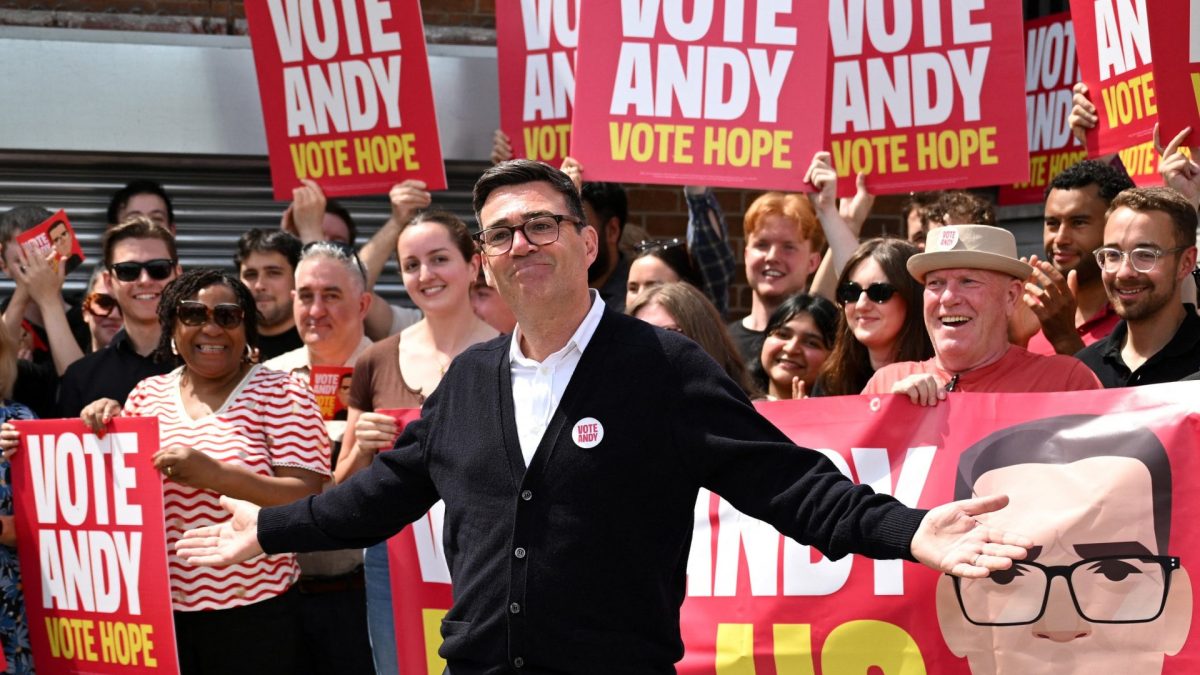
An early election is an idea that will not die, no matter how many times Prime Minister Andy Burnham and his team try to quash it. Burnham is piggybacking on Sir Keir Starmer’s majority, his critics say; he has no mandate of his own. If he wants to be as radical as he says he does, with ambitious spending plans, how does he pay for them? He’s constrained by tax-raising limitations in the 2024 manifesto. Taken alongside Reform UK’s infighting, the Conservatives’ polling and the Greens being past their popularity peak, why not chance an election now, some argue. Punters are feeling more positive. Figures released on Friday by market research company GfK showed consumer confidence rising to its highest in two years, the latest sign of sentiment seeing a “Burnham bounce”. Shorts And Burnham will really want to avoid going to the country at the latest possible date of 2029. While this autumn’s Budget will be grim, it’ll be nothing next to the departmental spending cuts of nearly 6 per cent pencilled in by former Chancellor Rachel Reeves for 2028-30. Rare clues of No 10’s thinking One reason for the speculation is simply that it’s August – and in silly season amateur Kremlinologists will over-interpret rare clues of No 10’s thinking. Examples include how Burnham has put some Government aides on three-month contracts to help with his transition. “The fact that No 10 has put most of its political staff on three-month contracts has led to two interpretations,” a Labour staffer said. “One that Andy wants to have the flexibility to move people around once the dust has settled. But there are also some people who think it means he’ll be able to go to the country if he wants to because these people can easily volunteer on a campaign.” When pressed, the staffer grinned cheerfully. “It’s probably the first, but the second is more fun.” Burnham is on a roll; his social media strategy is effective, and this might be the peak of his popularity. Instead of lacking the courage Gordon Brown did in 2007, why not grab this chance? The answer is that there are reasons for caution. Brenda from Bristol’s famous dismay – “not another one” – looms large in the mind of prime ministers tempted to go to the country. And while Burnham is doing well in the polls at the moment, he’s not doing exceptionally. For elections guru Sir John Curtice, it’s a no-brainer. Burnham should sit tight. “At the moment there is nothing in the polls to suggest it would be wise for Burnham to go early; he’s barely even ahead of Reform,” he said. Why Labour isn’t ready to fight an election More importantly, Labour is not ready to fight an election. A subterranean battle to become the party’s General Secretary is being played out this summer. There are three front-runners: Claire Reynolds, John Lehal and Joe Fortune. The role manages central party headquarters and staff, but also crucially oversees elections. Insiders say the favourites are being asked to make fundraising pitches to show how Labour can rebuild its coffers with an eye to fighting a future election, alongside rebuilding a level of “respect” between party HQ in Southwark and No 10, damaged by fractious relations during the Starmer era. “We are skint and morale is low, albeit on the up after Andy took over,” another Labour insider said. “That needs to be rebuilt before we can even think about an election, although there are also some glimmers of light around in the polls: the Greens falling, Reform infighting and the Tories nowhere.” “No 10 is putting such a huge effort into rebuilding relations with the PLP [Parliamentary Labour Party], it would be mad to squander that, never mind the fact we have no money. And we were 14 years in opposition; do we really want to waste Keir’s majority?” a different party source added. Reform can outspend Labour Most worrying is the moolah. Labour has had to recently employ headhunters to find a new fundraising chief, a role left open since the departure of Rachel McCaffrey in November 2024 and which it has found hard to fill. A trend in philanthropic giving is also working against Labour and the Tories. Giving to charities can be offset against tax for higher-rate earners, making them more attractive than political giving and resulting in fewer donations in the £100,000 to £200,000 bracket. Donors are also keen for clear evidence that their giving is having measurable impacts, which tends to be easier for charities to demonstrate than political parties. Labour is currently running a deficit of £2.56m, although donations would likely pick up in the run-up to an election. However, within a spending arms race, Labour would hope to be close to the legal cap – which in 2024 was £34m – before any race begins. And that’s not counting how the goalposts have shifted: while Labour spent the full amount allowed at the last election, Reform only spent £5m. Now Nigel Farage’s party can comfortably outspend Labour. Reform received £22.8m in political party donations in 2025, a 290 per cent increase on the previous year – more than the Conservatives and Labour combined over the same period. Would Burnham gamble on the polls like May? Nonetheless, speculation about an early election is “keeping us on our toes”, one senior Conservative said. They pointed to the fact the party is stepping up its candidate selection, although the source insisted this would have happened anyway. Shadow cabinet ministers grimace when they remember Theresa May’s 2017 walking holiday. Twenty points ahead in the polls, she took the unilateral decision to try to seek a fresh mandate and a stronger hand for Brexit negotiations. Instead, she lost seats and had to form an alliance with the DUP. Tories say they can’t see Burnham taking the same risk, even if they and Reform are squabbling for supremacy on the right and could split votes across the country. “The issue is the loss of majority is inevitable. I get the point that the right is never more divided, but what is the point? Is it simply a ‘mandate’ to tax more?” one senior Tory questioned. “When you have effective majority of 160 you ought to be able to govern.” With five-party politics delivering unpredictable outcomes and increased savviness about tactical voting, there are those in Westminster who think the most likely outcome of an early election is a hung parliament. Some Tories think a Labour alliance with the Liberal Democrats is almost inevitable, with Burnham favouring both proportional representation (PR) and closer ties to the Europe Union – key priorities of Lib Dem leader Ed Davey. “If Burnham goes early, I think the most likely outcome is he does a quiet deal with Davey in advance for the promise of PR or he’ll chuck [a renewed push on] customs union into the mix as the price for a coalition and they support his tax rises,” a Tory MP said. Some Tories think that a Labour alliance with Ed Davey’s Liberal Democrats is almost inevitable (Photo: Getty Images) Unlikelihood of Lib-Lab pact But a senior Liberal Democrat warned that the political landscape is very different to 1997 when then Labour leader Tony Blair made a commitment on PR to the then Lib Dem leader, Paddy Ashdown, in private talks ahead of the election. “The landscape has changed beyond recognition, and that’s partly down to the aftermath of the coalition government with the Tories from 2010 onwards,” the Lib Dem warned. “We learnt you have to make sure that what you do after polling day is what voters were expecting you might do in advance of polling day, and so for all that we thought we had been very clear that our priorities were on the front page of the manifesto, voters still punished us for our stance on tuition fees, which was nowhere near the front. “That makes signing up to any sort of coalition with Labour more tricky.” Some Labour insiders think Burnham will not go to the country next spring but predict he will not last until 2029 either. To achieve his more ambitious goals, such as nationalising utilities or reforming social care, the prime minister needs to escape the 2024 manifesto limitations and tax more. Baroness Louise Casey’s recommendations on fixing social care have been accelerated to next August. The Tories and Reform have already indicated they won’t support a tax rise to fund changes. At that point, seeking a fresh mandate to fund big changes could be inevitable. “I think we’re looking at spring 2028,” a Labour source speculated. Decision to call election is Burnham’s alone When to call an election is a decision entirely in the hands of the Prime Minister. Burnham could go on a walking holiday at any point and change his mind. Whatever happens, there is unlikely to be much warning. In David Hare’s play about the 1992 general election, an aide in the opposition leader’s office complains that the Tories hadn’t told them an election was coming. “Aren’t they meant to warn us? I thought they’re meant to let us have advance notice?” the aide demands. “For God’s sake, we should have known. Why didn’t we know?” This scenario holds true. Burnham can call an election whenever he wants to.
Why talk of an early election isn’t going away
Full Article
Original Source
Read the full article at Inews →KhanList aggregates and links to publicly available news content. We do not host full articles from third-party sources. Always verify important information with original sources.