
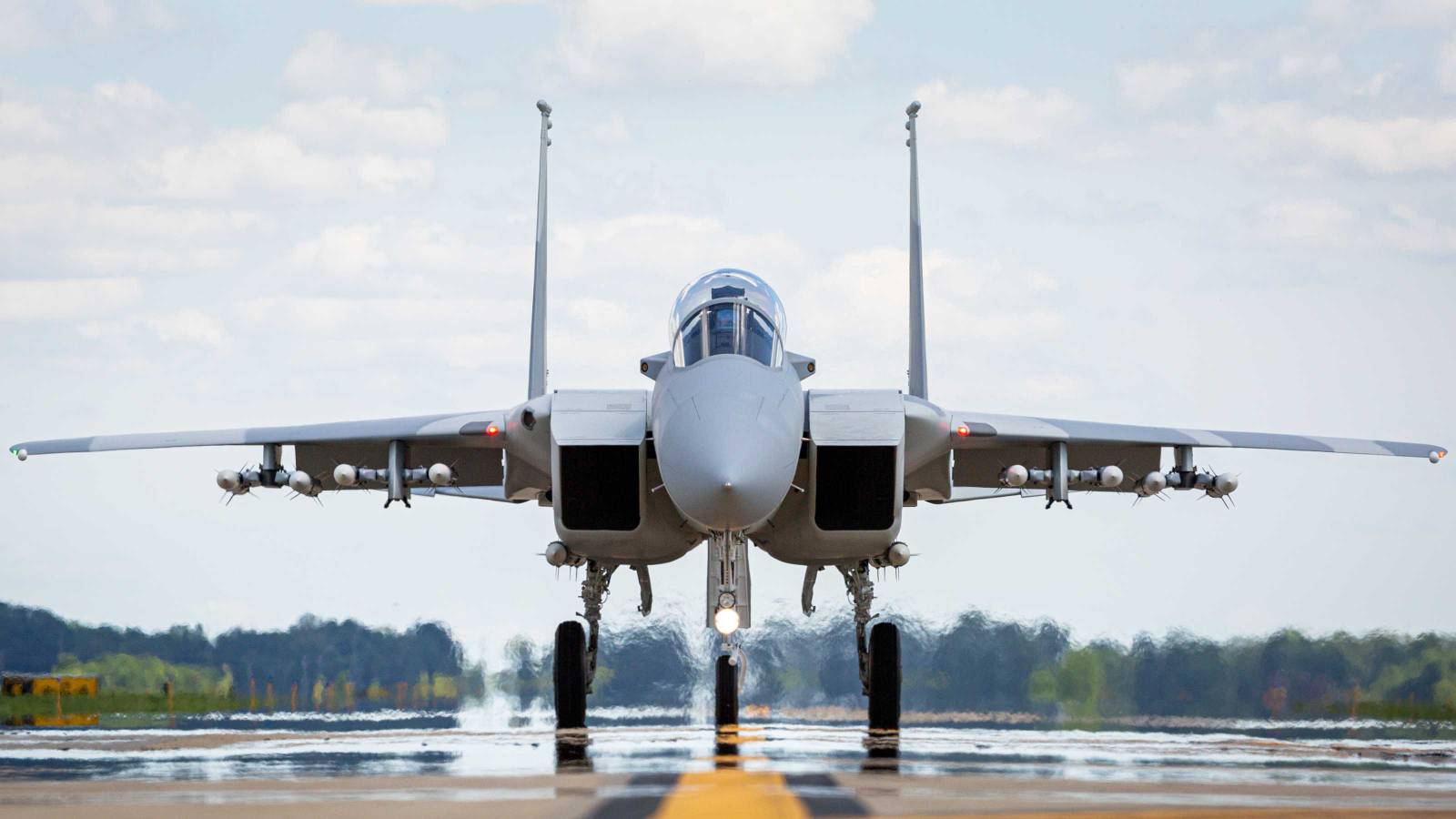
Published Sep 26, 2026, 8:00 PM EDT Aaron is an aviation enthusiast and world traveler with a deep interest in aerospace history and technology. He has traveled around the world numerous times, often incorporating visits to aviation museums and historic aircraft collections into his journeys. A native of New Zealand, he is an expert in aviation and maintains a broad interest in a variety of other subjects. Two of the US military's most iconic fighter jets are currently moving in opposite directions. The US Navy's F/A-18F Super Hornet is about to end production within months, while Congress is pouring in funds to increase the production capacity of the F-15EX and have Boeing deliver the type through the 2030s. Two of the drivers behind these developments are the need to have a force structure made up of fourth-, fifth-, and sixth-generation fighter jets and the need for more range. The Navy is currently receiving the last of its Super Hornets, and these will be able to fit into the Navy's force structure into the 2040s and beyond. Diminishing numbers of upgraded Super Hornets will be able to supplement increasing numbers of F-35Cs and F/A-XXs. However, the last F-15E was delivered to the United States Air Force in the early 2000s, meaning that its aging F-15Es and older F-15C/Ds need recapitalization. Let's examine why the Navy doesn't want more Super Hornets, but the Air Force wants more F-15EXs. Northrop Has Produced The Final Super Hornet Sections Credit: DVIDS In January 2026, it was reported that Boeing had passed a major milestone in winding up production of the Super Hornet. Northrop Grumman had completed the last batch of fuselage sections and vertical tails. At the same time, Boeing confirmed that the final EA-18G Growler electronic warfare examples had been delivered years ago following the completion of the Navy's and Australia's orders for them in the late 2010s. In an earnings call, Northrop stated that "we also expect a modest headwind on the F/A-18 program, with the final production lot completed in the fourth quarter of 2025. Margins are projected to be low-to-mid 9%, reflecting the higher mix of development programs." It is worth noting that the Hornet was originally a Northrop fighter jet. The Hornet was originally developed as the Northrop YF-17 Cobra lightweight fighter jet in the 1970s. The US Navy asked Northrop and McDonnell Douglas to redesign the YF-17 for carrier service, and through a series of aggressive maneuvers, McDonnell Douglas ended up taking over the program as the lead contractor. Eventually, Boeing merged with McDonnell Douglas in 1997, inheriting the program, although Northrop remained a major subcontractor. Dried-Up Orders For Super Hornets Credit: DVIDS In 2023, Boeing said it would shutter the F/A-18 Super Hornet line in 2025, and it was about to fulfill all outstanding orders. Congress then allocated the funds for the Navy to purchase 17 more and to keep production running into 2027. However, now much of that final batch has been delivered, and production is in its twilight. As of April 2025, the Navy had 325 single-seat F/A-18Es and 250 two-seat F/A-18Fs, along with 160 EA-18Gs in inventory. In its second-quarter deliveries report, Boeing announced that it delivered a total of five F/A-18s in the first half of 2026. At the time of writing, it has not disclosed third-quarter delivery numbers. It delivered a total of 14 Super Hornets in 2025. The final units are expected to be delivered to the US Navy by the spring of 2027. After that, the line will shut down. Funding for more Super Hornets does not appear in any Fiscal 2027 budget drafts, and the type is no longer seriously being considered by foreign customers, with all moving onto other platforms. The outlier is the confusing tale of Kuwait's orders for Super Hornets, none of which have been delivered. This was meant to be an order for 28 new-built aircraft, but it's unclear what the status of the project is. Why Super Hornet Production Is Ending Credit: DVIDS Multiple overlapping reasons are driving the Super Hornet out of production. One factor is that Boeing has repeatedly pitched the F/A-18 Super Hornet in foreign sales but has failed to secure any new orders. The type has been repeatedly beaten by the much more capable Lockheed Martin F-35A in places like Canada, Switzerland, Finland, and elsewhere. Notably, Australia previously ordered Super Hornets as a stopgap when the F-35A was delayed. For countries looking for a lighter-weight, affordable US fighter jet option, upgraded F-16 Fighting Falcons have proven more popular. For those wanting to upgrade their air force capabilities, the F-35A has tended to win. The F-35B is also much better suited to smaller aircraft carriers and offers a much better increase in capabilities. F-15 vs F/A-18 (per Boeing) First flight Entered service Final production USAF/USN retirement (including projected) F-15A/D 1972 1976 1980 2028 F-15C/D 1976 1979 1985 2028 F-15E Strike Eagle 1986 1989 2004 (USAF) 2037 F-15EX Eagle II 2021 2024 mid-2030s 2060s+ F/A-18A/B/C/D Hornet 1978 1983 1987 2029 F/A-18E/F Super Hornet 1995 1999 2027 2040s+ EA-18G Growler 2006 2009 2009 2040s+ The type's second-biggest customer, the US Marine Corps, turned away from the F/A-18 decades ago and didn't purchase any Super Hornets. It has recently retired the last of its AV-8B Harrier IIs, and is currently working to phase out its legacy Hornets with an all-420-strong F-35B fighter jet fleet. Why The Navy Doesn't Want Super Hornets Credit: DVIDS One of the biggest reasons why the F/A-18 Super Hornet has stayed in production for as long as it has is industrial. Once fighter jets go out of production, the supply chains and workforce shrivel, and it is incredibly difficult to get it restarted. Keeping these production lines operating is often seen as a strategic national necessity. For this reason, Congress kept providing funds for the US Army to buy tanks it didn't want for years, and it is also why the UK must keep its Eurofighter Typhoon in production until the industry can switch over to GCAP/Tempest fighter jets. The last year the Navy requested to purchase Super Hornets was in Fiscal 2021. Congress then provided money for the Navy to purchase more Super Hornets that it didn't want to keep the production line running long enough for Boeing to switch over to producing the F-47 fighter jet and the MQ-25 Stingray tanker drone. For the Navy, the Super Hornet is a very capable, affordable, and flexible fighter jet, but it lacks stealth, and critically, it lacks range. The Super Hornet boosts range considerably from the Hornet, and upgrades and the incoming MQ-25 have boosted it and will boost it further, but it is not enough. In the future, carriers will need to operate further out from shore to protect themselves, as China develops increasingly capable and longer-ranged fighter jets and anti-ship missiles. Increased combat radius is one of the core requirements of the Navy's ongoing F/A-XX next-generation fighter jet to eventually replace the Super Hornet. The Dramatic Turnaround For The Eagle Credit: DVIDS For years, the story of the F-15 Eagle family was somewhat similar industrially. The Air Force stopped purchasing the fighter jet while Congress was able to keep the production line humming at a lower rate through exports. It then decided in 2020 to purchase up to 144 upgraded new-built F-15EX Eagle IIs, partially to compensate for the lack of F-22 Raptors. This was then scaled back to 80, before being increased again to 104. However, this has dramatically changed the Fiscal 2027 budget documents, with the Air Force almost tripling that figure to 268 aircraft. Boeing executives have floated the possibility that the Air Force could eventually acquire more than 300 new Eagles. At the same time, Congress is allocating funds to boost the production rate capacity from the previous 12 per year to 24 and is now planning to reach as much as 36 per year. This is also coming amid 50 export orders from Israel in recent years and the potential export to more allies (such as Poland and Saudi Arabia). Production of the Eagle is now expected to extend deep into the 2030s. For now, the delivery rates remain low, with Boeing having delivered nine examples in 2025 and four in the first half of 2026. Previous estimates had the Eagle going out of production in the late 2020s, but, now, it seems the type will remain in production until at least 2035. Range & Evolving Force Structures Credit: US Air Force The requirements of the Air Force and Navy are fundamentally different. While there are many aspects to this, one factor is that of range. The Air Force claims the F-15EX has a combat radius of around 690 nautical miles (more than the F-22 Raptor). At the same time, the intended role is that of a delivery truck enabled by the platform's heavy payload capacity and respectable range. It is also important to note that even 300 new Eagles would be comparatively minor in the Air Force's planned high-low mix that will reportedly eventually have 1,763 F-35As and 185+ F-47s. The key difference is not simply range, but how many aircraft each service expects to field. The Air Force can afford for the F-15EX to be a specialized payload carrier because it plans a much larger fifth and sixth-generation fleet. In this force structure, the F-15EX can play a supporting role, carrying heavy stand-off munitions, conducting patrol missions, and working for the Air National Guard, but not be the backbone of the US Air Force tactical fleet. However, the picture is different for the Navy. It only has a program of record for 110 F-35Cs, which is woefully insufficient to fully replace the Super Hornet. The Super Hornet has a combat radius of around 390–500 nautical miles (depending on the configuration), while the F-35C is closer to 670 nautical miles. America's Navy wants the F/A-XX to have a combat radius of around 1,000 nautical miles. The Super Hornet may be able to complement future fleets of F-35C and F/A-XX fighter jets, but the Navy assesses it is increasingly insufficient to be the backbone of carrier fighter jet aviation into the 2040s.
Why Super Hornet Production Is Ending While The Air Force Is Buying More F-15EXs
Full Article
Original Source
Read the full article at Simpleflying →KhanList aggregates and links to publicly available news content. We do not host full articles from third-party sources. Always verify important information with original sources.