
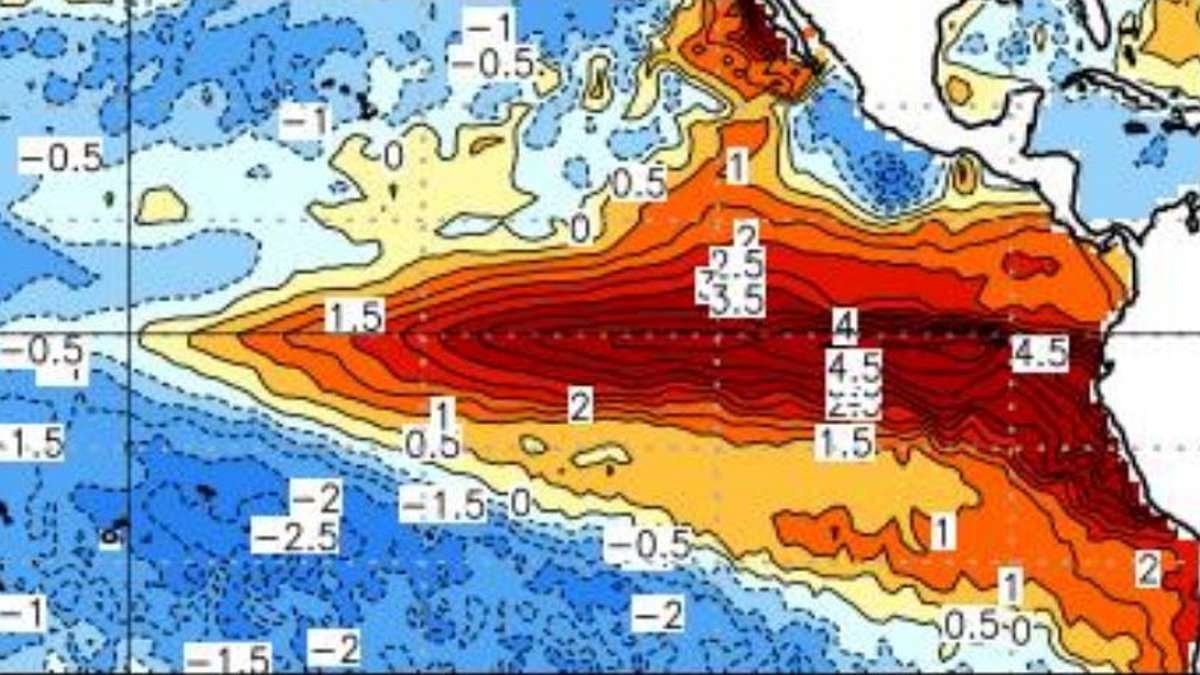
The impending Super El Niño may have experts worried, but a new study suggests that the powerful climate cycle could bring some good news this winter.That is because strong episodes are linked to 112,681 fewer cold-related deaths around the world.The increased warming does lead to 107,035 additional heat-related deaths, but that still leaves the world with 5,645 fewer fatalities.While this is a small change in the big picture, resulting in a 0.17 per cent difference, scientists say their findings could help the world prepare for the extreme weather to come.However, these changes are not distributed evenly, with some countries benefiting from big reductions in cold-related deaths while others face deadly summers.Lead author Dr Natalia Shartova, of the Barcelona Institute for Global Health, says: 'The fact that these two changes largely offset each other globally does not mean that El Niño is beneficial to health.'Combined heat– and cold–related mortality increases in countries with fewer resources and, in an increasingly warm climate, future episodes could exacerbate these inequalities.'The impending Super El Niño (pictured) may have experts worried, but a new study suggests that the powerful climate cycle could help reduce cold-related deaths this winter El Niño is part of a naturally occurring climate cycle called the El Niño Southern Oscillation that moves between hot and cold periods once every two to seven years.During the hot El Niño phase, warm water builds up near the surface of the central and eastern tropical Pacific.This releases vast amounts of heat into the atmosphere, altering global weather patterns and raising the planet's average temperature.Scientists have warned that the current level of warming in this critical area suggests the world is on track for one of the strongest El Niño events this millennium.Recent data released by the National Oceanic and Atmospheric Administration show that sea surface temperatures in parts of the equatorial Pacific are now 4.7ºC (8.5°F) above average.Meanwhile, experts from the World Meteorological Organisation warned that super El Niño is 'off the charts' and has already started to 'supercharge' our weather.In their paper, published in Nature Medicine, the researchers looked at mortality records and climate data from 1980 to 2023.This period includes some particularly intense El Niño years, such as 1982-1983 and 2015-2016.They then analysed records from 1,667 regions in 125 countries, and used state-of-the-art techniques to extrapolate epidemiological associations between temperature and mortality. As experts warn El Niño is 'off the charts', a study shows that strong events lead to 112,681 fewer cold-related deaths around the world by increasing the average temperature This revealed that strong El Niño events are associated with significant reductions in cold-related deaths, and increases in heat-related mortality.Dr Shartova says: 'El Niño develops over several months and peaks in boreal winter (December–February), so it also affects winter temperatures. Warmer winters mean less exposure to cold, and therefore fewer cold–related deaths.'The researcher cautions that this is not true everywhere, as some regions, such as the UK, typically experience more severe winter temperatures due to the way El Niño disturbs global weather patterns.However, over the globe as a whole, this generally means that there are fewer cold-related deaths during strong El Niño periods.The problem is that this potential benefit is balanced out by an almost equally large increase in heat-related deaths in the El Niño-boosted summer.Likewise, while some regions benefit overall from a reduction in winter deaths, others face a disproportionately large death toll.In Europe, for example, 10,759 fewer cold-related deaths in the winter are balanced by just 1,943 extra deaths in the summer, leading to 8,816 fewer temperature-related deaths overall.Sub-Saharan Africa stands to see an even greater overall benefit, leading to 9,969 fewer temperature-related deaths, despite facing 28,961 additional mortalities in the summer.South & South-East Asia, on the other hand, bears the brunt of El Niño's most devastating impacts.Here, there are 75,969 more deaths in the summer balanced by just 40,981 fewer winter deaths, leading to a net increase of 34,988. However, there will also be 107,035 additional heat-related deaths. A recent study suggests that Nigeria, India and Brazil will bear the brunt of the crisis, accounting for more than a third of upcoming projected heat deaths by March Dr Shartova says: 'El Niño redistributes temperature–related mortality across regions. The largest increases in heat–related deaths occur in the tropics, where fewer cold deaths cannot compensate for the extra heat deaths.'Additionally, the worst effects disproportionately affect low and medium-income countries around the tropics, which are least equipped to face the consequences.In these countries, even small increases in temperature can lead to significant numbers of additional deaths.The researchers point out that their data is only based on events in the past and shouldn't be taken as a forecast for the coming Super El Niño.Every El Niño event is unique, and the exact timing, intensity, and local weather effects could be very different.However, Dr Shartova says that we should expect a 'broadly similar geographic pattern'.Study coordinator Dr Joan Ballester Claramunt, of the Barcelona Institute for Global Health, says: 'Our findings identify the regions and seasons most affected by El Niño and, therefore, where health preparedness could be most valuable.'This could support coordinated action plans involving health authorities, region–specific warnings and targeted interventions for populations at greatest risk.'WHAT IS THE EL NINO PHENOMENON IN THE PACIFIC OCEAN?El Niño and La Niña are the warm and cool phases (respectively) of a recurring climate phenomenon across the tropical Pacific - the El Niño-Southern Oscillation, or ENSO for short.The pattern can shift back and forth irregularly every two to seven years, and each phase triggers predictable disruptions of temperature, winds and precipitation. These changes disrupt air movement and affect global climate. ENSO has three phases: El Niño: A warming of the ocean surface, or above-average sea surface temperatures (SST), in the central and eastern tropical Pacific Ocean. Over Indonesia, rainfall becomes reduced, while rainfall increases over the tropical Pacific Ocean. The low-level surface winds, which normally blow from east to west along the Equator, instead weaken or, in some cases, start blowing the other direction from west to east. La Niña: A cooling of the ocean surface, or below-average SST, in the central and eastern tropical Pacific Ocean. Over Indonesia, rainfall tends to increase, while rainfall decreases over the central tropical Pacific Ocean. The normal easterly winds along the Equator become even stronger.Neutral: Neither El Niño or La Niña. Often tropical Pacific SSTs are generally close to average.Source: Climate.gov
Why Super El Niño could be GOOD news this winter: Study reveals strong episodes are linked to 112,681 fewer cold-related deaths every year
Full Article
Original Source
Read the full article at Dailymail →KhanList aggregates and links to publicly available news content. We do not host full articles from third-party sources. Always verify important information with original sources.