
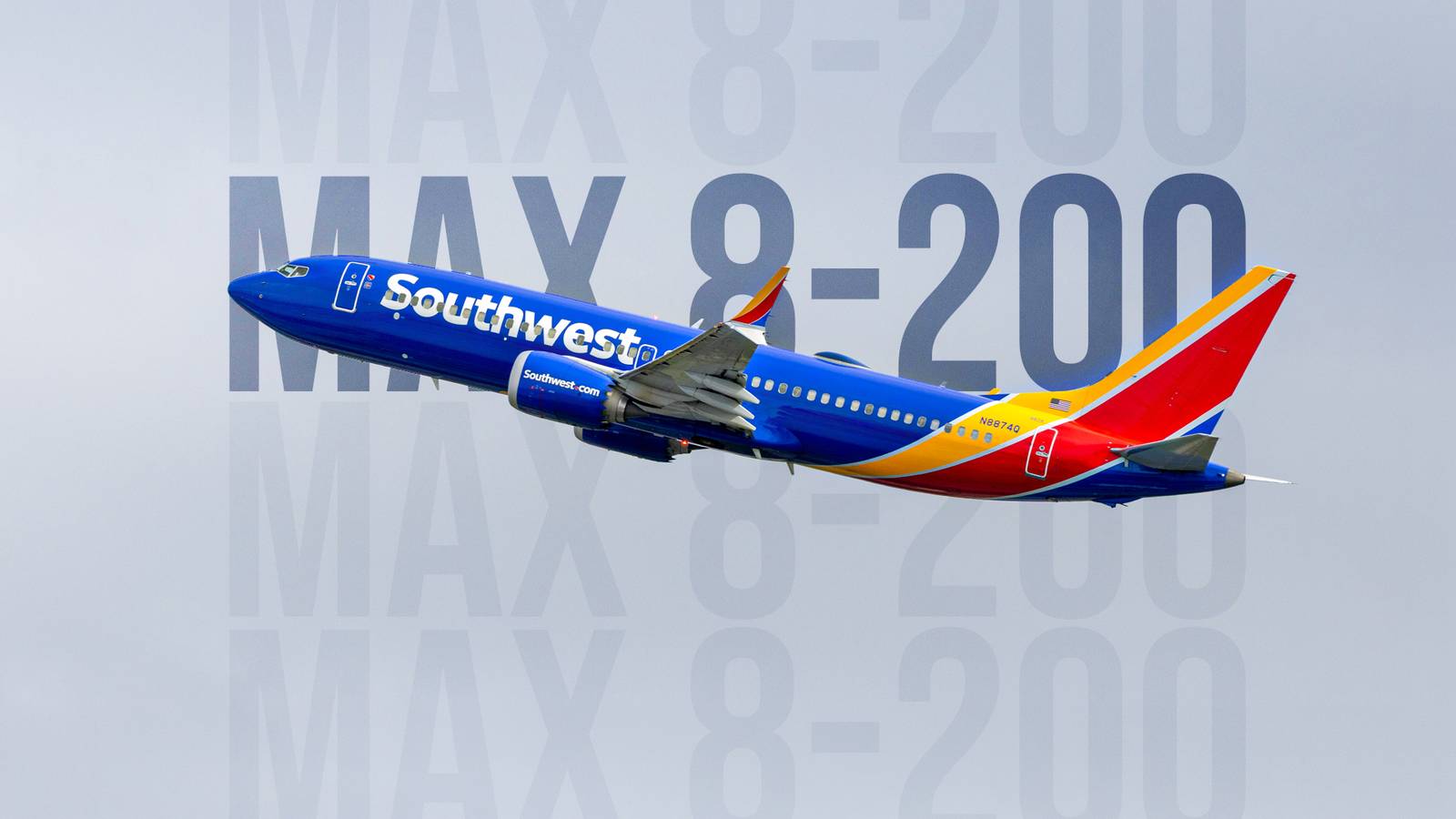
Southwest Airlines has not publicly issued a formal explanation for why it does not operate the 737 MAX 8-200, but its commercial direction in 2026 points straight toward the underlying reason. The 8-200 is engineered to pack maximum seating density into a single-aisle cabin, whereas Southwest has spent 2026 reshaping its cabin experience around assigned seating, extra-legroom rows, new fare tiers, and upcoming Icon lounges. If an airline moves away from open-seating boarding toward structured comfort and paid upgrades, squeezing 15 to 20 extra seats onto every aircraft works directly against that strategy. Contrasting Southwest against ultra-low-cost operators such as Ryanair and Allegiant Air shows how the same Boeing 737 MAX family can serve massively different commercial models. Ryanair configures its 8-200 jets for maximum seat count, Allegiant pairs high-capacity seating with extra-legroom rows, and Southwest keeps 175 seats across its standard 737 MAX 8 and 737-800 aircraft. The way in which the 8-200 is designed, how carriers like Ryanair and Allegiant use it, and how Southwest's 2026 product shift unfolds explains why the Dallas-based carrier is unlikely to chase maximum-density narrowbody layouts. What is the MAX 8-200? The 737 MAX 8-200 is a high-density derivative of the standard 737 MAX 8 created to help ultra-low-cost operators push seat counts on single-aisle routes. As One Mile At A Time notes, the variant keeps the same fuselage length, overall airframe dimensions, engines, maximum takeoff weight, and range capability as a baseline 737 MAX 8. Contrary to a standard stretching of the airframe or altering core flight performance, Boeing focused on regulatory evacuation thresholds and interior floor-space efficiency so airlines could carry more passengers per flight. For the allowance of higher passenger loads while meeting evacuation rules, Boeing added an extra pair of emergency exit doors behind the wing on the 737 MAX 8-200. Reporting from Aviation Week explains that this mid-cabin exit modification raised the design capacity from the standard 737 MAX 8 ceiling up to 200 seats initially, with later configurations reaching up to 210 seats. Across Europe, aviation rules cap the 737 MAX 8-200 at 202 passengers, forming a strict ceiling even in high-demand short-haul markets. Achieving those higher seat totals comes from the design of the high-density 8-200 configuration rather than any single airline's livery or onboard branding. As highlighted in Simple Flying analysis, packing additional rows into a single-aisle cabin of roughly 11 feet 7 inches (approximately 3.53 meters) in width means using slimline seats, tighter seat pitch, compact lavatories, and reduced galley space. Those hardware and floorplan choices lower cost per seat on paper, but they leave far less room for cabin comfort or generous legroom. How Ryanair Uses The Max 8-200 Ryanair is the clearest real-world example of the 737 MAX 8-200 deployed strictly as a high-density, low-fare machine across busy short-haul European routes. As shown in trip reports from WillAviation, Ryanair fits 197 slimline seats spaced at 28 inches (approximately 71.1 centimeters) of pitch, the distance from one seat back to the next, compared with 189 seats on its older 737-800 aircraft. Adding eight extra seats per jet spreads fixed operating costs across more fare-paying flyers on high-frequency point-to-point sectors. Squeezing 197 seats into that single-aisle cabin, Ryanair leans on interior space compromises tailored to ultra-low-cost operations. The layout relies on three small lavatories and removes some galley space, trading onboard amenity space and restroom capacity for lower cost per seat, as noted by Simple Flying. On short European flights built around rock-bottom base fares and rapid turnarounds, maximizing seat count per departure takes clear priority over extra cabin room. As the 737 MAX 8-200's main operator by a wide margin, Ryanair shows how directly the variant supports an ultra-low-cost business model. Packing 197 seats into the airframe helps lower per-seat costs across high-frequency schedules, so that Ryanair does not have to step up to a larger aircraft type and change its single-type business model. Allegiant Air's Approach Allegiant Air takes a slightly more segmented approach to the 737 MAX 8-200, combining high overall passenger capacity with a dedicated block of extra-legroom seats aimed at leisure travelers. As One Mile At A Time reports, Allegiant configures its 737 MAX 8-200 aircraft with 190 seats, including 21 extra-legroom Allegiant Extra seats. That cabin arrangement allows flyers who want extra space to pay a little extra for it but keep the total seat count substantially higher than a standard narrowbody layout. For a leisure-focused airline whose routes center on vacation and seasonal demand, having high-capacity rows and paid legroom upgrades has a clear commercial role. Reporting from One Mile At A Time notes that Allegiant Extra seating provides at least six inches (approximately 15.2 centimeters) of extra pitch over standard rows, paired with power ports and larger overhead bins. Even with those extra-legroom seats built into the cabin, the 190-seat total remains a high-density narrowbody setup. Comparing Allegiant's 190-seat layout against Ryanair's 197-seat configuration shows how airlines adapt the same 737 MAX 8-200 airframe to different revenue strategies. Both carriers take advantage of the 8-200's high-density capability to boost passenger volume per flight, but Allegiant sets aside 21 seats for extra-legroom upsells, not chasing the highest possible seat count across every row. Even with that nuance, Allegiant's leisure-driven density sits well apart from Southwest's evolving cabin model. At Odds With The Spacious Seating Structure Southwest Airlines moves in the opposite direction from maximum-density narrowbody layouts, offering 175 seats on its standard 737 MAX 8 and 737-800 aircraft. As reported by Travel Weekly, Southwest has reconfigured jets to sell extra-legroom seats with 34 to 36 inches (approximately 86.4 to 91.4 centimeters) of pitch up front, while keeping standard seats at 31 inches (approximately 78.7 centimeters). That standard seat pitch already gives flyers roughly one inch (approximately 2.5 centimeters) more legroom than many flights on American, Delta, and United. Squeezing 15 to 20 additional seats onto a Southwest 737, the jump from 175 seats into the 190-to-197-seat range seen on high-density layouts, would clash directly with that seating structure. Tighter row spacing or trimmed cabin spaces would take away the comfort edge Southwest is building across its extra-legroom rows and standard seats throughout the main cabin. Adding extra seats simply to chase peak density would undermine the legroom differentiation meant to win over higher-yielding domestic travelers. Those cabin geometry trade-offs carry real weight for an airline that spent decades operating uniform single-class cabins with fast turns. Integrating 34-to-36-inch (approximately 86.4-to-91.4-centimeter) extra-legroom pitch and 31-inch (approximately 78.7-centimeter) standard pitch in a way that does not massively affect overall seat count is what shapes cabin layout, passenger comfort, and fare revenue across every flight. Keeping a 175-seat setup protects the legroom and seat segmentation Southwest now relies on across its fleet. Identity Changes At Southwest Southwest Airlines' recent cabin evolution has stemmed from a repositioning away from its old no-frills open-seating identity toward structured choices and elevated customer touchpoints. Highlighted in Simple Flying coverage, initiatives such as assigned seating, extra legroom rows, new premium fare types, and upcoming Icon lounges signal an airline reshaping how travelers experience the brand across its network. In that context, an ultra-dense narrowbody cabin designed around bare-bones squeezing projects the wrong brand message. Customer perception and onboard atmosphere matter just as much as seat counts when an airline is actively rebranding its travel experience. Moving from open boarding to assigned seats and tiered fare options changes what flyers expect from the moment they book through boarding and lounge access. A cabin geared toward maximum crowding conflicts with a brand leaning into comfort, structure, and hospitality across every stage of the journey. That brand shift mirrors a wider divide across commercial aviation between ultra-low-cost carriers pushing maximum density and airlines moving toward more space and premium options. Ryanair, Allegiant, VietJet, and Akasa Air have all committed to the 737 MAX 8-200, while airlines such as Southwest and United favor the standard 737 MAX 8 with fewer seats. Together, those opposing camps show why Southwest's brand direction ultimately points away from the 8-200. Passing On The Higher Capacity Variant Taken together, the 737 MAX 8-200 illustrates how a single airframe family can pull in opposite commercial directions depending on how an airline values seat volume versus cabin space. While the 8-200 gives ultra-low-cost and high-density operators extra exit capacity to push seat counts up to 197 or 190, Southwest Airlines has moved away from maximum squeezing toward assigned seating, extra-legroom rows, new premium fare tiers, and upcoming Icon lounges. Holding on to 175 seats on its standard 737 MAX 8 and 737-800 aircraft aligns naturally with that space-led shift, whereas packing 15 to 20 extra seats onto each jet would undermine the comfort edge Southwest is building. Ultimately, Southwest does not need to publicly explain away the 737 MAX 8-200 for its fleet logic to come into sharp focus for travelers and industry watchers across the market. A high-density variant engineered to maximize seat count per departure simply does not match an airline repositioning around extra space, structured seating, and higher-tier customer touchpoints. Unless Southwest reverses course and abandons that 2026 product direction in favor of ultra-low-cost crowding across its single-aisle fleet, the 737 MAX 8-200 is unlikely to find a place in its aircraft lineup.
Why Southwest Airlines Likely Won't Fly The Boeing 737 MAX 8-200 Like Allegiant Air & Ryanair
Full Article
Original Source
Read the full article at Simpleflying →KhanList aggregates and links to publicly available news content. We do not host full articles from third-party sources. Always verify important information with original sources.