
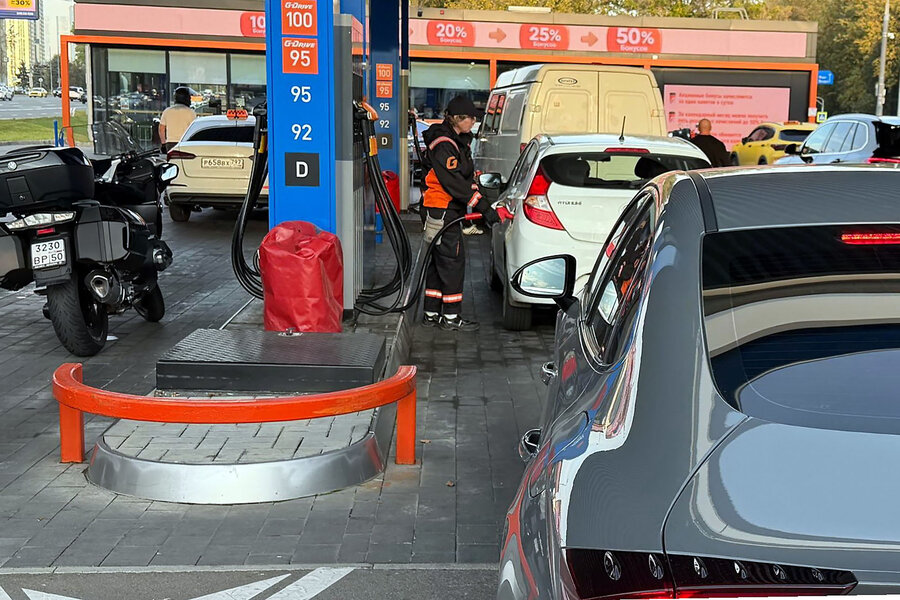
Moscow | Oct. 09, 2026, 5:00 a.m. ET | 4 min read Russians had thought long lines to purchase goods were a thing of the distant past. But they are reliving that unpleasant experience due to stepped-up Ukrainian drone attacks on Russian oil refineries.Now, instead of dealing with the skyrocketing fuel prices that many around the world are seeing, Russians are wrestling with fuel rationing by the government, such that they need to search far and wide for a gas station with stocks, and then wait their turn to fill their tanks.“If it takes you half an hour to fill your tank in any Russian region, you have been extremely lucky,” says Sergey Kanaev, head of the Federation of Car Owners of Russia, a grassroots group. “Usually it takes an hour or more. Often we see people leaving their car at a gas station, and when fuel becomes available they get on a bicycle and hurry back. You can see cars left near gas stations like that in just about every region. No driver likes this situation.”A different sort of fuel controlAbout 70 drone strikes on Russian refineries so far this year have – at least temporarily – put as much as 30% of production offline, leading to widespread shortages and various rationing plans in 50 regions of the country. Hundreds of gas stations have suspended operations, while others limit purchases to as little as five gallons at a time. In many regions, drivers are only served on select days, depending on their license plate number. Some independent distributors have been able to raise prices by 50% or more, making it easy for those willing to pay extra to fill their tanks. But large chains, under government pressure to curb inflation, have kept their prices relatively stable. The resulting long lineups snake out from working gas stations into the main thoroughfares of Moscow and other Russian cities. ReutersPlumes of smoke rise from fires at an oil refinery after what the authorities say was a Ukrainian drone strike in Moscow, Sept. 20, 2026. An August poll by the Levada Center, Russia’s only independent public opinion agency, found the vast majority of respondents had encountered the gasoline shortages, with 55% complaining it made life more difficult, and 32% saying that it “seriously hampered” their daily activities.Dozens of internet resources have sprung up to help drivers navigate the changing supply landscape, locate stations dispensing the kind of fuel they need, and avoid the biggest crowds.Drivers say the best ones are apps created by big banks, like the state-run Sberbank, which use credit card data from tens of millions of customers to pinpoint locations where drivers are successfully paying for fuel. Russia’s answer to Google, the digital behemoth Yandex, has a popular app that crunches several streams of data to generate an interactive map that indicates real-time availability of different grades of gasoline, waiting times, and likelihood of supplies running out at over 20,000 gas stations around the country. Mr. Kanaev says the apps can be useful at least half the time, but none of them is able to completely keep up with the dynamically changing situation. “Their information is sometimes outdated,” he says.Shifting burdensThe Ukrainian tactic of focusing on refineries, as well as consumer warehouses, has succeeded in bringing the war home to millions of average Russians, but it’s not clear how much it may have damaged Russia’s war-fighting capabilities.Under wartime economic controls, consumers are last in line for gasoline and diesel after the military and defense industries, which by all accounts remain well supplied. Russia has been forced to import gasoline products from friendly countries like India, Belarus, and Kazakhstan, and has imposed a ban on exports of diesel until at least the end of October. But thanks to rising global oil prices, Russia’s revenue from its export of crude oil in September was the highest of any month since the beginning of the war.It’s also hard to gauge how much public attitudes toward the ongoing war may have shifted. Last month’s elections for the State Duma, Russia’s lower house of parliament, produced a predictable pro-Kremlin majority and little sign of social instability. About 10% of the deputies in the new Duma are veterans of the Ukraine war, a possible result of Kremlin efforts to avert possible social unrest by prioritizing measures to ease reintegration of men returning from the war.In an August presidential decree, the Kremlin ordered Russian big businesses to defend their own refineries and industrial properties or risk having them taken over by the state.“If our oligarchs can spend millions of dollars to buy [soccer] players for their teams, why can’t they afford to protect their property?” says Viktor Litovkin, an independent security expert in Moscow. “They need to hire some reservists to patrol the grounds and set up anti-drone defenses. It doesn’t take much: machine guns, light anti-aircraft missiles, even hunting rifles are enough to handle these drones. But it wasn’t until Putin threatened them with state management of their property that they decided to act. The situation is still unsettled.” Deepen your worldviewwith Monitor Highlights.Politics with respectGet political stories with respectful analysis.There‘s a world of new ideas in everyBooks newsletter.There‘s more to life, enrich yours withCulture & Learning weekly.Follow humanity‘s discoveries withScience & Nature stories in your inbox.Gain a spiritual perspectivefrom the stories in your inbox.Want to understand the deeper impact of critical events? Learn the Monitor‘s insight.Already a subscriber? Log in to hide ads. Meanwhile, Russian drivers grit their teeth, endure the lines, and hope that government promises that the shortages will ease after the agricultural harvest season – a time of peak demand – are fulfilled.“We’ve had to limit the use of our family car” because getting the tank filled up is too much of an ordeal, says Kirill Poputnikov, an architect in Yaroslavl, a city about 170 miles northeast of Moscow. “It’s not pleasant, but a lot of people seem to be finding other ways to get around, even if it’s more expensive and inconvenient. What can you do?” ALREADY A SUBSCRIBER? LoginReal news can be honest, hopeful, credible, constructive.The Christian Science Monitor was founded in 1908 to lift the standard of journalism and uplift humanity. We aim to “speak the truth in love.” Our goal is not to tell you what to think, but to give you the essential knowledge and understanding to come to your own intelligent conclusions. Join us in this mission by subscribing.
Why Russian gas isn’t getting pricier, but is becoming harder to buy
Full Article
Original Source
Read the full article at Csmonitor →KhanList aggregates and links to publicly available news content. We do not host full articles from third-party sources. Always verify important information with original sources.