
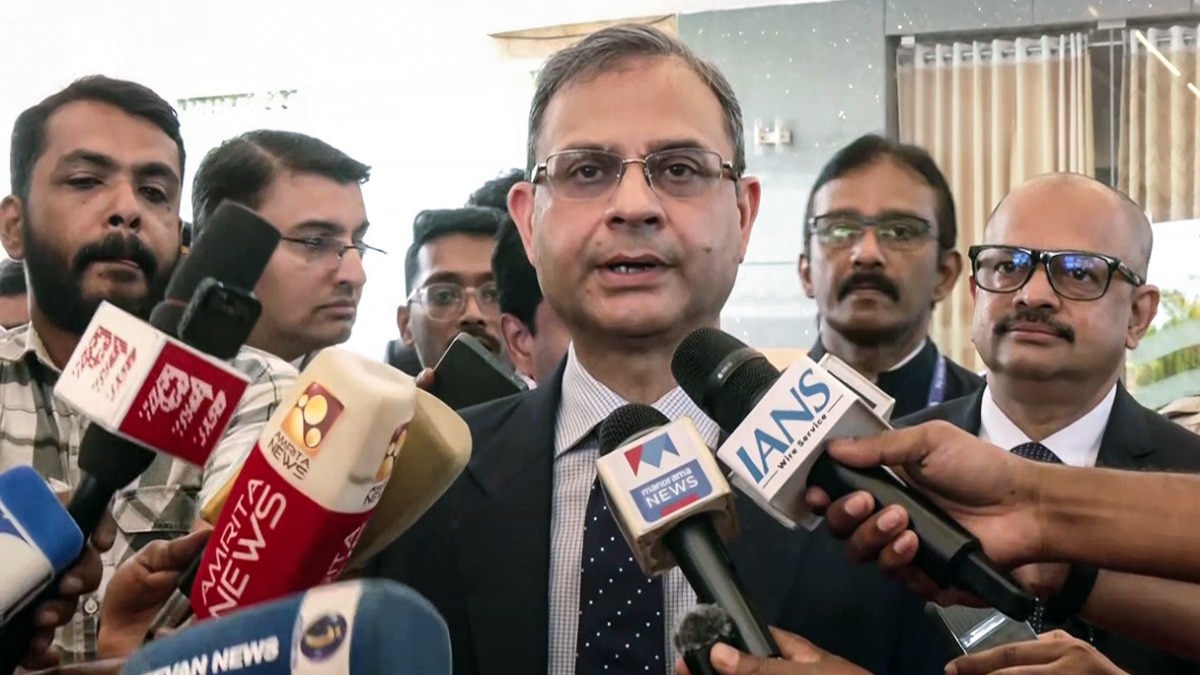
The RBI has held the repo rate at 5.25 per cent, its fourth hold in a row that came barely a week after the US Federal Reserve took a similar callMumbai continues to be in alliance with major economies to maintain the ‘global pause’. The Reserve Bank of India (RBI) has held the repo rate at 5.25 per cent, kept its stance neutral and voted six to nothing to do it. This is the fourth hold in a row, and it comes barely a week after the US Federal Reserve made the same call.The markets expected exactly this, which is why the interesting material lies in the projections rather than in the decision itself. The Monetary Policy Committee (MPC) of he RBI nudged its growth forecast for 2026-27 to 6.7 per cent from 6.6 per cent, and trimmed its inflation forecast to 5 per cent from 5.1 per cent. Two revisions of 10 basis points in opposite directions amount to a statistical shrug. Nothing in the domestic data moved enough to matter.Look instead at the levels. The RBI is forecasting inflation at 5 per cent, a full percentage point above its target while holding the policy rate at 5.25 per cent. That leaves a forward-looking real rate of roughly a quarter of a percentage point.Set those two numbers beside each other and the comfortable reading of this policy falls apart. A central bank that expects a year of above-target inflation while running a real rate of 25 basis points is not sitting on a cushion. In substance it is still running an accommodative policy, and it is doing so unanimously. What that tells you is what the committee believes, which is that the overshoot ahead is arithmetic rather than demand. The logic holds. As recently as December 2025, the RBI was projecting inflation of 2 per cent for the current year, an extraordinarily low number driven by collapsing food prices and by the GST rationalisation working its way through the consumption basket. Both were one-off events. As they drop out of the base, headline inflation climbs on its own, without a single new price pressure being added. A good part of the journey from 2 per cent to 5 per cent is arithmetic, and looking through it is the textbook response.The difficulty is what that leaves in reserve. Should a real shock arrive on top of a path already rising for mechanical reasons—whether a crude spike, a monsoon failure or a slide in the rupee—it will land on a policy rate with almost no real cushion beneath it. The RBI would then be raising rates from 5.25 per cent into an economy growing at close to 7 per cent, having cut into 2 per cent inflation only eight months earlier. That is an awkward sequence for any RBI governor to have to explain.RBI governor Sanjay Malhotra was candid enough about the position. The MPC wanted greater clarity on the inflation outlook before acting. Read that as a group of people who know their forecast is carrying a great deal of weight.The rate corridor is frozen. The rest of the toolkit is not, and that is where readers should look. Malhotra confirmed there is no proposal to close the FCNR(B) deposit measures before their September deadline. Those measures exist to pull dollars in and take pressure off the rupee. Keeping the window open while holding rates means the central bank is saying that external defence is a balance-sheet problem rather than an interest-rate one.Alongside it came the harmonisation of lending rate regulations, which the governor was careful to describe as rationalisation rather than change. Whatever the label, it is transmission policy. With more than 100 basis points of easing already delivered and the rate lever parked, persuading those cuts to reach borrowers is the only stimulus still available.This is the shape of Indian monetary policy now. The repo rate stays still while liquidity, foreign exchange tools and regulation carry the adjustment. Anyone reading only the rate decision has read about a third of the policy.Consider how differently the major central banks are placed. The US Fed is still contending with inflation that will not fully subside. The European Central Bank faces growth that will not properly recover. The Bank of England is trying to stop an energy shock from becoming a wage-price spiral for the second time in five years. The Bank of Japan, after three decades of fighting deflation, has rates at a generational high and is arguing about whether to go further. The US is helping Tokyo by buying their dollar reserves ensuring some stability in the yen, and central bankers there can maintain the calm and not increase the rates further. India is growing faster than all of them.Five diagnoses, one shared constraint. The marginal driver of inflation now sits outside the domestic economy, and interest rates cannot reach it. Malhotra said as much about the global picture, noting that growth is slowing, that inflation is likely to stay elevated through the year, and that central banks themselves have diverged, some tightening while others wait. When the behaviour of your peers becomes a source of uncertainty rather than a guide, coordination has broken down in a way the post-2008 playbook never anticipated.Higher rates cannot pump crude out of a blockaded strait, reopen a shipping lane, or make it rain. What they can still do is stop a price shock from turning into a price spiral. That is now most of the job, and it is work that rests on credibility rather than on the cost of money.A single central bank holding is a domestic story. Five holding at once is a global condition, and the consequences run well beyond the cost of borrowing.Begin with the shock they are all watching. When Iranian forces declared the Strait of Hormuz closed in March, roughly 27 per cent of the world’s seaborne trade in crude and refined products lost its route. Global supply fell by 10.1 million barrels a day that month. Brent rose about 65 per cent, some 46 dollars a barrel, in four weeks, the sharpest monthly move ever recorded, and the World Bank expects output in the June quarter to have fallen at the fastest pace since the Covid pandemic. Nothing on this scale has occurred in the history of the oil market.What makes it so difficult for policymakers is not the size of the shock but the fact that it has never resolved. There was a ceasefire in April, a memorandum in June, renewed fighting in July that emptied the Strait again, and now an understanding between Iran and Oman on managing traffic that is reportedly being finalised, even as Washington alternates between talk of negotiation and threats of force. On the morning the RBI announced its policy, Brent settled at $79.45 per barrel and the American contract slipped to $75.22. This is a market that has given up pricing the outcome and started pricing the argument.A binary is the one thing monetary policy cannot forecast its way around. A committee can model a 10 dollar move in crude. It cannot model a waterway that is either open or shut on a timetable set by negotiators. Faced with a distribution that has two humps and nothing between them, waiting is the rational choice, and waiting is what five central banks did.The most immediate effect falls on the plumbing of global finance. When every major policy rate stops moving, interest rate differentials freeze and the usual driver of currency and capital allocation goes quiet. Money does not stop moving. It simply begins responding to something else, in this case the headline cycle out of West Asia.For emerging markets that is a worse regime than monetary divergence. Divergence at least trends, and can be positioned for. Flows driven by headlines arrive and reverse within a session, pay no attention to domestic fundamentals, and hit the currency and the bond market at the same time. India can execute its fiscal consolidation impeccably and still watch the rupee move on a statement out of Muscat.There is a second asymmetry worth naming. An oil shock is not evenly distributed. It transfers income from importers to exporters, and the United States, now broadly self-sufficient in crude and products, absorbs it far more easily than India, Japan or the eurozone. That gives the Fed more room to sit still, which supports the dollar, which means importers pay more for oil in a firmer currency. The same event lands as one squeeze in Washington and two in Mumbai and Tokyo.Macro data is about to become harder to read, and awkward to explain. Headline inflation across importing economies will carry an energy component that has nothing to do with domestic demand, and core inflation will begin absorbing it through freight and input costs with a lag. Current account balances will swing on terms of trade alone. The familiar rule of thumb in Delhi, that a sustained 10 dollar move in crude shifts India’s current account by roughly a third of a percentage point of GDP, is about to do a great deal of work in commentary.Two mechanisms will keep prices firmer than any ceasefire headline suggests. The first is insurance. War-risk premiums, the danger of mines and the disappearance of transparent transits mean the landed cost of a barrel now sits well above the screen price, so Brent understates what importers actually pay. The second is restocking. Every importing nation is rebuilding inventory drawn down through the spring, which puts a floor under demand that will survive a peace deal. The dividend from de-escalation will be smaller and slower than markets currently assume.Hormuz is not the only vulnerable node either. Attacks on Black Sea ports and repeated suspensions at the Caspian Pipeline Consortium have disrupted the alternatives at the same time, which matters particularly for India, whose access to discounted barrels has been the quiet shock absorber of the past four years.Then there is the question of stability, and here the picture is uncomfortable. The synchronised pause amounts to a kind of coordination. Nobody is easing to steal growth and nobody is tightening to defend a currency, so nobody is exporting instability through the exchange rate. Currency wars need someone to move first.But this is coordination by paralysis rather than by design, and it leaves the system thin. No one is holding a buffer in reserve. If the Strait closes for good, the response will have to be simultaneous, improvised and directed at a supply shock that rate cuts cannot fix. If it reopens cleanly, the risk inverts into a disorderly scramble to ease, with every central bank trying not to be last.Forward guidance, meanwhile, has quietly become impossible. No central bank can credibly signal a path when the decisive variable is a negotiation it is not party to. That is why the vocabulary everywhere has shifted towards clarity, flexibility and optionality. It is not evasion. It is an honest admission that the terminal rate is being set somewhere off the coast of Oman.Domestically, India remains in strong shape, and the RBI’s own forecast says so, with growth of 7 per cent in the first quarter easing to 6.4 per cent and 6.5 per cent in the middle of the year before recovering to 6.8 per cent by the fourth, and risks evenly balanced. Consumption is holding up. Government capital spending remains the dependable engine. Private investment has been building on healthy credit growth and high capacity utilisation. Bank and corporate balance-sheets are in far better condition than they were a decade ago. Malhotra also noted that supply-side pressures from the West Asia conflict have eased.Note how carefully that reassurance was framed. Pressures have eased rather than resolved, and the governor paired the observation with a warning that oil is moving sharply in both directions on geopolitical news, blurring the near-term view. This is a central bank describing a truce it does not trust. India still imports more than 85 per cent of the crude it burns, which is why every escalation in West Asia is now an input into Indian monetary policy.Four things could still go wrong. The first is El Nino, and specifically the distribution of rainfall rather than its volume. The RBI flagged both the timing and the spread of the monsoon, which is the technically correct worry, because rain that arrives at the wrong moment in the wrong districts damages crop output as effectively as rain that does not arrive at all. Adequate foodgrain stocks and active supply management are the offset, and both have worked well through this cycle.The second is the second-round effect. The committee’s own formulation is that generalised pressures remain modest so far, while the risk of food, fuel and input costs feeding into broader inflation persists. A one-off spike can be looked through. What cannot be looked through is that spike migrating into freight rates, service charges, wage settlements and household expectations. The line between a shock and a cycle is drawn precisely there.The third is the thin real rate. With the policy rate barely a quarter of a point above projected inflation, the next move is two-sided for the first time in this cycle, and it is not obvious that markets have priced that.The fourth is the division of labour. If supply shocks dominate the inflation outlook, the effective instruments are not interest rates at all. They are buffer stocks, fuel taxation, tariff policy and strategic reserves. Monetary policy can anchor expectations. It cannot substitute for the rest, which makes the government’s handling of food and energy a monetary variable, whether or not anyone in North Block chooses to describe it that way.Which is why the August meeting amounts to rather more than a routine hold. It marks the working reality of the post-globalisation central bank, an institution whose principal risks originate beyond its borders, whose most powerful instrument is its own credibility, and whose rate corridor has become the least interesting part of its policy.The RBI did not hold because it is waiting for data. It held because the decisive variable is not in its dataset. It is in a shipping lane, and nobody yet knows which way it opens.Subscribe to India Today Magazine- EndsPublished On: Aug 10, 2026 17:37 IST
Why RBI joined world's central banks in the great rate pause
Full Article
Original Source
Read the full article at Indiatoday →KhanList aggregates and links to publicly available news content. We do not host full articles from third-party sources. Always verify important information with original sources.