
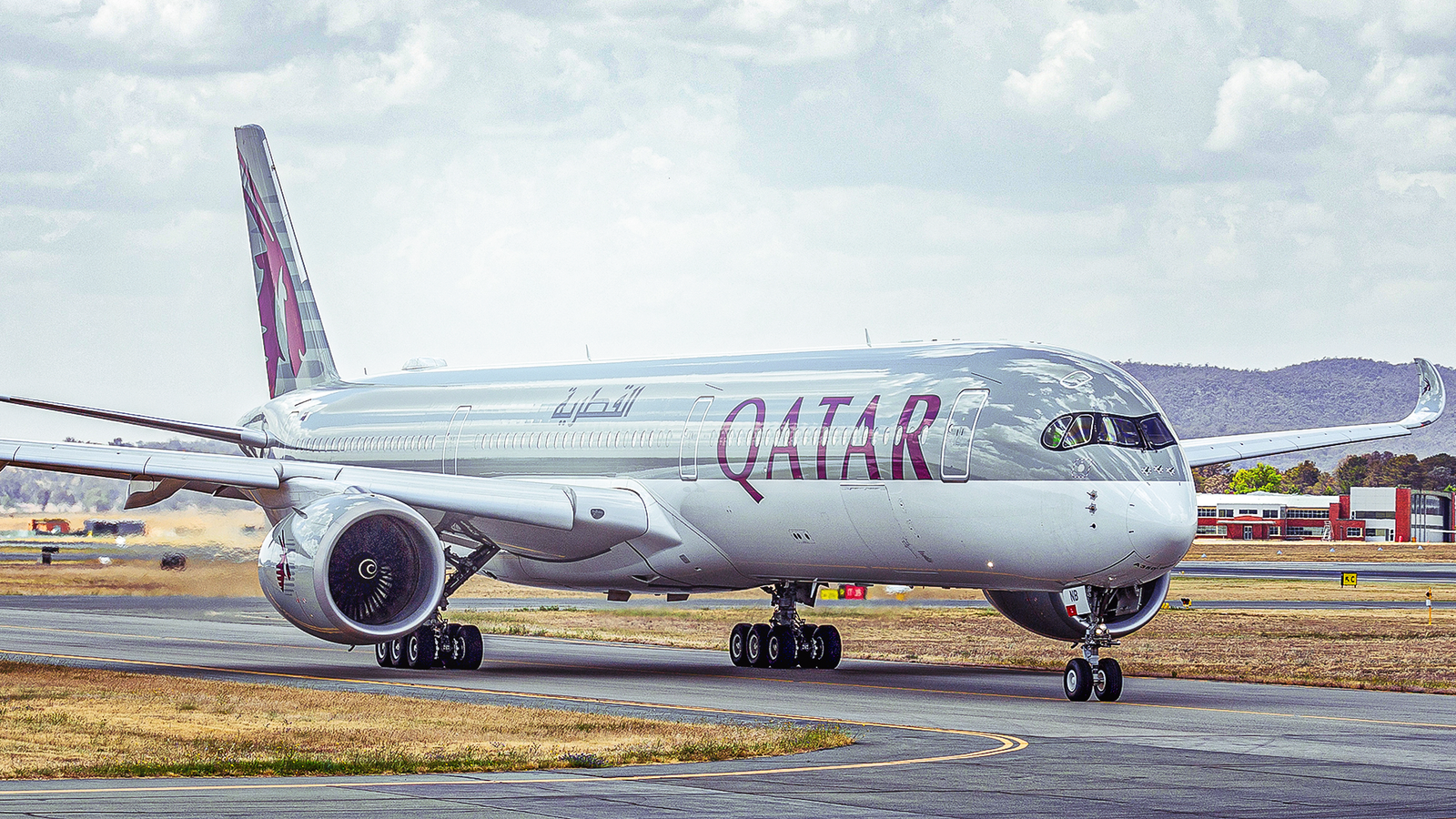
Published Oct 14, 2026, 7:01 AM EDT Airline and Airport Management Graduate, Student Commercial Pilot and Commercial Aviation Writer. Based in London & Nagoya Reducing flight frequencies on an ultra-long-haul route is usually a sign of unprofitability or shifting commercial priorities, often leading airlines to substitute smaller, lower-capacity aircraft to protect margins. With schedule filings from AeroRoutes revealing that Qatar Airways would trim its Doha International Airport (DOH) to Los Angeles International Airport (LAX) service from daily to four weekly flights for the winter 2026/27 season, conventional industry logic suggested a downgrade from the flagship Airbus A350-1000 to the smaller A350-900 or Boeing 787-9. Instead, the Gulf carrier opted to maintain its largest widebody variant on the 16-hour and 35-minute transpacific-crossing sector, defying standard capacity management strategies. The decision in itself is a complex one. For Qatar, the reality at the moment is an operational balancing act between aircraft range constraints, premium cabin yield, and cargo belly-hold economics on one of the world's longest commercial air routes. Instead of scaling down seat size, executive scheduling teams at DOH chose to reduce departure frequency while preserving maximum unit capability. The big picture here is that ultra-long-haul profitability clearly depends far more on premium passenger density and cargo capacity than simple weekly seat volume. Why Stick With The A350-1000? Qatar Airways chose to keep the A350-1000 on the 8,300-mile (13,357 km) route to LAX because downsizing to the smaller A350-900 would compromise the premium seat count and cargo payload needed to make the flight financially viable. Data published by AeroRoutes indicates that while frequency cuts across four major US markets were implemented to balance network-wide aircraft availability, the LAX sector needed the maximum volumetric capacity of the -1000 variant. Sacrificing premium seating on a flight spanning over 16 hours would directly undercut high-yield revenue streams that offset the massive fuel burn of transpacific flying. The flagship A350-1000 configuration features 46 Qsuite business class suites alongside 281 economy seats, compared to 36 Qsuite seats on the carrier's A350-900 fleet, as per Seat Maps. According to schedule tracking from AeroRoutes, the winter 2026/27 adjustment cuts total weekly two-way seats on the DOH-LAX sector from 4,578 to 2,616, but it preserves 184 high-yielding business class suites per week in each direction. On an 8,300-mile (13,357 km) sector where premium tickets frequently command five-figure fares, preserving the 46-seat Qsuite cabin is really designed to generate the highest revenue density, compensating for three fewer weekly frequencies. Belly-hold cargo capability further cemented the choice to retain the larger aircraft type. The extended fuselage of the A350-1000 provides up to 20.8 tons (18.9 metric tons) of cargo capacity across 44 LD3 container positions, whereas the shorter A350-900 accommodates significantly less freight volume. On transpacific trade corridors connecting Southern California to Middle Eastern and South Asian logistics hubs, high-value cargo yields are vital to route profitability. However, keeping the flagship aircraft assigned to Los Angeles is slightly problematic for Qatar Airways' expanding North American network. A Wider US Reduction In reality, the frequency trim to LAX is part of a broader rebalancing across Qatar Airways' North American network for the winter 2026/27 season. Beyond the West Coast, the oneworld carrier reduced service from Doha to Hartsfield-Jackson Atlanta International Airport (ATL) from seven to four weekly flights while keeping the Airbus A350-1000 assigned to the route, as per Aviation A2Z. Boston Logan International Airport (BOS) also saw a reduction from seven to four weekly flights, operated by the smaller A350-900 variant, and Miami International Airport (MIA) shifted from 10 to seven weekly flights on the A350-1000. Analysis from Simple Flying reflects just how important the A350-1000 is for Qatar Airways' ultra-long-haul strategy, operating 61 daily departures from DOH across 73 global destinations. Reallocating flight hours from three weekly LAX round trips, each spanning over 33 block hours per round trip, provides the operational flexibility needed to support expansion elsewhere in the network. For instance, Qatar Airways has confirmed that it is boosting Johannesburg Airport (JNB) services to 18 weekly flights starting in December 2026, alongside frequency additions across African and East Asian corridors. Also of note, retaining the A350-1000 on the LAX route protects operational consistency. Using Simple Flying's Flight Tracker, regular aircraft rotations between major US hubs like Dallas/Fort Worth International Airport (DFW), Houston George Bush Intercontinental Airport (IAH), and San Francisco International Airport (SFO) can be seen, all of which retain dedicated A350-1000 operations. Standardizing aircraft types across these long-haul sectors is particularly useful for the airline when streamlining maintenance scheduling and flight crew rotations at its DOH hub. Downgrading LAX to a different aircraft family, such as the 787-9, would therefore bring crew scheduling complexities and product inconsistency on one of its most prestigious transpacific routes. Plenty Of Competition To Watch Out For Market dynamics out of Southern California create an environment where product downgrades carry noticeable commercial risks. LAX is one of the highest-yielding premium travel corridors in global aviation, with competing long-haul carriers all using top-tier flagship cabins. Emirates, for instance, operates a daily Airbus A380 service into LAX equipped with first class private suites and expansive business class cabins. If Qatar Airways were to substitute a smaller aircraft with a scaled-down premium footprint, high-yielding corporate travelers and premium passengers could easily migrate toward rival Gulf options offering daily flagship availability. Opting to instead trim departure frequency to four weekly flights rather than shrinking airframe size, executive planners see yield density as far more important than raw schedule volume. On ultra-long-haul transpacific sectors, fixed operational costs, including heavy crew staffing, extended block-time fuel loads, and station landing fees, are extraordinarily high regardless of aircraft size. Spreading lower seasonal demand across daily flights on a smaller jet dilutes profit margins, whereas operating four weekly departures on the largest widebody maximizes gross revenue per flight and protects average fare yields. Preserving the flagship product on every departure helps to cement essential brand parity across the US West Coast as well as preserving long-term commercial flexibility. Operating four weekly A350-1000 flights allows Qatar Airways to maintain its premier hard product reputation in Southern California during off-peak winter months without forfeiting market presence. Furthermore, when peak seasonal demand recovers, scaling back up to daily service means no fleet swaps, station re-tooling, or passenger cabin re-education are needed. Waiting On The 777X Widespread manufacturing supply chain issues across the aerospace sector have completely changed how long-haul airlines manage their international networks. Ongoing delivery delays for next-generation widebody aircraft, alongside extended certification timelines for incoming models like the Boeing 777X, have left major international carriers operating with tighter fleet margins. For Qatar Airways, the A350-1000 and 777-300ER airframes are somewhat filling a space that the incoming 777X orders are supposed to fill. The airline currently has 124 777X aircraft on order, according to Aerospace Global News. Ongoing certification delays for the 777X program have forced Qatar Airways to rely even more heavily on its Airbus A350 than it initially expected to carry the burden of its ultra-long-haul expansion. While the flagship 777-9 was originally intended to step in as the carrier's primary high-capacity flagship for prime routes like LAX, repeated timeline slips mean the A350-1000 remains Qatar Airways' undisputed workhorse on high-yield, long-range corridors. Qatar chose not to wait on delayed 777X deliveries, and instead turned its focus purely to its current A350 fleet. After all, the airline has very little leverage over delivery times. By trimming flight frequencies across off-peak North American routes, the airline can free up critical block hours to redeploy its A350-1000s where demand is highest. Keeping the A350-1000 on strategic routes like LAX closes the capacity gap, ensuring product parity and premium revenue density remain intact until the next-generation Boeing widebodies finally join the fleet. A Common Trend Across The Industry? Prioritizing individual flight density over daily departures is a viewpoint that is being shared across global megahub carriers, especially for managing ultra-long-haul routes during seasonal lulls. For the passenger, it creates a dual reality: schedule options become less frequent, but the onboard hard product on every single operation remains uncompromised. From Qatar's standpoint, maintaining maximum Qsuite concentration and full underfloor cargo volume is exactly what makes a flight profitable and viable for long-term service across a massive route network. As noted in Simple Flying analysis, many legacy transatlantic and transpacific operators often downsize to smaller twin-aisle aircraft like the Boeing 787-8 or Airbus A330-300 during off-peak winter months, diluting their premium seat count to preserve daily flight schedules. In contrast, Qatar Airways' approach mirrors the operational logic used by high-yield Asian long-haul carriers, which prefer to drop individual weekly rotations rather than forfeit high-revenue premium berths or heavy cargo pallet positions on flagship routes. Now that aircraft delivery delays extend and operating costs on 15-plus-hour sectors continue to rise, what will high-yield international carriers plan to do? There is a high chance that many will permanently abandon the pursuit of daily flight frequencies in favor of heavier, lower-frequency widebody operations. Airlines like Delta Air Lines and Virgin Atlantic have already begun to move in a direction that favors this increase in premium seating, but for now, not too many carriers are following along. A Good Choice For Qatar Airways? Qatar Airways' winter schedule overhaul shows that on ultra-long-haul polar routes, pure departure count is no longer the benchmark of a route's health or an airline's commitment to a market. Instead, route success comes down to an airframe's ability to maximize gross yield per block hour across both premium passenger suites and heavy belly-hold freight positions. Qatar's retention of the Airbus A350-1000 in Southern California and the freeing up of block hours for expanding secondary markets is an incredibly strategic move, one that gives the airline a strong upper hand in terms of flexibility. When peak summer travel demand returns and Boeing 777X certification milestones are finally met, the success of the strategy will become far clearer. If Qatar Airways can seamlessly scale back up to daily LAX departures using its existing A350-1000 fleet without diluting yields or suffering market share erosion to regional rivals, gauge-over-frequency management will likely become a seriously strong operational template that many carriers choose to adopt.
Why Qatar Airways Kept Its Airbus A350-1000 To Los Angeles Despite Cutting To 4 Weekly Flights
Full Article
Original Source
Read the full article at Simpleflying →KhanList aggregates and links to publicly available news content. We do not host full articles from third-party sources. Always verify important information with original sources.