
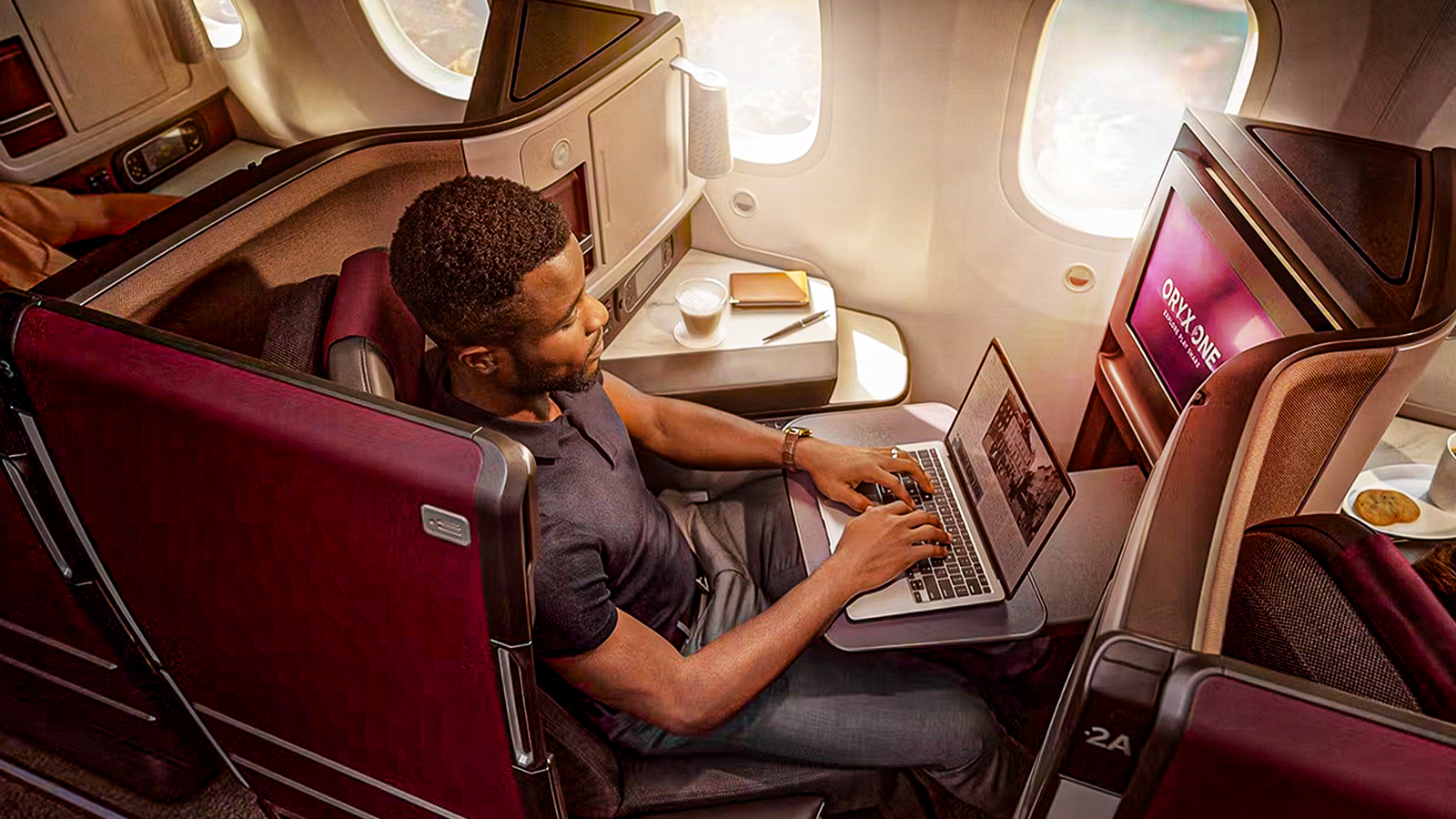
For Qatar Airways, an airline globally renowned for establishing the gold standard of business class travel through its revolutionary Qsuite, widebody fleet management is approached in a noticeably different way to most other major carriers. Passengers booking premium tickets on the carrier's Boeing 787 Dreamliner fleet frequently encounter a striking operational split: the 787-8 features a classic open reverse-herringbone layout, while the larger 787-9 sports an entirely different suite design complete with sliding privacy doors. Why is it that Qatar Airways operates two distinct business class products across its Dreamliner family? When compared to peer carriers like Etihad Airways or Singapore Airlines, which uphold varying degrees of cabin uniformity across their composite twin-aisle fleets, Qatar’s dual-seat approach on the Dreamliner highlights the uncompromising realities of aircraft dimensions and how those are often the main driver of what a cabin ends up looking like. Not Enough Cabin Space? Qatar Airways could not install its signature Qsuite across its entire Dreamliner fleet, primarily due to dimensions of the 787 fuselage. According to Simple Flying analysis, the cabin cross-section of the Dreamliner is approximately 9 inches (23 cm) narrower than that of the Boeing 777 and Airbus A350 families where the Qsuite was originally designed to operate. While this difference sounds marginal, in widebody cabin engineering, it is the exact threshold between a spacious enclosed double suite and dangerously constrained aisle space. When Qatar introduced the Qsuite in 2017, the airline was already well into taking delivery of its initial 787-8 aircraft. Fleet records from AeroLOPA show that Qatar took delivery of 32 Boeing 787-8s featuring a traditional 1-2-1 reverse-herringbone layout utilizing the B/E Aerospace Super Diamond seat, the same hardware found on the carrier's Airbus A380s and older A350s. However, when network planners looked toward the subsequent acquisition of the stretched 787-9 variant, attempting to cram the bulky, double-hinged Qsuite hardware into the narrower 787 cross-section would have reduced aisle widths to unfavorable dimensions, violating safety evacuation clearances and passenger service standards. Unlike the likes of Etihad Airways, which standardized its long-haul fleet around the 787-9 and 787-10 without introducing closing doors until recently, Qatar faced a unique dilemma. The airline had staked its global marketing reputation on closed-door business class privacy, but physics prohibited replicating the Qsuite on its newest Boeing twin-jets. The restriction pushed Qatar's network and product development teams to seek an entirely different seat manufacturer and engineering solution for the 787-9 program, setting the stage for a two-year delivery delay as new interior architecture was custom-developed and certified. Not Quite Qsuite, But Outperforms Many Other Products The foundation of Qatar's initial Dreamliner passenger experience rests on the B/E Aerospace Super Diamond reverse-herringbone seat deployed across all 32 units of the 787-8 subfleet. Configured in a standard 1-2-1 layout across six rows, these seats angle outward toward the composite cabin windows, maximizing exterior viewing angles while maintaining direct aisle access for every single passenger. Although it lacks the enclosed privacy doors that define modern high-end travel, this hardware is a proven industry favorite known for its ergonomic bed length and reliable mechanical deployment. For travelers accustomed to the enclosed privacy of an A350-1000 Qsuite cabin, stepping onto a Qatar 787-8 can feel like stepping back in time, even if the 787 is still considered to be an equally modern aircraft. As detailed by Live and Let's Fly, the Super Diamond seat offers an open suite environment with generous side console workspace, an adjustable touchscreen entertainment monitor, and ample storage compartments for personal items. The 787-8 cabin layout omits central overhead bin installations above the middle rows in certain configurations, so the space feels exceptionally open and airy, though it sacrifices enclosed overhead storage capacity compared to later widebody iterations. Comparing this setup to regional widebody operators like Singapore Airlines highlights how different airlines prioritize cabin standardization. Singapore has a uniform seat product across its regional 787-10 network, whereas Qatar chose to preserve the Super Diamond layout on its smaller Dreamliners due to weight and spatial limitations. Despite its age, this product continues to serve key European and Middle Eastern regional trunk routes effectively, even if frequent flyers booking a Qatar Dreamliner should double-check their specific aircraft subvariant to avoid missing out on closing doors. The Move To The Adient Ascent Platform Credit: Elevate Aircraft Seating When Qatar Airways committed to acquiring the stretched 787-9 variant, the airline refused to compromise on offering a closing door, initiating an intensive collaboration with seat manufacturer Adient to engineer an entirely new suite architecture. The result was the Adient Ascent seat, a product custom-tailored to fit within the narrower fuselage constraints of the Dreamliner without violating critical aisle width clearances or emergency evacuation regulations. This engineering milestone made Qatar the global launch customer for the Ascent product, introducing sliding privacy doors to a narrow widebody cross-section for the very first time. However, bringing this custom hardware to market proved to be exceptionally challenging, triggering a publicized two-year delivery delay for Qatar's Boeing 787-9 program. Aviation analysts and industry reports from outlets like Head for Points noted that the seat achieved FAA certification in January 2021, but integrating the complex door mechanisms, motorized armrests, and bespoke trim into the 787 interior meant undergoing exhaustive safety testing. Marketing materials frequently referred to the hardware as a next-generation Qsuite variant, though industry observers quickly clarified that the Ascent seat was an independent off-the-shelf design adapted specifically to solve the Dreamliner's dimensional limitations. The protracted introduction can illustrate the risk involved in modern airline product development. Where carriers like Etihad could accept standard manufacturer-catalog seats for their 787 fleets without delay, Qatar's unwavering commitment to privacy doors forced a prolonged development cycle. The resulting cabin features 30 suites arranged in a 1-2-1 herringbone layout across 8 rows, becoming an excellent middle ground between open reverse-herringbone seating and full-height private suites. Truly Distinct From Qsuite? A direct comparison between Qatar's signature Qsuite and the Adient Ascent seat shows clear differences in dimensions, door height, and overall passenger comfort. While both products feature sliding privacy doors and direct aisle access, the Ascent seat is inherently narrower and lighter than the flagship Qsuite to accommodate the 787's tighter fuselage geometry. Specifically, the Ascent door stands at 48 inches (122 cm) tall, four inches shorter than the 52-inch (132 cm) Qsuite doors found on the A350-1000 and 777 fleets, providing a slightly more open sightline across the cabin. Bed dimensions and seat width also reflect these spatial compromises. In fully flat bed mode, the Ascent seat extends to 77 inches (196 cm) in length with a fixed width of 21 inches (53 cm), compared to the more expansive 80-inch (203 cm) bed length of the traditional Qsuite. Passenger reviews of the Ascent cabin present a mixed consensus regarding comfort: some travelers praise the airy feel and modern touchscreen interface, while others note that the addition of central overhead bins above the middle seats in the 787-9 cabin creates a slightly more enclosed, claustrophobic atmosphere compared to the open-ceiling design of the 787-8. These nuanced differences demonstrate how aircraft cross-sections can dictate interior ergonomics. Unlike widebody aircraft where airlines can install massive double beds and central double suites, the 787 leads manufacturers to prioritize millimeter-precision engineering. Qatar's implementation of the Ascent seat shows that privacy doors are ultimately achievable on a Dreamliner, but only through deliberate compromises in overall square footage and berth dimensions. The Qsuite Guarantee Qatar Airways now operates both the 787-8 and -9 subvariants alongside its uniform Qsuite fleet, and so passengers frequently face the risk of an aircraft substitution. A scenario can exist where a traveler booking a modern 787-9 suite is swapped onto a 787-8 with open Super Diamond seating. Naturally, Qatar needs to be able to protect high-yield passengers and maintain booking transparency, so the airline instituted a robust passenger protection policy known as the Qsuite Guarantee, offering compensation or rebooking options when marketed cabin products are swapped at the gate due to operational contingencies, as noted by Head for Points. The smaller Boeing 787-8 features exactly six rows of business class seating in a 1-2-1 open layout, whereas the stretched Boeing 787-9 features eight rows of business class equipped with the enclosed Adient Ascent suites. Reviewing the cabin layout prior to seat selection makes sure that passengers know precisely whether they are securing a classic reverse-herringbone seat or a door-equipped private suite. It is not overly straightforward to work around Qatar's dual Dreamliner strategy, but it ultimately brings to light the complexities of modern network management. Combining detailed seat map analysis with an understanding of historical delivery constraints, it is possible to master the nuances of Qatar's widebody fleet. Now, as the airline continues to refine its premium product offerings across diverse aircraft families, the ability to decode these cabin variations is an essential skill for the discerning global flyer. When Available Space Makes The Tough Decisions The split personality of Qatar Airways' Boeing 787 fleet is a perfect example of how physical aircraft dimensions and manufacturing timelines dictate commercial aviation strategy. Passenger expectations lean heavily toward uniform, door-equipped suites across every long-haul route, but the immutable laws of fuselage geometry make universal Qsuite integration impossible on narrower twin-aisle aircraft like the Dreamliner. Successfully deploying the B/E Aerospace Super Diamond on the 787-8 and pioneering the Adient Ascent seat on the 787-9, Qatar has worked through a complex engineering hurdle, all while never compromising network connectivity. Qatar Airways is eagerly waiting for more orders to be delivered, and so even when these new aircraft inevitably steal the spotlight, just remember that the 787 has helped pave the way for the future of the airline.
Why Qatar Airways Has Different Business Class Seats On Its Boeing 787-8 & 787-9
Full Article
Original Source
Read the full article at Simpleflying →KhanList aggregates and links to publicly available news content. We do not host full articles from third-party sources. Always verify important information with original sources.