
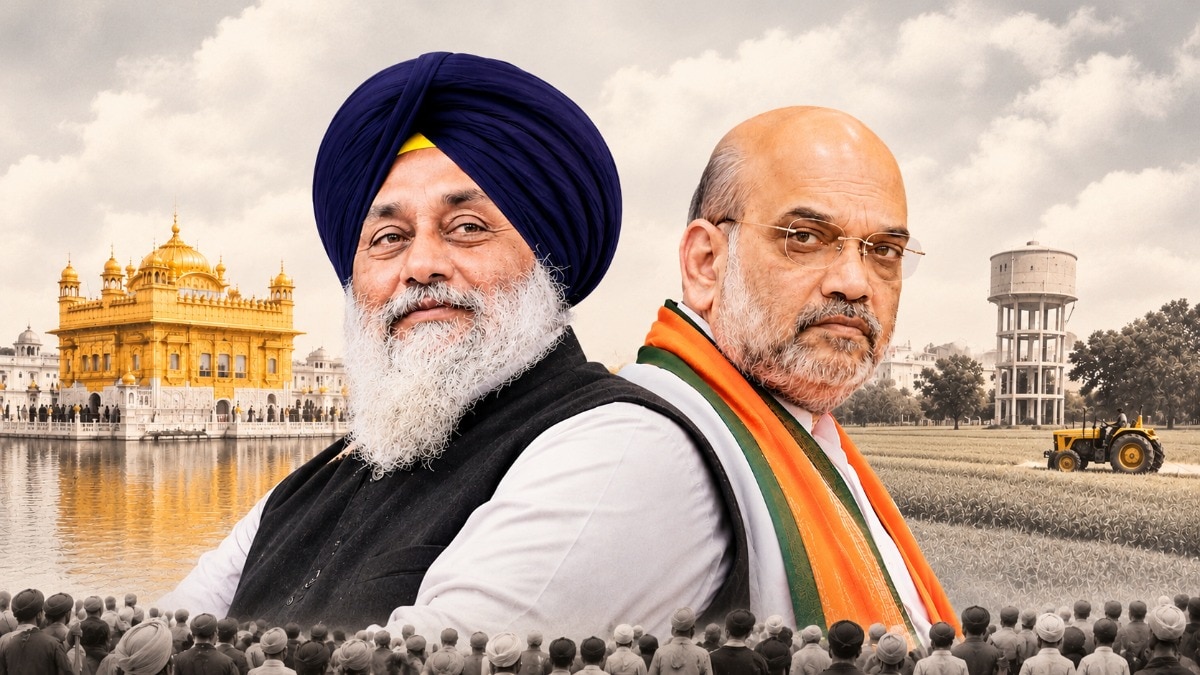
The BJP and the Shiromani Akali Dal (SAD) have reunited after six years, bringing back an alliance that once dominated Punjab politics. But the state they are returning to is very different from the one they left behind.Announcing the reunion at the BJP headquarters in New Delhi on Tuesday (November 24), Union Home Minister Amit Shah declared that the SAD would remain the "big brother" in the alliance, adding, "Jo bada bhai hai wahi CM rahega (The party that is the big brother will have the Chief Minister's post)."It is learnt that an internal assessment by the BJP's state in-charges suggested that neither party had much chance of making a significant impact in the 2027 Assembly elections if it contested separately. Together, however, they could pose a stronger challenge to the ruling Aam Aadmi Party (AAP) and the Congress.But the reunion has not automatically resolved the political challenges facing the two parties. By joining hands, the BJP and SAD have brought together not only their traditional support bases but also the baggage of their separate political journeys. Vote transfer, the drug menace, are among the issues that could double the challenge of the alliance. Union Home Minister Amit Shah, BJP National President Nitin Nabin and Sukhbir Singh Badal of the Shirmonai Akali Dal held a joint press conference in New Delhi to announce the reunion of the NDA partners. (PTI) VOTE TRANSFER WILL BE THE FIRST BIG TESTThe BJP and SAD have historically complemented each other in Punjab since 1996. The Akalis have had a stronger presence in rural and Sikh-dominated constituencies, while the BJP's traditional support base has been concentrated in urban areas and among Hindu voters. Their alliance allowed the two parties to pool these distinct electoral constituencies.Six years of separation, however, have changed the equation. The parties have contested elections independently, with their workers spending years campaigning against each other. Rebuilding an alliance at the leadership level is one thing, persuading voters to support candidates from the former partner is another. The Vote Vibe opinion poll, conducted on November 12, offers an indication of the ground they are trying to recover. The BJP recorded a vote share of 14.7%, ahead of the SAD's 12.5%. Their combined support is therefore 27.2%. This cannot be treated as a projected alliance vote share.The poll revealed that the BJP is strongest in Doaba, while the SAD leads in Majha. The BJP also leads among Hindu General voters, with 34.7% support.The crucial question is whether traditional BJP voters will back SAD candidates in rural constituencies and whether Akali supporters will vote for BJP nominees where the saffron party contests."The possibility of vote transfer is difficult. The BJP voters will back the Akali Dal candidate, but due to the fallout of farm bills and other factors, the traditional Sikh votes of the SAD will not vote for the BJP," Political analyst and Vote Vibe founder Amitabh Tiwari told India Today Digital.AAP'S WELFARE POLITICS HAS RAISED THE ELECTORAL BARThe reunited alliance is not returning to a political vacuum in the state. It faces an incumbent government that swept the 2022 Assembly elections, winning 92 of Punjab's 117 seats, with Bhagwant Mann becoming Chief Minister. In that election, the two former allies contested separately. The SAD won three seats and the BJP just two.AAP's rise was built on promises of cleaner governance, affordable services and eye-catching welfare benefits. Still, the AAP government continues to project its schemes and public-service delivery as central to its political pitch. The opposition, therefore, will have to offer more than a consolidation of traditional voter bases to challenge it.Political observers suggest that AAP's internal assessments indicate confidence about securing a second term. Anti-incumbency could give the opposition an opening, but the BJP-SAD alliance must first convince voters that it can offer a credible alternative.DRUGS AND CORRUPTION COULD BOOMERANG ON THE NDA ALLIANCEThe drug menace could be among the most difficult issues for the reunited partners to navigate. The BJP, with Amit Shah repeatedly making a drug-free Punjab a central political promise, has targeted the Mann government over its failure to curb the problem.But the SAD carries its own baggage on the issue. The Akali leadership has faced allegations over the drug crisis and the alleged political protection enjoyed by influential figures accused in connection with it. Senior Akali leader Bikram Singh Majithia has also faced vigilance scrutiny.Now that the BJP has reunited with the Akalis, AAP and Congress will use the SAD's past controversies to question the credibility of the BJP's anti-drug campaign.The opinion poll highlights the importance of the drug menace. It is Punjab's biggest election concern, with 31.1% of respondents identifying it as the most important issue. The concern is higher in rural areas, at 36.1%, than in urban areas, at 22.7%. Among respondents aged 25–34, it rose to 42.2%. Unemployment and migration follow at 23%.RECLAIMING THE PANTHIC VOTE IS A BIGGER CHALLENGE FOR SADThe Akali Dal is not just another regional political outfit. Its identity has historically been intertwined with Sikh religious institutions, Panthic representation and the assertion of Sikh interests. Much of its electoral strength was built around that political identity.Over the years, however, the party's credibility among sections of the Sikh electorate has taken a hit. The 2015 sacrilege incidents, the subsequent police firing and the handling of the controversies by the SAD-led government continue to haunt the party.The emergence of competing Panthic voices has further complicated its position. Waris Punjab De chief Amritpal Singh's electoral victory in Khadoor Sahib Lok Sabha constituency in 2024 demonstrated that the SAD no longer has an uncontested claim over sections of the Sikh political constituency.For SAD president Sukhbir Singh Badal, the challenge is not merely to win back voters who have shifted to AAP or Congress. He must also reclaim political space contested by rival Sikh groups."With joining hands with the BJP, the already eroding Panthic vote bank of the Akalis will be damaged further," Amitabh Tiwari said. The political analyst further claimed that there would be around a 70% fall in SAD voters after this alliance.BOTH PARTIES HAVE LOST GROUND; REBUILDING WILL TAKE MORE THAN AN ALLIANCEPerhaps the biggest challenge is that neither party is returning to the alliance from a position of strength. The SAD and BJP's performance in the 2022 Assembly polls and 2024 Lok Sabha elections reflects it. For the Akalis, the decline was particularly significant for a party that had governed Punjab for multiple terms and once commanded a formidable rural network.The BJP, meanwhile, has attempted to expand beyond its traditional urban support base. Its independent electoral journey has also altered the power equation within the alliance."The BJP's vote share is increasing, it is the SAD which is actually losing its ground in Punajb," Tiwari told India Today Digital. "Historically, Punjab never had a Hindu voter consolidation concept, but now it is happening with BJP's increased focus," he added.The Vote Vibe survey gives Sukhbir Badal a Chief Ministerial preference of 14.6%, compared with 10.1% for the BJP's Kewal Singh Dhillon. Amit Shah's declaration that the SAD will remain the big brother has addressed the immediate question of leadership, but seat-sharing and the distribution of political influence could still test the partnership.The BJP-SAD reunion might have resolved the arithmetic of contesting together. Whether it can rebuild voter trust, reclaim lost political ground and restore the loyalty that once made the alliance formidable is a much harder question.- Ends
Why Punjab is double the challenge for BJP-Akali Dal alliance
Full Article
Original Source
Read the full article at Indiatoday →KhanList aggregates and links to publicly available news content. We do not host full articles from third-party sources. Always verify important information with original sources.