
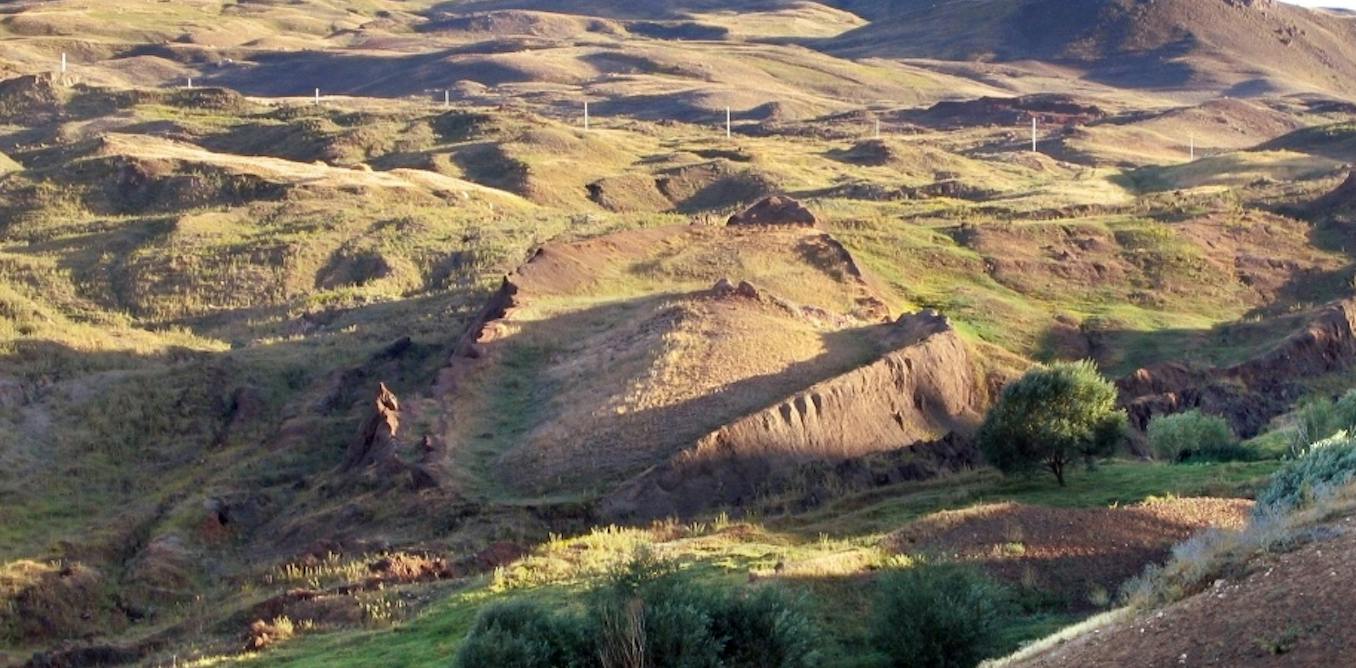
A team of researchers from Sivas Cumhuriyet University in Turkey is investigating a long-standing claim: that a boat-shaped geological formation in the country’s east contains the remains of Noah’s Ark. In the biblical Book of Genesis, God decides to destroy the world with a flood. Following God’s instructions, Noah builds an ark – a large wooden vessel – to save himself, his family and animals of every kind. The formation in question, known as Durupınar, has been associated with Noah’s Ark for nearly 70 years. This new research team has attracted social media attention through a partnership with a separate U.S.-based Christian organization called Noah’s Ark Scans. This group has promoted the Durupınar site as the resting place of Noah’s Ark since at least 2021. Durupınar is a natural geological formation composed of sedimentary material rich in iron oxides. It is located near the town of Doğubayazıt, just a few miles from the Iranian border. Official statements from researchers involved in this project say that laboratory analysis is still underway. Researchers have nevertheless described some preliminary findings as potentially consistent with a shiplike structure, while claims circulating on social media have been more definitive, saying that scans have confirmed the formation is man-made and “100% not geological.” Claims that the formation is man-made have also appeared in British and American media coverage. As a scholar of early Christianity, I study biblical texts and their interpretation. Certain claims about the Durupınar formation have been circulating for decades, and they offer an opportunity to examine how people read and interpret the biblical flood story. To understand the current claims, it helps to ask how this formation came to be associated with Noah’s Ark in the first place. A boat-shaped formation in eastern Turkey The Durupınar formation takes its name from the Turkish Army captain İlhan Durupınar, who noticed the formation’s boatlike shape while examining aerial photographs of the region in 1959. Because of its close proximity to a peak known since the Middle Ages as Mount Ararat, which the Genesis flood account claims is the place that Noah’s Ark came to rest, Durupınar wondered whether this formation might be the petrified remains of the ark, preserved in the landscape over time. The following year, Durupınar joined a team sponsored by the Archaeological Research Foundation in the United States on an expedition to the site. Led by George Vandeman, a television evangelist, and Arthur Brandenberger, a specialist who used aerial photographs to measure and map the landscape, the team traveled to the site with the explicit goal of confirming whether it was, in fact, the petrified remains of the fabled Ark of Noah. The expedition was the subject of a short article in the Sept. 5, 1960, issue of LIFE magazine. The article noted that while one member of the expedition remained skeptical on whether nature alone could be responsible for a shape like this, the surveys conducted ultimately “revealed no sign that the object was man made.” The expedition therefore concluded that it was a natural geological formation. In other words, it wasn’t the petrified remains of the biblical Noah’s Ark. How Durupınar became Noah’s Ark In the wake of the 1960 expedition, interest in Durupınar waned, and the case was closed for a time. The site returned to public attention in the late 1970s, when Ron Wyatt, a nurse anesthetist and amateur archaeologist inspired by the LIFE article, traveled to Durupınar to investigate for himself. While at the site, Wyatt conducted a series of tests and eventually claimed that the formation was actually the remains of Noah’s Ark. He argued that radar and other scans showed evidence of walls, decks, petrified wood, metal fittings and other materials that one might expect to find in the ruins of a wooden ship. Wyatt was also intrigued by large stones near the site that he claimed would have hung from the boat and steadied it while it was afloat. Wyatt was initially able to convince another amateur archaeologist from the U.S., David Fasold, that his claims were true. In fact, in 1988 Fasold published a book in which he argued that the Durupınar formation was Noah’s Ark. Flemish painter Simon de Myle’s illustration of Noah’s Ark on Mount Ararat. Sotheby's Paris, June, 23 2011 via Wikimedia Commons Fasold’s enthusiasm for the site was relatively short-lived, however, and not even 10 years after publishing his book on the topic he co-authored a journal article with geologist Lorence Collins that overturned his earlier conclusions. After a full assessment of the available evidence, Fasold concluded that “the supposed Ark near [Doğubayazıt] is a completely natural rock formation. It cannot have been Noah’s Ark nor even a man-made model.” Trained geologists have tended to agree with the assessment of Fasold and Collins: Durupınar is a natural geological formation rather than the remains of a wooden ship. Geologist Murat Avcı, for example, identifies the boat-shaped feature as a large block of limestone that moved downslope in a landslide and was subsequently shaped by an earthflow and other geological processes. Geological analyses identified the material that Wyatt described as petrified wood as ordinary rock, and the objects described as iron brackets as weathered volcanic material. The patterns that were interpreted as compartments of the ark are consistent with the formation’s natural structure and fracturing, while the proposed “anchor stones” are actually made of local volcanic rock. New research, ancient myth All of the results from the most recent research project are, at the moment, still preliminary and inconclusive. Samples are waiting to be analyzed in labs, and official communications from the university say that evaluation of the evidence will continue into 2027. As a biblical scholar, though, I am more interested in our ongoing fascination with flood stories. Most biblical scholars read the story of the flood in Genesis as part of a much older tradition of flood mythology from the ancient Near East. Writers in ancient Mesopotamia told several versions of a story in which the gods send a catastrophic flood but warn one man, who then builds a large boat to save his family and animals. In the Atrahasis Epic, for example, known from manuscripts dating back to the second millennium B.C.E., that survivor is Atrahasis. Another version of the same story also appears in the Epic of Gilgamesh, where the flood survivor Utnapishtim builds a large boat to weather the storm. Genesis does not simply copy these older stories; it reshapes them. In Atrahasis, noisy humans become annoying to the gods, so the gods drown them. Genesis, on the other hand, presents violence and corruption as the chief problem. The ending of Genesis also moves in a different direction. Rather than imposing new limits on human reproduction, as the Atrahasis epic does, God in Genesis blesses Noah’s family, tells them to “be fruitful and multiply,” and establishes a covenant with all of humankind and every living creature. One of the more interesting things about the flood story in Genesis is that the flood actually fails to solve the problem that caused it in the first place. Before the flood, humankind is inclined toward evil. After the flood, the problem is still there. But the story isn’t ultimately about eliminating human wickedness; it is about how life goes on despite humankind’s enduring flaws. The current search at Durupınar, like those that came before it, assumes that behind the biblical story there is tangible evidence just waiting to be found. For nearly 70 years this boat-shaped formation has kept that possibility alive. Ancient flood stories and how they changed across cultures can reveal how people made sense of catastrophe, human violence and the possibility of starting over. A boat-shaped formation in eastern Turkey probably cannot.
Why people keep looking for Noah’s Ark in a natural rock formation in Turkey: A scholar of early Christianity explains
Full Article
Original Source
Read the full article at Theconversation →KhanList aggregates and links to publicly available news content. We do not host full articles from third-party sources. Always verify important information with original sources.