
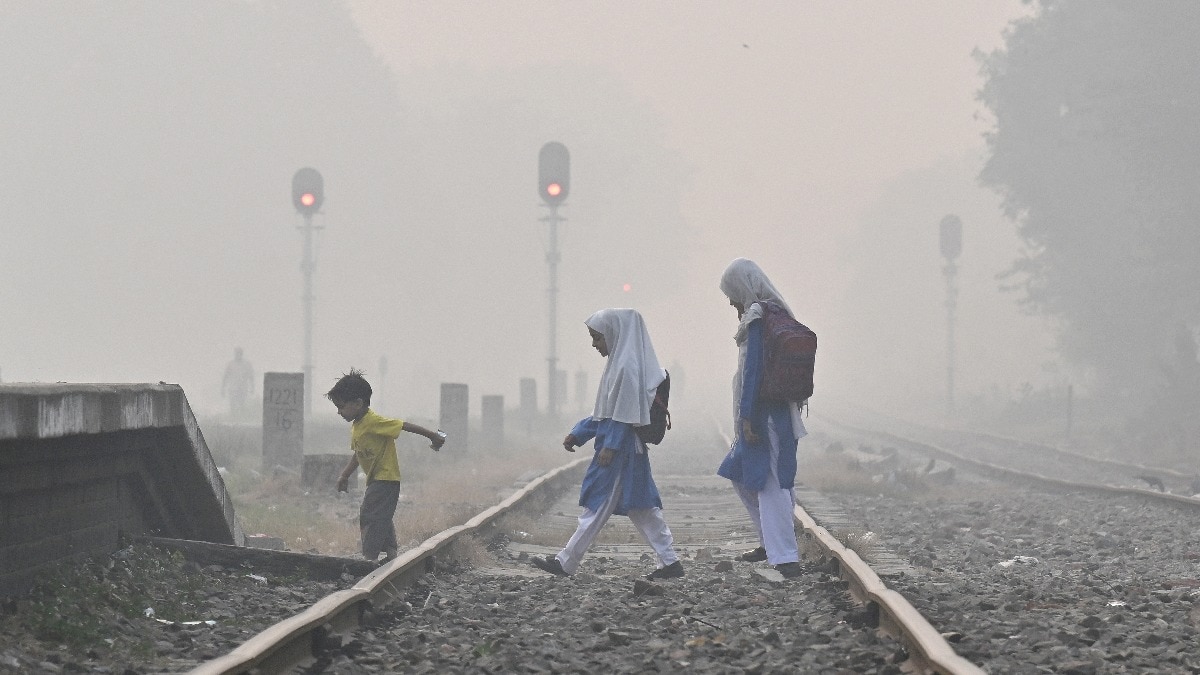
While smoke from farm fires in Punjab and Haryana is believed to be driving the spike in Delhi's pollution, an unusually high number of stubble burning incidents in Pakistan is aggravating the crisis, satellite data shows. We explain the Pakistan factor behind the rise in Delhi's AQI.Schoolgirls cross railway tracks amid smog in LahoreNew Delhi,Nov 3, 2026 12:15 ISTDelhi's annual pollution season appears to have arrived earlier than usual, with the air quality (AQI) deteriorating sharply to 'very poor' days before Diwali. While stubble burning in Punjab and Haryana is believed to be driving the spike in Delhi's pollution, an unusually high number of crop fires in Pakistan is aggravating the crisis. The result? Delhi is already breathing some of its worst air of the season.Usually, the spell of hazardous-looking winter smog begins after Diwali. Year after year, Supreme Court directives on a 'green' Diwali and various piecemeal government initiatives go up in smoke. This season, Delhi's AQI slipped into the 'very poor' category for the first time on Monday (November 2). On Tuesday, while the average AQI hovered around 330, at least three stations recorded severe air quality (above 400).DELHI AQI: 2026 vs 2025Just three days ago, on October 30, Delhi's AQI was down to 60 following rainfall. In fact, Delhi saw its cleanest October air quality in more than eight years, recording an average AQI of 167.The pollution spike well before Diwali has led the government to impose GRAP II emergency measures. This includes stricter pollution control measures, like water sprinkling, use of anti-smog guns, and monitoring of construction sites. According to the Central Pollution Control Board (CPCB), an AQI between 301 and 400 falls in the 'very poor' category, while 401 to 500 is classified as 'severe'.Compared with last year, Delhi's AQI first entered the 'very poor' category on Diwali eve (October 19). GRAP II came into force from that day. This year, the AQI has crossed the 300 mark nearly a week before Diwali. Satellite data shows a sharp rise in agricultural fires across Pakistan's Punjab PAKISTAN TO BLAME FOR DELHI POLLUTION?Meteorological experts say a key factor is the sharp rise in agricultural fires across Pakistan's Punjab. Favourable weather conditions have added to the concerns.Northwesterly winds are currently blowing across the region, creating a pathway for the smoke from crop fires in Pakistan to travel across Punjab, Haryana, and Delhi-NCR. Moreover, relatively low wind speeds are making it difficult for the pollutants to disperse.The landlocked geography of the northern plains adds to the problem, trapping pollutants closer to the ground."Active stubble burning across Pakistan and Punjab is peaking now. Northern plains are, as usual, acting up as landlocked geography. As the fires continue to rise and local emissions will keep on adding, the AQI across the region is expected to deteriorate further in the coming days," meteorological expert Navdeep Dahiya tweeted. Stubble burning in Punjab and Haryana is believed to be driving the Delhi AQI spike (PTI) Satellite data shows that fire counts in Pakistan's Punjab are unusually high this year. Crop-fire detections in Pakistan's Punjab are 4.2 times higher than in Indian Punjab during the first 29 days of October, according to a report in Dawn.The findings are based on NASA's Fire Information for Resource Management System (FIRMS), which uses satellite instruments to detect active fires.As per the data, Pakistan's Punjab recorded 13,241 stubble burning incidents between October 1 and 29. In comparison, Indian Punjab recorded 3,158 detections during the same period.The stubble burning activity has spiked towards the end of October. As many as 6,655 incidents, nearly half the month's total, were detected in Pakistan's Punjab in the last seven days of October alone.Much of it has been concentrated in the rice-growing belt around Lahore. This has resulted in Lahore ranking as the world's most polluted city on November 2. As per reports in Pakistan, the AQI exceeded 500 in several areas.The data points to a reversal of the situation in 2019, when Indian Punjab recorded almost five times as many crop-fire detections as Pakistan's Punjab.An analysis found that satellite-detected crop fires in Indian Punjab fell by 95% between 2021 and 2025, Dawn reported. In Pakistan, however, it increased by 33% between 2019 and 2025.However, it must be noted that a higher number of fires in Pakistan does not, by itself, mean that they contributed to Delhi's pollution.IS THERE ANY RELIEF IN SIGHT FOR DELHI?There is a combination of factors, including falling temperatures and sluggish winds. Also, smoke from farm fires in Punjab and Haryana continues unabated.Moreover, many farmers were unable to harvest their fields in October due to untimely rainfall in the north triggered by Cyclone Arnab. "Many of them will now rush to do that, which will lead to an accumulation of stubble fires," a senior CPCB official told The Print.The IMD forecast indicates that northwesterly winds are likely to continue for the next four days. This means more smoke from farm fires in Pakistan, Punjab and Haryana is likely to travel across Delhi-NCR. Coupled with relatively calm winds, it is likely to trap pollutants closer to the ground."We could expect the first day of severe AQI within the next 3 days," Navdeep Dahiya said.The coming days will, therefore, prove crucial for Delhi-NCR. With Diwali approaching, the possibility of additional pollution from firecrackers will add another layer of concern to an already deteriorating situation.- Ends
Why Pakistan is also a factor as Delhi's air turns toxic before Diwali
Full Article
Original Source
Read the full article at Indiatoday →KhanList aggregates and links to publicly available news content. We do not host full articles from third-party sources. Always verify important information with original sources.