
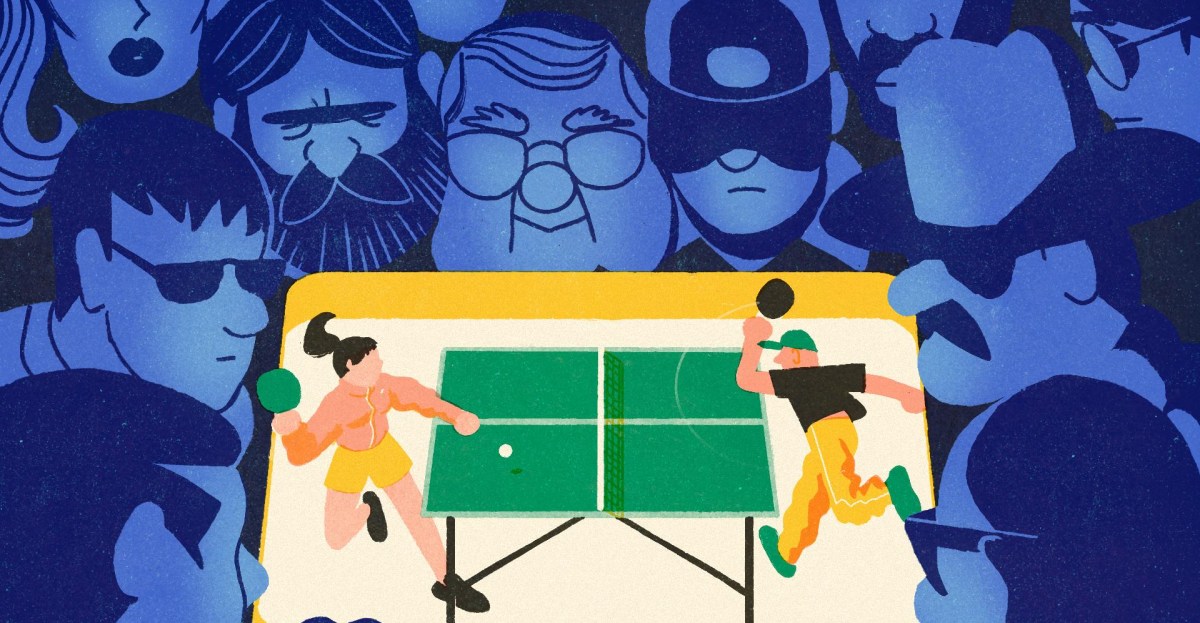
If you were living in Colorado in May and bet on sports online, you’d statistically have been most likely to bet on professional basketball. Next on the list was baseball. The third-most wagered sport?Table tennis.Colorado is almost certainly not an outlier. Table tennis occupies a similarly high ranking in Oregon, the only other state to provide sport-by-sport breakdowns of gambling revenue. And it’s likely true in every other state that allows sports gambling. This is a strange fact, one that’s been reported by a few local and national outlets. And beyond the bets involved, it’s also a window into where sports gambling is going, and how sports betting is morphing into something stranger and more destructive than dropping $100 on the New York Yankees to cover the spread on Saturday.There’s the old quip that the Holy Roman Empire was neither holy, nor Roman, nor an empire. In some sense, this is sports betting that involves neither sports nor betting. The gambling on table tennis isn’t really on the game of table tennis. It’s on a strange simulacrum of table tennis created solely for the purpose of creating more ways to gamble on it. For many of the people involved, it’s a kind of mindless, by-the-second slot machine rather than an informed wager on a player they might think can win. Ping-pong, in other words, has been reengineered into an addictive technology.The story of how table tennis came to occupy this outsized role in sports betting — and what it really looks like now — offers an unsettling peek at how fast all of this is moving, and how much the business of gambling can distort the real world around it.First, there’s a recent historical quirk. When most professional sports leagues shut down during the early stages of the Covid-19 pandemic, low-level, peculiar table tennis leagues in Eastern Europe popped up and were often the only game in town when it came to being able to place bets on sports. In May 2020 in Colorado, $6.5 million was wagered on table tennis, more than 25 percent of the statewide total — making it the most popular sport to bet on, simply because it was available.But even after other sports came back, table tennis stuck around. In Colorado this past May, with every other sport back and operating, table tennis was bringing in $33.9 million, five times what it had been. The same pattern held in Oregon: In May 2020, table tennis was the most bet sport in Oregon, with $3.7 million wagered. By this past February, it was still the second-most bet sport, but now with $9.5 million wagered.LSports, a company that collects and provides the real-time data that sportsbooks use to take and pay out bets, has a report intended for gambling operators that provides some of the starkest information on this. Its advice: “Table tennis is no longer sports betting’s dark horse; it has become an essential asset for sportsbooks seeking 24/7 bettor engagement.” And a main reason for the appeal is the intense, constant flow of matches, so betting companies have “minimal gaps in their live offerings.”How is table tennis producing this much betting content? Sports aren’t on 24/7, and they have leagues, tournaments, offseasons, and training camps. But table tennis is different. The matches being bet on are not real leagues.They have players that true fans of the sport would not recognize. They are played in strange, unmarked basements in Eastern Europe, with players whose names, if searched, reveal nothing beyond profiles on sports betting websites. The players’ abilities are clearly not at a professional level. Real, professional table tennis like World Table Tennis has packed arenas, high production value, professional announcers, and trophies for winners. Top athletes are elite physical specimens, able to hit small plastic balls 50 miles an hour at 150 rotations a second, with unfathomable hand-eye coordination. Players are national celebrities in their home countries.When I logged on to DraftKings in Maryland and saw the “TT Elite” league available to bet on, the livestream of the match showed a single table in a bare, windowless, dark-gray room with no evident spectators, coaches, or even windows.It is the gambling tail wagging the sports dog; the sports exist solely to provide fodder to be bet on.How sports betting became an addictive productFor those who don’t gamble on sports, there may still be a misunderstanding that what people are doing on DraftKings or FanDuel is dropping a basically simple bet or two a week, gambling on this or that team to cover the spread, or maybe betting a favorite player will win an end-of-season award. It isn’t.These apps, however, are now a labyrinth of parlays (combining multiple bets into one, all of which must win to pay out), prop bets (bets on some individual event, like a single point), and invitations to bet on the next quarter, the next point, the next five seconds. The betting dashboard gives an impression of nothing so much as a casino floor: overwhelming and constantly changing, giving the impression that skilled play is possible, whether or not that’s the case. Most of all, there are hundreds upon hundreds of ways to bet, a salami that can be sliced infinitely thin.This is very much how these companies intended it. Simple sports bets, like who will win a game, are actually not terribly profitable for bookmakers, who in fact can lose if betting lines are set incorrectly. This made companies actively seek to reengineer sports betting into slot machines, where bets come close to becoming totally abstracted button pushing. With prediction markets entering every nook and cranny of culture and politics, and casinos pushing states extraordinarily hard to get their products on our phones, it’s difficult to see where this stops.“Betting on ping-pong…is not a product built for recreation. It’s a product built to deliver constant action.” — Harry Levant, Public Health Advocacy InstituteThe Public Health Advocacy Institute (PHAI) filed a lawsuit against FanDuel, DraftKings, and the NFL, among others, for selling a “known addictive product.” The organization’s complaint filed on March 24 specifically notes of one of their client’s betting behavior that “if there were no U.S. games happening at a certain time, he would bet on international table tennis, again wagering repeatedly on every single point.” FanDuel did not respond to a request for comment on the allegations in the suit. DraftKings referred Vox to its trade group, the Sports Betting Alliance.I reached out to Harry Levant, PHAI’s director of gambling policy, and while he declined to expand on the facts in the complaint, he spoke generally about how someone might end up betting hundreds of times on table tennis a day. “By the time a person reaches pathological betting on ping-pong, they have often experienced many other forms of gambling, but more importantly, betting on ping-pong…is not a product built for recreation,” Levant said. “It’s a product built to deliver constant action.”Joe Maloney, the president of the Sports Betting Alliance, a trade advocacy organization representing online sportsbooks, told me on the question of addictiveness that “the existence of any market doesn’t make it more or less addictive.” He went on to say that “the vast majority of people that enjoy these products, that walk into casinos, that download legal apps…overwhelmingly these are people that are able to enjoy these products responsibly, but there are some people that demonstrate problematic behavior, and those people need all the support.”One reason for the rise in table tennis betting is, frankly, its fakeness allows it to provide that action during otherwise barren hours. These are not prexisting and longstanding sports leagues that an interested consumer can decide they enjoy and place a bet on — they are ad hoc “leagues” created solely for the purpose of allowing sports betting for consumers at hours and during dates when more “normal” bets are not available, like PHAI’s client.So, availability is one reason for table tennis’s continued success on sportsbooks — the fact that one can find a bet at almost any time, any day of the year.The second is the betting itself. By now, the concept of a proposition (prop) bet has become well-known: Will the first touchdown be from a pass or a run? Will the first pitch be a ball or a strike?Prop bets have come under fire from critics who say they push sports betting into dangerous territory. Two MLB pitchers were indicted for altering pitches in order to rig specific prop bets they could then profit on. Similarly, two NBA players pled guilty to federal charges after manipulating their performances to ensure certain prop-bet outcomes. One of them, according to a story in the New Yorker, was an avid table-tennis bettor. (In October, the NBA directed sportsbooks it has partnerships with to remove certain kinds of prop bets.)But those scandals aside, online, mobile technology that allows live, in-game betting has fundamentally warped how sports gambling now takes place. In those TT Elite games and many other sports, you have the ability to make individual bets point by single point, which means many gamblers end up with dozens, even hundreds of bets laid an hour, with a constant stream of wins and losses. This is what led one gambling researcher to refer to it as “the crack cocaine of sports gambling.”Tennis is a sport I play poorly but follow reasonably seriously. On DraftKings, betting on tennis is completely inscrutable to me. I can barely interpret the odds it offers for point-by-point betting, or the numbers and statistics flashing and disappearing on the screen constantly. But there’s a reason it’s all there: As with ping-pong, tennis has a reasonably fast pace of point play, which fits the need for a gambler who wants the ability to push a button incessantly to gamble.It isn’t about winning and losing betsYou may ask: Why? What does a gambler get out of this? It seems to defeat the purpose of sports betting as one sees it in pop culture, even degenerate gambling like in Uncut Gems: the immense bet on an outcome that will either make you a zillionaire or bankrupt you. What satisfaction is someone getting out of a steady stream of $30 bets on individual points of table tennis, which doesn’t even dangle the prospect of making you rich?The answer brings us to slot-machine design, which is what in-game betting has in essence devolved into.Natasha Dow Schull, who wrote Addiction by Design on casino gambling and specifically slot machines, explained why players end up searching for this experience. She interviewed many users of slot machines, who explicitly stated they were not searching for excitement or a prospective “big win” but a kind of flow state or sedating “zone” through high-speed action.Dow Schull writes, “Speed is a critical element of the zone experience,” and gives several stark quotes from her interviewees.“The speed is relaxing. It’s not exactly excitement; it’s calm, like a tranquilizer. It gets me into the zone,” says one. “In a very paradoxical way, the speed of it slows me down,” says another. Schull expands, “As he [the interviewee] recognizes, a mechanically mediated tempo functions as a form of predictability that structures and regulates his play, transforming risk into rhythm. As long as gamblers hold their speed steady, it suspends them into the holding pattern of the zone.”As a matter of fact, problem gamblers sometimes even actively dislike winning a jackpot. Schull describes gamblers telling her, “It’s so weird, but when I win a jackpot, I get really frustrated and angry and irritated. … I think it’s because it interrupted the zone, and really why I’m sitting there is to stay in the zone. And when I win a jackpot, the lights start flashing, the machine freezes up. … Suddenly I’m back in the world where I don’t want to be.” Levant echoed this to me. He said, noting that winning money is not the point, really, “Gambling disorder has nothing to do with money, full stop. … It’s being in action, and that is what all of these products, including every serve in a ping-pong [match] that you can’t even see, is delivering.”This is how one can mindlessly bet on two men playing mediocre table tennis in an empty gymnasium. No, there’s no inherent meaning — but does a slot machine have any inherent meaning?This was discovered by casino management consultants decades ago, long before the same phenomenon started infecting sports betting. Schull cites one consultant as writing, they designed the machinery of slot machines to “harness technology for continuous gaming productivity.” Long play durations and a slow bleed definitively take more money than single, high-stakes bets. (As a side point, this is actually why traditional slot machine arms were replaced with digital buttons: They were easier and faster to push, and fatigued users less to allow for longer play durations. Phones have the same benefits versus, say, traveling to a physical sportsbook.)This language is echoed in that LSports report on table tennis, where they note specifically that the game’s strength is that its “extraordinary fixture volume enables fast cycles, encouraging bettors to reinvest their winnings quickly and fueling repeat engagement.”I was struck listening to Schull in an interview describe modern slot machines as fundamentally inscrutable in a way similar to what I experienced looking at tennis bets. Unlike an old-fashioned one-armed bandit, that you pulled once and hoped you won by a single line of three cherries, modern slot machines have hundreds of possible ways to win, with diagonal lines, criss-crossing lines, and so on.A player might “bet 100 pennies on 100 lines,” which “creates more of a sense of flow. Instead of losing everything, winning everything, which can be very jarring…today, people are lounging back with glazed-over eyes in these ergonomic chairs spending a huge amount of time…slowly chipping away at their money…if you put in $100 and you win back $20, that’s a loss…it feels the same as a win. Lights flash, ding ding ding ding, and you kind of relax into the flow of the machine.”This is remarkably similar to the kinds of same-day parlays, bet hedging, and in-game live point-by-point betting that saturates modern sports gambling. In the same way it sounds a bit off to say you’re “betting” on a slot machine, this is the second part of that fork: The sports aren’t real, and neither is the betting.If you were asked to look at two players you’d never heard of, in a sport you neither watched nor played, and decide who would win this point, then the next, then the next, you would have created a certain kind of slot machine. A button is being pushed and a result is coming back. A single DraftKings page might have rows of bets, “Game 3 – Point 9,” “Game 3 – Point 10,” “Game 3 – Point 11,” each a spin of the proverbial slots.What you’re gambling on becomes rapidly irrelevant to someone deep into problem gambling; there simply has to be something available and preferably fast. In the podcast Nothing Off the Table, a recovering problem gambler explained simply: “When you don’t have anything to gamble, you find a way, no matter what.” Which is why he also states at night he’d gamble on “Chinese ping-pong, Japanese tennis, anything I could get my hands on.”The bleak future of sports bettingCompanies are well aware of this phenomenon, which is why even legitimate niche sports are quickly taking sponsorship deals to collate and provide their data to betting platforms hoping that they can be the next table tennis.In many states you can now bet on the Disc Golf Pro Tour, the World Surf League, and the Grand Slam of Curling. For those not deep into the weeds of this kind of gambling, seeing maps of where gambling on “Street League Skateboarding” is legal, FAQs answering: “Why can’t I bet on BKB Bareknuckle Boxing in my area?” and headlines like “How to Get Started with Power Slap Betting?” might be jarring.If the legitimate version of these sports are not available, they can simply be created ex nihilo, like the basement table tennis leagues. A reporting collaboration between Bellingcat and Josimar found similar “leagues” of school gymnasium soccer, sometimes with actual children as the players being bet on, along with glorified lawn games and literal arcade games, all taking place in gymnasiums and warehouses in Russia, Ukraine, and Belarus solely to provide something to bet on.The scale is breathtaking: Bellingcat’s reporter, Ross Higgins, estimated that they “played” and streamed 1,000 games in a 24-hour period: “It’s like watching sport with all the fun and competitive element taken out. You’re watching it to gamble on. … There’s no commentary…there’s no referee, there’s nothing that you’d enjoy from sports.”Because these are filmed with cheap webcams, they have the appearance of “watching Squid Game through a camcorder.” The images are frankly difficult to fathom.1xBet via Bellingcat1xBet via BellingcatWhile this may seem like a seedy underbelly of the sports betting industry, it has to be emphasized that there are only a couple jumps between these sham competitions and the most successful multinational sports betting companies, along with professional sports.These fake school gym matches were being streamed and bet on 1xBet, which is an official sponsor of FC Barcelona, one of the top soccer clubs in the world, and sponsors many legitimate sports, like the ATP Challenger Tour, professional tennis’s “minor league.” LSports lists “TT Elite,” the warehouse table tennis I watched on Draftkings, as the second-most popular table tennis league to bet on. The seedy underbelly is just the creature itself. (I also contacted 1xBet and TT Elite for their comments on steps they take to ensure match integrity, but they didn’t respond.)It’s unsurprising that many of these matches have turned out to be rigged. This was a serious enough problem in the early days of Covid that New Jersey, Colorado, and Indiana suspended betting on these kinds of leagues, that is, those “not sanctioned by the sport’s top governing bodies.” And in 2023, an Australian table tennis player pleaded guilty of having inside information and placing over a thousand bets on matches he knew were rigged.As real sports leagues like the NBA and MLB desperately try to control the damage to their brands by having platforms like DraftKings and FanDuel limit prop bets, problem gamblers will simply flow downstream to platforms and sports that allow the behavior they’re now in thrall to. Table tennis, for the time being, has a unique and powerful alchemy of speed of play and constant availability, but the devolution will likely continue.Indeed, by the time you read this, this piece of writing may itself be out of date. Companies from multiple sectors are pushing extraordinarily hard to open up new venues to exploit potential profit centers. Eight states have already legalized so-called iGaming, which allows casino games and slot machines themselves to be played on one’s phone, removing the need for a fake sport to be played at all.Prediction markets, widely talked about as they enter into sports, politics, and current events also have bets on things like “Lowest temperature in Denver on November 5” and “# of views of next MrBeast video on day 4.” States have resisted legalization and in some cases sued prediction markets as being de facto gambling operators. But when they are legalized, the evolutionary process here escalates rapidly.As The Upshot found, Pennsylvania allowed mobile casino gambling in 2017, and within seven years, it was generating more than five times the revenue than all of sports betting. (They also rocketed up as the reason for calls to problem gambling hotlines.)A moderate’s commonsense position might be to decide that if sports betting is to be legal, then the activity should consist of, well, betting on the sport. Not betting on whether a first pitch of a game is a strike, or the 14th point of the third game of a table tennis league in a warehouse basement will be won by player A or B, but a bet about an event at least one hour into the future, on the final outcome of a sport overseen by a top governing body. What’s wrong with “$100 on the Yankees to cover the spread tomorrow”?Various countries have versions of these kinds of limits. Australia prohibits betting on live games online. Germany has intervals between live bets to prevent compulsive by-the-second bets. Norway has monthly limits on losses imposed on every resident. Nebraska voters on Election Day rejected a referendum supported by DraftKings and FanDuel to allow mobile gaming, in what Nate Grasz, the executive director of the Nebraska Family Alliance, a conservative organization, told me was “an effort by out-of-state gambling companies to make money off addiction.” That result means that residents will continue to need to go to a physical racetrack casino to bet.Each of these restrictions share the same goal of increasing friction on betting. Meanwhile, we’ve let companies do the opposite — remove every last form of friction, whether physical, financial, or psychological. Even if we can’t return to the days of $100 on the Yankees, we don’t need to allow $5,000 to be spent in seconds on the 27th, 28th, 29th, and 30th point of YouTube gymnasium table tennis.
Why online gamblers are obsessed with table tennis
Full Article
Original Source
Read the full article at Vox →KhanList aggregates and links to publicly available news content. We do not host full articles from third-party sources. Always verify important information with original sources.