
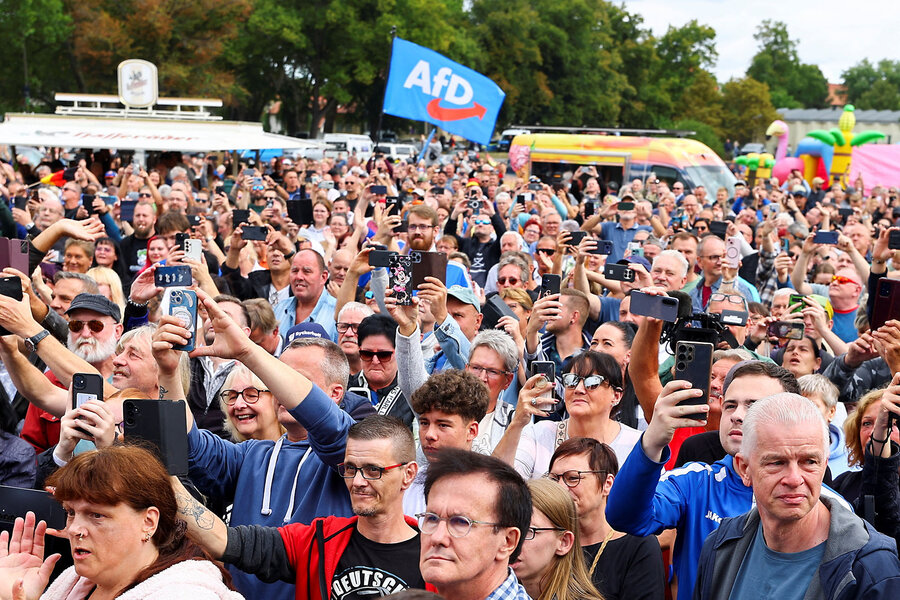
Whatever the result, Sunday’s election in the state of Saxony-Anhalt is a clear signal flare that the foundations of modern Germany are groaning.The far-right Alternative for Germany (AfD), which has been declared extremist by the German government, will almost certainly win the most votes. It is polling at over 40%, with the closest party in the low 20s. In some scenarios, it could win an outright majority of seats.It would be the first far-right party to control a German state since World War II. This matters not just because of the historical echoes, but because it would represent a dramatic failure of the postwar German order. German government, culture, and education have been carefully crafted in recent decades to prevent precisely this scenario. Why We Wrote This Germany’s postwar political system has been built around a single core principle: never again. But with the very real possibility of a far-right party winning state elections this weekend, that system is suddenly looking rickety. The AfD denies it is antidemocratic, but it relishes the idea of putting Germany on a new path. For years, Germany has built its identity on its leadership role in a broader and more open Europe and on its culture of remembrance – keeping the horrors of the Nazi regime ever fresh in thought. The AfD’s success shows the mounting tensions within Germany over whether that identity endures at the core of the new German state or has now outlived its usefulness.“It would defy the legacy of ‘never again,’” says Marcus Böick, a professor of German history at Cambridge University, speaking of the remembrance culture. “The prospect could be seen as a watershed moment.”At the AfD’s final preelection rally Thursday in the state capital, Magdeburg, a crowd of 6,000 is buzzing. For many Germans, flying the national flag brings a sense of discomfort – a fear of nationalism run amok. At the rally, German flags fly everywhere. Ulrich Siegmund rides on a tractor during a campaign rally ahead of the Saxony-Anhalt election, in Klein-Wanzleben, Germany, Aug. 31, 2026. The desire for dramatic change is no less evident. Gerda Werner grins broadly as she listens to the speakers talk about deporting migrants and taking on Chancellor Friedrich Merz’s unpopular government. The grandmotherly figure with vibrant red hair and sunglasses says Germany has no choice.“We must change,” she says. “All the other parties talk and do nothing.”For the AfD to win a majority of seats, several of the smaller parties would need to win less than 5% of the vote. Parties with less than 5% of the vote are excluded from the legislature, with their votes apportioned to the larger parties.If the AfD falls short of a legislative majority, all the other parties – from the conservative Christian Democratic Union to Die Linke on the far left – would likely join together to prevent the AfD from taking power. This “firewall” is an informal agreement among all other parties against the AfD.But it highlights the growing tensions reshaping German politics. In Saxony-Anhalt, that means dealing with a different kind of political wall: the former West and East Germany are reunited but not unified. SOURCE: Federal Statistical Office of Germany | Jacob Turcotte/Staff Saxony-Anhalt is in the former East Germany, and Dr. Böick remembers growing up there under communist rule. It seems almost wondrous to him now that doctors, teachers, and factory workers all lived in his same apartment block. “We didn’t have the wealth of the West, but we were all in it together,” he says.Life centered on the factories and the Communist Party – from festivals to youth groups. When East Germany collapsed, it all disappeared. “The whole fabric of Eastern German society was disrupted massively,” Dr. Böick adds. “No one filled those gaps.”Until the AfD. A map of voting patterns in last year’s federal elections looks like the Soviet-era wall between East and West has returned. And in a way it has. The AfD finished first across the former East Germany. While the largest traditional parties have roots in the West, AfD has made itself the people’s party of the East, embedding itself in numerous clubs and organizations. Historic half-timbered construction surrounds the central plaza in Quedlinburg, Germany, Aug. 4, 2026. While in western Germany much AfD support stems from opposition to immigration, experts say that in eastern Germany, the issue matters less. More significant is the states' shared East German legacy of shrinking populations, shortages of skilled labor, and higher unemployment and lower incomes than in western Germany. By almost every economic measure, the East still significantly lags the West. Dr. Böick says the population of his hometown in Saxony-Anhalt has declined by half since reunification. The state is the oldest in the country by the average age of its residents, with the youth heading off to cities or the West.“Voting for right-wing populists is a very rational thing to do in the rural areas” of the East, says Dr. Böick. “It is a cry for support.”“They are unhappy with their fate,” adds Markus Ziener, an analyst in Berlin for the German Marshall Fund of the United States. “They feel the West Germans are in control of everything.”They also didn’t grow up on a steady diet of remembrance culture and European integration. In some ways, the rise of the AfD points to a clash of the different visions of German identity and nationalism in the former East and West.In the West, “there was a feeling that, as long as we built up their cities and gave them money, they would be happy and vote for middle-of-the-road parties,” adds Dr. Ziener. “There was so much beneath that superficial prosperity that we misjudged.”For Ronald Gläser, Saxony-Anhalt is just the beginning. The AfD member of parliament from Berlin sees the scales tipping – and the firewall is helping, in a way.“The firewall made us the only real opposition in Germany,” he says. “Anyone who is upset turns to us.”The question is whether the party is a threat to German democracy. Mr. Gläser rejects the charges against his party as an attempt to unfairly control the political discourse. “The AfD is just a party like all the others – more libertarian and more conservative, but not fascist,” he says. Nazism is a thing of the past, he adds. “It was a bad part of our history, but there is no neo-Nazi element in our country – at least not in any significant way.”Within modern Germany’s remembrance culture, such words are shocking, even alarming. For Mr. Gläser, that is the point – to change the conversation. For others, the AfD’s willingness to play down the past – combined with tough anti-immigrant rhetoric some see as racist – stokes the fear that has defined modern Germany, that they might repeat that past.“The question has a lot to do with our history – that we face what happened in World War II,” says Dr. Ziener of the German Marshall Fund. “If you start questioning this, are you abandoning the core principle of who we are?”
Why one state election could rattle modern Germany
Full Article
Original Source
Read the full article at Csmonitor →KhanList aggregates and links to publicly available news content. We do not host full articles from third-party sources. Always verify important information with original sources.