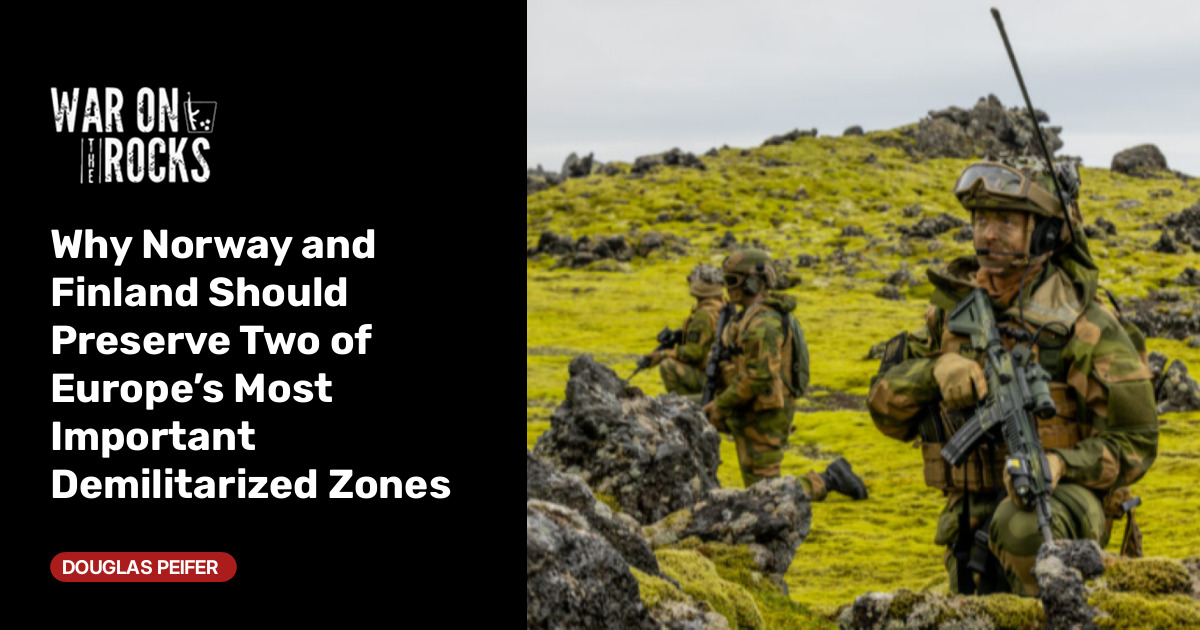
Svalbard is a stark archipelago of glaciers and coal mines lying 650 kilometers (403 miles) north of Norway’s North Cape, roughly halfway between the Norwegian mainland and the North Pole. It belongs to Norway but is governed under a 1920 treaty that grants nationals of more than 40 signatory states sweeping economic rights while barring Oslo from constructing naval bases or using the archipelago for “warlike” purposes. Far to the south, in the Baltic Sea between the Finnish and Swedish coasts, lie the Åland Islands, which are composed of roughly 6,500 islands and skerries. They are also home to 30,000 Swedish-speaking Finns. These islands are similarly bound by a 1921 convention that prohibits military fortification, constraining what NATO can do in and above them.When these treaties were inked, a Europe exhausted by World War I believed that treaties, arbitration, and international law would serve as an alternative to force of arms as the primary vehicle for addressing territorial disputes. World War II shattered that illusion, but the treaties survived.Russia’s invasion of Ukraine and NATO’s enlargement to include Finland and Sweden have generated serious debate whether these two century-old treaty regimes remain viable in a deteriorating security environment. Critics argue the restrictions are strategically obsolete and that the rules-based international order underpinning them is collapsing under great power assault from Russia, China, and an increasingly transactional United States.Those arguments deserve engagement but are unconvincing. The military gains from revision would be modest. Finland’s existing capabilities make remilitarization of the Åland region a marginal improvement. Norwegian and allied forces can replicate from mainland positions most of what enhanced Svalbard basing would provide. The diplomatic and normative costs of abandonment, by contrast, would be substantial: handing Russia a propaganda victory, antagonizing dozens of treaty signatories, and signaling that Norway and Finland regard their legal obligations as optional when inconvenient. For smaller states that cannot rely on hard power alone, a reputation for keeping agreements is a strategic asset. Jettisoning these treaty restrictions would trade a modest military benefit for a significant and lasting diplomatic liability.Historical Roots of Special Status The earlier of the two settlements — and, in some respects, the simpler — is the Svalbard Treaty, signed at Paris on Feb. 9, 1920. The archipelago then called Spitsbergen had long been terra nullius, belonging to no one. Coal discoveries in the early 20th century created a pressing need for legal administration. Norway, the geographically closest state with the largest commercial presence, had been pressing for resolution since roughly 1890, and the post-World War I Versailles negotiations provided that opportunity.The treaty — signed by Denmark, France, Italy, Japan, the Netherlands, Norway, Sweden, the United Kingdom, and the United States — resolved the sovereignty question in Norway’s favor while protecting the economic interests of other signatories. Article 9, the provision that generates most of the current controversy, specifies:Norway undertakes not to create nor to allow the establishment of any naval base in the territories specified in Article 1 and not to construct any fortification in the said territories, which may never be used for warlike purposes.The Åland dispute unfolded against a backdrop of chaos that makes the Svalbard settlement look straightforward. The islands had been part of the Kingdom of Sweden for centuries, sharing language and culture with the Swedish mainland. When Finland passed from Swedish to Russian rule in 1809, the Åland Islands were included in the transfer. Russia constructed a massive fort on one of the main islands, but British and French gunfire pounded it into submission during the Crimean War. The 1856 Treaty of Paris ending that conflict prohibited Russia from refortifying or garrisoning the islands and is the legal precedent for the 1921 convention that demilitarized them.When Finland declared independence in December 1917, the status of the Åland Islands became a bone of contention between Sweden and Finland. In one of the League of Nations’ first tests, the dispute was referred to the League’s Council in June 1920, where Sweden pressed its case with considerable vigor. When the League’s rapporteurs concluded in April 1921 that Finnish sovereignty was incontestable, Swedish diplomats objected that the ruling was incompatible with the principle of self-determination. Only sustained League diplomacy and the offer of robust cultural autonomy and minority protections for the Ålanders persuaded Sweden’s Liberal-Socialist government to reluctantly accept the Council’s decision.The resulting 1921 Convention on the Non-Fortification and Neutralisation of the Åland Islands is precisely what its name suggests. Finland may not construct fortifications, station troops, or allow foreign military forces to operate on the islands. Military aircraft may not overfly the zone without special authorization. A bilateral Finnish-Soviet Treaty of 1940, confirmed by the Paris Peace Treaty of 1947 and reaffirmed in a 1992 Protocol between Finland and the Russian Federation, established a Russian consulate in Mariehamn — the largest city in Åland — with the specific mandate of overseeing compliance. That consulate remains open today.On their face, the two arrangements share a common architecture: great power settlements that resolved contested sovereignty claims in favor of a Nordic state, while placing restrictions on military activity and guaranteeing access rights for other parties. The similarity is real but misleading.Key Differences in StatusMedia coverage and some scholarly writing treat Svalbard and the Åland Islands as two demilitarized zones where military activity is broadly prohibited. The characterization is accurate for Åland but misleading when applied to Svalbard. The distinction matters.Andreas Østhagen’s 2024 article “The Myths of Svalbard Geopolitics” provides the best systematic corrective. The most consequential misconception, Østhagen demonstrates, is describing Svalbard as demilitarized. Article 9 prohibits naval bases and fortifications and bars warlike use of the archipelago. It does not prohibit military transit, naval patrols, or military presence for non-warlike purposes. The Norwegian Coast Guard regularly docks at Longyearbyen for resupply and the Norwegian navy sends a frigate annually to demonstrate Norwegian sovereignty.The Åland Islands are demilitarized in the full legal sense of the word. The 1921 Convention neutralizes the islands: Finland may not use them as a base of wartime operations and foreign belligerents are barred from the zone. This is a substantially more comprehensive set of restrictions than those pertaining to the Svalbard archipelago.Arguments for RevisionTwo distinct but reinforcing arguments drive the case for revision. The first is straightforward: Times have changed. Both Norway and Finland now sit at the frontline of an alliance facing a revisionist Russia, creating a geopolitical situation utterly unlike anything the framers of 1920 and 1921 contemplated. The restrictions designed to keep these archipelagos out of great power competition increasingly feel like unilateral disarmament. The second argument is more corrosive: The rules-based international order that gives these treaties their normative foundation is itself under siege — not from adversaries alone, but from allies. When great powers treat international legal obligations as optional, the argument for small and medium-sized states to bear the costs of compliance weakens considerably.Svalbard’s position near the Greenland-Iceland-United Kingdom-Norway gap and its proximity to Russia’s Northern Fleet on the Kola Peninsula gives it real military relevance: The archipelago overlooks the routes Russian submarines must transit to reach the Atlantic. On Svalbard, concerns have grown since Putin’s annexation of Crimea in 2014 and its full-blown invasion of Ukraine in 2022. In 2018, James K. Wither — a professor at the George C. Marshall European Center for Security Studies — warned that Svalbard’s distance from the Norwegian mainland, Russia’s presence in Barentsburg, and the absence of any arbitration mechanism for treaty disputes left the archipelago “exposed both politically and militarily.” More recently, Chair of the Longyearbyen Community Terje Aunevik argued that Norway must be able to defend the archipelago, asking an audience in Harstad how NATO would respond to a possible military attack.The Åland Islands’ significance is primarily as a potential control point sitting astride the sea lines of communication and air corridors between Sweden and Finland. Concern about these has intensified since Finland and Sweden joined NATO. Alpo Rusi, a professor and former presidential advisor, has described Åland as “the Achilles’ heel of Finland’s defence,” arguing that its status creates a military vacuum Russia could exploit. Pekka Toveri, a former major general and ex-chief of intelligence of the Finnish Defence Forces, asserts the demilitarization clause does not hold well: “The world has changed, the security situation has changed, our neighbour has changed, and none of them has changed to a better direction.” A 2022 Yleisradio Oy poll found that 58 percent of Finns on the mainland supported a military presence on the islands. The Ålanders themselves have been considerably more cautious, but the Finnish mainland debate has shifted.The argument for revision gathers additional force from the increasingly open contempt with which great powers treat the rules-based international order when it does not suit their interests. Russia’s full-scale invasion of Ukraine in February 2022 was the most dramatic violation of the foundational premise of the postwar order that force is not a legitimate tool for redrawing internationally recognized borders. In the Baltic Sea, a campaign of undersea sabotage between October 2023 and January 2025 severed around a dozen pipelines, power cables, and communications links in anchor-dragging incidents attributed to shadow fleet vessels. In the Arctic, Russian subversive activities on Svalbard constitute a sustained campaign to test Norwegian reactions through provocations calibrated to remain below the threshold of NATO’s Article 5.China’s behavior in the South China Sea has made the same point from a different direction. Beijing dismissed the 2016 Permanent Court of Arbitration ruling against its South China Sea territorial claims as “null and void” and has continued constructing artificial islands and military installations regardless. If a major economy can simply disregard an adverse international legal ruling without meaningful consequence, the credibility of rules-based constraints is damaged for everyone who relies on them.Even from within the Western alliance, the signals have been troubling. At the 62nd Munich Security Conference in February 2026, U.S. Secretary of State Marco Rubio dismissed the entire post-Cold War framework of a rules-based global order as “a foolish idea that ignored both human nature and it ignored the lessons of over 5,000 years of recorded human history.” Weeks later, Secretary of Defense Pete Hegseth was dismissive: “We let ourselves get distracted by empty globalist rhetoric about the rules-based international order, while European capitals threw open their borders and hollowed out their militaries.”The question this raises for Oslo and Helsinki is uncomfortable: Why continue observing treaty restrictions when your large and powerful neighbors seem to regard the rules-based order as little more than rhetoric? Russia uses the Svalbard Treaty as political leverage while flouting international law in Ukraine and the Arctic. China ignores the South China Sea ruling. The United States sends mixed signals about its commitment to the rules-based international order. In that environment, the argument that Norway and Finland should abandon treaty obligations that constrain their freedom of action seems justified.The Case for the Status QuoThe case for maintaining the status quo rests on two related but distinct arguments. First, the military case for remilitarizing the Åland Islands and the Svalbard archipelago is weaker than its proponents claim. Second, smaller states benefit from rules-based frameworks. Abandoning the rules-based international order in response to great power bad behavior is precisely the wrong response.The Åland Islands Convention: Inconvenient but not IntolerableOn purely military grounds, the benefits of remilitarizing the Åland Islands are limited. Russia’s anti-access/area denial capabilities in the Baltic Sea region are already formidable and do not depend on the Åland Islands. Missiles, drones, and aircraft from Kaliningrad and the St. Petersburg area can threaten access to much of the Baltic Sea and Sea of Bothnia regardless of what happens on the islands. A Russian seizure of the Åland region would add marginally to those capabilities at the catastrophic cost of triggering NATO’s Article 5. Finnish air and naval forces, substantially enhanced since 2022, would make a large-scale Russian amphibious assault on the islands costly. Even if a lodgment succeeded, resupplying and reinforcing the position would be difficult against the combined Nordic air fleets of over 250 fourth- and fifth-generation aircraft. Finnish special operations forces, coast guard, and police are more than capable of dealing with any minor demonstrative incursions in the Åland region. Remilitarization would not transform the military balance in the Baltic.Finnish defense planners who favor revisiting the regime argue that credible defense of an unfortified archipelago cannot be improvised once war breaks out: Sensors, surveyed firing positions, hardened communications, and rehearsed amphibious response all require peacetime preparations. Anders Gardberg’s 1995 strategic survey, which explored the risks of a Russian rapid seizure of the islands, concluded that an “increased emphasis on mobile amphibious units instead of stationary units decreases the need for stationary fortifications. Thus the demilitarization of Åland becomes less important in the future.” This logic still holds. Surveillance aircraft, naval minelayers, and fast-response amphibious units do not need to be stationed on the islands. The Convention does not prohibit Finnish coast guard and police presence, over-the-horizon radar coverage of the surrounding waters, or P-8 maritime patrol aircraft operating outside the zone.When Finland negotiated NATO accession, both the alliance and Helsinki accepted the status quo. The Finnish government’s 2024 Report on Finnish Foreign and Security Policy, the first comprehensive foreign and security policy statement issued after Finland’s full NATO membership, was unambiguous: “Finland’s NATO membership does not affect the status of the Åland Islands, which is based on international conventions.” Finland’s April 2026 Government Report on Changes in the Foreign and Security Policy Environment, issued amid a markedly more dangerous security landscape, reaffirms that Finland “stands up for compliance with international law” and treats the rules-based international system as a cornerstone of Finnish security without recommending any revision to the Åland regime. NATO’s Baltic Sentry mission is designed to deter attacks on undersea cables and infrastructure. It does so while respecting the special status of the Åland Islands.One more consideration deserves weight: the Ålanders themselves. The 30,000 Swedish-speaking Finns who live in this demilitarized zone are unconvinced about the benefits of jettisoning the status quo. That perspective is sustained and institutionalized in the Åland Islands Peace Institute, an independent research foundation based in Mariehamn that holds international conferences and produces peer-reviewed publications, including a major Routledge volume on demilitarization in international law. The Institute’s sustained scholarly output, including the 2015 to 2018 research project “Demilitarisation in an Increasingly Militarised World” and regular Kastelholm Talks on Peace, represents the most comprehensive ongoing analysis of the archipelago’s status in international law. Contrary to the suggestion that demilitarized status leaves Åland isolated from Nordic security, the May 2025 Nordic Summit in Finland agreed to include Greenland, the Faroe Islands, and Åland in future Nordic ministerial meetings. Integration without remilitarization is a viable path.The Svalbard Status Quo: Worth the InconvenienceMaintaining the status quo in Svalbard is a harder case to make, yet Østhagen — the leading expert on the security dimensions of the Svalbard Treaty — leans against overturning inconvenient restrictions. He argues that Svalbard’s strategic vulnerability has been overstated and points out that Russia benefits from the status quo. As the only other state with a community on the archipelago, and with interests ranging from coal mining to scientific research to tourist spending in Barentsburg, Moscow has strong economic and political reasons to preserve the Treaty regime rather than challenge it. Østhagen concluded in 2024:Although Russia prefers to continue to pressure Norwegian authorities on Svalbard issues, it is not interested in instigating further regional instability and tension — unless the security situation should deteriorate further.Norwegian law already provides the tools to deal with provocations. Oslo can already enforce regulations related to vessel safety and seaworthiness, provided that those regulations apply equally to all. Environmental and safety regulation under Norwegian domestic law gives authorities broad discretionary powers to restrict activities in Svalbard’s fjords under nature reserve protections, entirely independent of treaty provisions. The treaty gives signatory nationals equal rights to fish, mine, and conduct commercial activity: It does not grant an unlimited right to use Norwegian-controlled fjords for operations that violate Norwegian law.Pauline Baudu offers a prescription that is both realistic and consistent with the treaty: NATO should “credibly signal its intention to minimize capability development and military exercises in Svalbard” while maintaining a strong deterrent force on the Norwegian mainland, incorporating hybrid threat elements into exercises, and improving allied information-sharing and consultation. This is essentially what Norway did throughout the Cold War, and it worked. Norway managed the Soviet threat across the full arc of the Cold War without abrogating the Svalbard Treaty. Putin’s Russia is dangerous and revanchist, but it is not the Soviet Union. Its military has been severely degraded by years of attrition in Ukraine. The argument that treaty obligations which survived the height of the Cold War cannot survive Russia’s current strategic maneuvering demands more evidence than its proponents provide.Against that backdrop, what are the costs of abandoning treaty restrictions? Abrogating or systematically violating the Svalbard Treaty would antagonize more than 40 signatory states and allies, validate Russian narratives about Western indifference to international law, remove the legal basis for Norway’s management of civilian life and commercial activity on the islands, and accelerate the great power competition over Arctic resources and access that the treaty was designed to prevent. Norway is a medium-sized power. It has more to lose in a scramble for the Arctic than it has to gain from marginally enhanced military positioning on Svalbard. Norway is strengthening its military presence in Trøndelag, Nordland, and Finnmark. Norwegian air and naval forces, reinforced by NATO forces, are more than capable of defending Norway’s internationally recognized sovereignty in Svalbard.Adhere to the RulesThe rules-based international order is fraying at its edges and under assault at its core. Russia wages aggressive war in Europe. China dismisses arbitration it finds inconvenient. U.S. commitment to the legal frameworks that underpin alliance solidarity is less certain than it once was. In that environment, the temptation for Norway and Finland to quietly shelve century-old restrictions that are genuinely inconvenient is understandable.It would also be a mistake. The treaties governing Svalbard and the Åland Islands should be maintained, for reasons that go beyond principle.For the Åland region, the military case for remilitarization is marginal: Finnish forces are adequate to deter and, if necessary, repel Russian activity without a permanent military presence on the islands. Article 7(ii) of the 1921 Convention already provides for emergency defensive measures should the neutrality of the zone be imperiled. The diplomatic and legal costs of revision would be substantial, handing Russia a pretext for action, creating uncertainty about the treaty foundations of Finnish sovereignty over the islands, and antagonizing an Ålandic population that has made its preferences clear. The restrictions are more inconvenient than intolerable.For Svalbard, the case is similarly clear. Norway coped with treaty restrictions throughout the Cold War, against a Soviet threat far more capable than anything Russia can currently field. The marginal military gains from treaty revision do not outweigh the diplomatic cost of abrogating the agreement. Russian pressure on Svalbard is real and may even escalate. This can be dealt with within the framework of the treaty. As for some sort of out-of-the-blue seizure of the archipelago by Russian military forces, the scenario is both unlikely and beyond Russia’s capacity to sustain and reinforce. Norway’s response should be to improve Norwegian and allied intelligence, surveillance, and reconnaissance in the High North, coupled with building up sufficient forces to project forces to the island in a timely manner should the need arise.The Svalbard Treaty has lasted over a hundred years. The demilitarized status of the Åland Islands traces back to 1856, and while ignored during World War I and World War II, poses more of an inconvenience than a strategic liability. The case for jettisoning the treaty restrictions that make these islands special, if not tranquil, has not been made.Douglas Peifer, Ph.D., is a professor of strategy and history at the U.S. Air War College. Peifer’s research centers on European security issues — particularly those related to Germany and Northern Europe, Arctic security, and transatlantic relations.The views expressed in this article are those of the author and do not reflect the official policy or position of the U.S. Air War College, the U.S. Air Force, the Department of Defense, or the U.S. government.Image: Sgt. Addysyn Tobar via DVIDS
Why Norway and Finland Should Preserve Two of Europe’s Most Important Demilitarized Zones
Full Article
Original Source
Read the full article at Warontherocks →KhanList aggregates and links to publicly available news content. We do not host full articles from third-party sources. Always verify important information with original sources.