
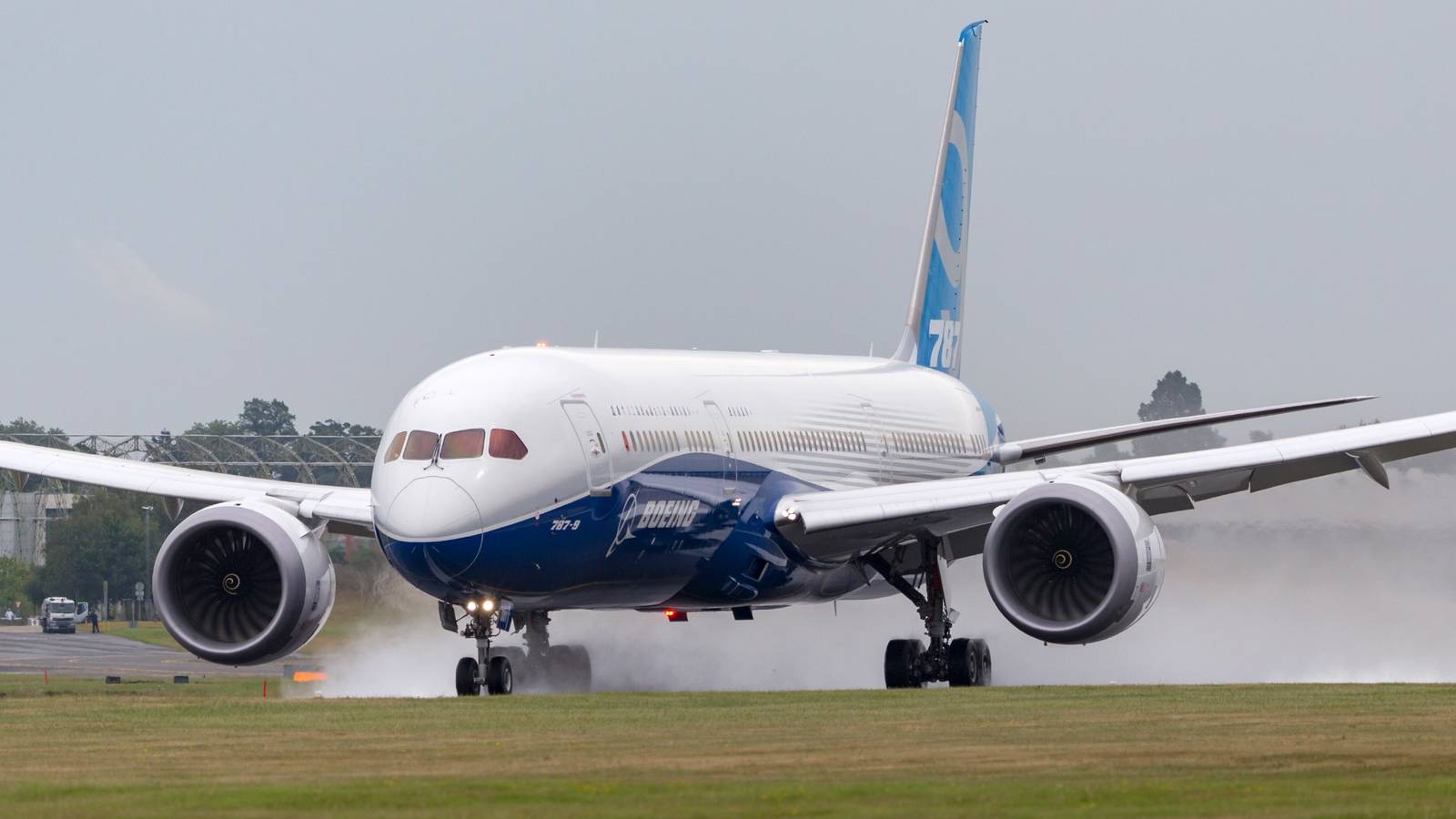
Credit: Shutterstock Published Jul 20, 2026, 1:30 PM EDT Josh is an Aviation Journalist and lifelong aviation enthusiast who's now turning that passion into a career. From watching planes and playing flight simulators at a young age to now sitting in the cockpit, Josh has always been drawn to the world of flight. Currently training to become a commercial pilot, Josh aims to make aviation interesting and accessible to everyone, whether you're in the industry or simply passionate about aviation. Now actively building a career in Aviation, Josh is focused on telling stories from inside the aviation world, stories shaped by firsthand experience, curiosity, and a genuine love of all things that fly. Sign in to your Simple Flying account The Boeing 787 Dreamliner has quietly become the most commercially successful widebody aircraft in aviation history. In the nearly 15 years since it entered service, the twin-aisle jet has carried over a billion passengers, flown nearly five million flights, and helped airlines unlock hundreds of nonstop routes that were once thought uneconomical. With more than 2,000 orders placed by nearly 90 customers, the Dreamliner has earned its place as the world’s best-selling widebody, reshaping how airlines think about long-haul travel. The Dreamliner’s mix of efficiency, versatility, and global adoption gives Boeing a powerful advantage in the mid-to-long-haul segment. As the 787 continues to expand its lead, Airbus faces pressure to respond with fresh innovation, sharper positioning, and a long-term strategy that ensures it won’t be left behind in the most competitive part of the widebody space. The Rise Of The Dreamliner Credit: Shutterstock When Boeing launched the 787 program, the ambition was to reshape the economics of long-haul travel. Instead of building ever-larger aircraft, Boeing bet on a mid-sized widebody capable of flying farther, faster, and cheaper than its predecessors. That gamble paid off handsomely, and the Dreamliner became the first twin-aisle aircraft to surpass 2,000 orders, cementing its place as the best-selling widebody in aviation history. The aircraft’s introduction was not without turbulence. Early development delays, battery issues, and supply chain hurdles raised doubts about its long-term viability. However, once in service, the 787 quickly proved its worth, delivering substantial fuel savings and reliability to airlines eager to modernize fleets. Within a decade, the aircraft had carried hundreds of millions of passengers, becoming a staple on international routes. Today, with almost 1,300 Dreamliners in service and close to 1,150 more on order, the 787 has firmly established itself as a backbone of global long-haul fleets. Its rapid adoption has changed the narrative from whether it could succeed to how much further it can stretch its dominance over rivals. Efficiency That Changed the Game Credit: KLM At the heart of the 787’s appeal is its efficiency, as, being built with around 50% composite materials, it weighs significantly less than traditional aluminium-framed jets. Coupled with advanced aerodynamics and next-generation engines, the Dreamliner delivers roughly 20–25% lower fuel consumption compared with older widebodies. For airlines facing volatile fuel prices and tighter environmental regulations, that’s a transformative improvement. The aircraft’s lower operating costs translate directly into profitability, as airlines can operate routes that previously would have been marginal or unprofitable, while passengers benefit from more nonstop choices at competitive fares. The economics of the Boeing 787 have been particularly valuable for airlines in regions like Asia and the Middle East, where long-haul growth is strongest. Beyond just fuel burn, the 787 also offers lower maintenance costs and improved passenger comfort, thanks to higher cabin humidity, larger windows, and quieter engines. These features make it not just an efficient airplane for airlines, but also a favorite for travelers, a dual advantage that strengthens Boeing’s position. Opening New Routes & Markets Credit: Shutterstock Perhaps the Dreamliner’s greatest contribution to aviation has been its ability to open new nonstop routes. With a range of around 7,500 nautical miles (13,900 km), the 787 allows airlines to connect secondary cities directly, bypassing traditional hubs. This 'long and thin' market, where smaller passenger loads still demand long range, was underserved before the Dreamliner. Airlines such as All Nippon Airways, Qantas and United Airlines have used the 787 to pioneer routes like Tokyo–San Jose, Perth–London, and Denver–Tokyo, proving the concept’s viability. These flights not only attract premium passengers seeking convenience but also reshape global travel patterns, forcing competitors to adjust their networks. Of the top ten longest routes by distance last year, according to FlightRadar24, four were operated by Boeing 787 variants, as detailed in the table below. # Airline / Flight Route Distance Aircraft Type Average Flight Time 1 Singapore Airlines SQ23 / SQ24 New York (JFK) to Singapore (SIN) 8,288 nm (15,349 km) A350-900ULR 18 Hours 27 Minutes 2 Singapore Airlines SQ21 / SQ22 Newark (EWR) to Singapore (SIN) 8,285 nm (15,344 km) A350-900ULR 17 Hours 58 Minutes 3 Qatar Airways QR921 / QR920 Auckland (AKL) to Doha (DOH) 7,848 nm (14,535 km) A350-1000 16 Hours 34 Minutes 4 Qantas QF9 / QF10 Perth (PER) to London Heathrow (LHR) 7,829 nm (14,499 km) 787-9 16 Hours 57 Minutes 5 Qantas QF21 / QF22 Dallas/Fort Worth (DFW) to Melbourne (MEL) 7,814 nm (14,472 km) 787-9 17 Hours 13 Minutes 6 Qantas QF33 / QF34 Perth (PER) to Paris Charles de Gaulle (CDG) 7,701 nm (14,263 km) 787-9 16 Hours 40 Minutes 7 Air New Zealand NZ1 / NZ2 & Qantas QF3 / QF4 New York (JFK) to Auckland (AKL) 7,671 nm (14,207 km) 787-9 16 Hours 52 Minutes 8 Emirates EK449 / EK448 Auckland (AKL) to Dubai (DXB) 7,667 nm (14,200 km) A380-800 16 Hours 41 Minutes 9 Singapore Airlines SQ35 / SQ36 & SQ37 / SQ38 Los Angeles (LAX) to Singapore (SIN) 7,621 nm (14,114 km) A350-900ULR 16 Hours 10 Minutes 10 Air India AI175 / AI176 San Francisco (SFO) to Bengaluru (BLR) 7,562 nm (14,004 km) 777-200LR (or A350-900 interchangeably) 17 Hours 22 Minutes By enabling the creation of, or improving efficiency and profitability on, countless new nonstop routes worldwide, the 787 has fundamentally altered airline strategy. Hub-and-spoke models are no longer the only way to grow long-haul markets. Point-to-point travel is increasingly attractive, and Boeing’s aircraft sits at the center of that shift. Airbus On The Defensive Credit: Shutterstock For Airbus, the Dreamliner’s runaway success presents a challenge. The A330neo is the 787's immediate competitor from Airbus, and it was meant to compete in the same segment, but sales have lagged, with many carriers choosing the proven economics of the 787 instead. While the A350 is a similar airframe in the sense of being a revolutionary twin-engine widebody, it isn't generally seen as an immediate competitor, and has carved out success in the larger, long-range category. This makes it more likely to pitch up against Boeing's very late-to-market 777X programme. The danger for Airbus lies not just in lost orders, but in lost momentum. Airlines and lessors often follow market leaders, and the 787’s strong order book reinforces confidence among financiers. That creates a self-reinforcing cycle where Boeing’s jet becomes the default choice for many carriers planning their fleets. The table below details a side-by-side comparison of the A330-900 and 787-9, utilizing data from Airbus and Boeing. Specifications Airbus A330-900 Boeing 787-9 Typical two-class seating 287-303 seats 296 seats Maximum Range 7,350 NM (13,600 km) 7,565 NM (14,010 km) Maximum Take-Off Weight 550,000lbs (250,000kg) 560,000lbs (254,000kg) Cruise Speed Mach 0.82 Mach 0.85 Length 209 feet (63.7m) 206 feet (63m) Wingspan 210 feet (64m) 197 feet (60.1m) Height 55 feet (16.8m) 56 feet (17m) Cabin Width 222 inches (5.64m) 216 inches (5.49m) Airbus must also contend with perception, as the 787 is widely seen as a modern, efficient, and passenger-friendly aircraft, a reputation some people feel Airbus has struggled to replicate with the A330neo. While the A350 has been praised, it competes more directly with Boeing’s 777X, leaving Airbus exposed in the mid-size widebody space where the Dreamliner dominates. Cracks In Boeing’s Armor Credit: Boeing Despite its achievements, the Dreamliner is not invincible. Production setbacks, quality-control lapses, and delivery delays have periodically frustrated airlines. Boeing’s well-documented supply chain challenges have at times slowed output and raised costs, creating opportunities for Airbus to position itself as the more reliable partner. Another vulnerability lies in the regulatory and sustainability landscape, as governments are pushing for lower carbon emissions. As such, the next wave of efficiency improvements may come not just from aircraft design but also from compatibility with sustainable aviation fuels and hybrid technologies. If Airbus can leapfrog Boeing here, it may capture future market share. Finally, customer diversification is key. While the 787 is flying with around 90 operators, Boeing’s heavy reliance on this program for widebody sales exposes it to risk if demand ever cools. Airbus could thus capitalize by offering a broader portfolio of aircraft with incremental upgrades, reducing Boeing’s dominance in any one segment. On top of this, the 787's design is already ageing: with technology and development having already moved on, some airlines have already started scrapping their Dreamliners. Whilst the aircraft is still a viable option for airlines and orders are still being placed, could we see a change in the market over time if Boeing shows a lack of foresight with either replacing or redeveloping the 787? Should Airbus Be Worried? Credit: United Airlines The Boeing 787’s success is not a fleeting trend. Rather, it represents one of the first steps in a long-term shift in the widebody market. By combining efficiency, range, and passenger appeal, the Dreamliner has redefined what airlines expect from a twin-aisle jet. Its record sales and widespread adoption underscore the confidence the industry has in its capabilities. For Airbus, the pressure is clear. While its current lineup has strengths, particularly with the A350 which has trounced the 777X so far, the lack of a true direct competitor to the 787, which has gained traction with airlines in the mid-size widebody market, presents a vulnerability. Unless Airbus responds with bold innovation or a next-generation aircraft program, it risks ceding this space to Boeing for years to come. In aviation’s high-stakes duopoly, no victory is ever permanent. However, for now, the Dreamliner’s dominance is undeniable, and it leaves Airbus with hard questions about how to reclaim lost ground in one of the most competitive and lucrative segments of commercial aviation.
Why Might The World’s Best-Selling Passenger Widebody Of All Time Have Airbus Worried?
Full Article
Original Source
Read the full article at Simpleflying →KhanList aggregates and links to publicly available news content. We do not host full articles from third-party sources. Always verify important information with original sources.