
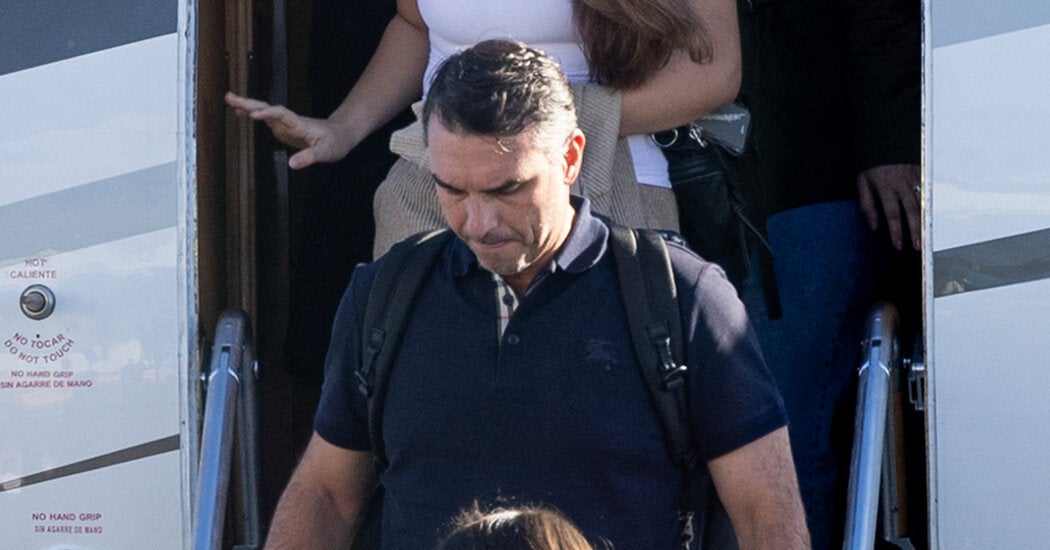
AdvertisementSKIP ADVERTISEMENTThe city’s Hispanic majority, news media reach and air links to Latin America have made it an ideal base for politicians escaping their home countries.Flávio Bolsonaro arriving at Opa Locka Executive Airport in Miami on Wednesday.Credit...Ricardo Arduengo/Agence France-Presse — Getty ImagesOct. 29, 2026, 3:13 p.m. ETWhen Flávio Bolsonaro arrived in Miami on Wednesday from Brazil, he joined a long list of Latin American politicians who have fled to the city to escape arrest or prosecution at home.Mr. Bolsonaro lost Sunday’s election to President Luiz Inácio Lula da Silva, and Brazilian authorities asked him to surrender his passports as part of a money-laundering investigation. He crossed to Argentina by land on Tuesday night with his wife and two daughters, then took a private plane to Ecuador and onward to Miami.From there, he issued a statement claiming that the election was fraudulent and declared himself the “legitimate president-elect” of Brazil.Exiled political leaders from Venezuela, Cuba, Nicaragua and other countries have found supporters in the Miami area, which is home to large Latino immigrant communities and is connected to major cities in the Caribbean and Central and South America by dozens of daily nonstop flights.“Miami is the hub,” said Guilherme Casarões, an associate professor of political science at Florida International University in Miami.He noted that the influx of anti-Castro Cubans starting in the 1960s, and especially since the 1980s, fomented a strong anti-communism sentiment in the city and a rightward drift in general. Many who have been exiled to or sought refuge in Miami, including Mr. Bolsonaro, come from the right side of the political spectrum.Mr. Bolsonaro also has the support of President Trump, who is ever-present in South Florida. Mar-a-Lago, the president’s private club and residence in Palm Beach, “is the informal capital of the country,” Dr. Casarões said.Many Latin American exiles may also find it comfortable.“Miami is a crossroads, with direct flights to nearly every Latin American capital, a language and daily life that feel familiar, and lawyers, banks and media already experienced in receiving people from the region,” said Luisa Turbino Torres, an assistant professor of political science at Florida Atlantic University in Boca Raton who studies Brazilian politics and social movements. “This makes it feel less like exile and more like an extension of home.”Here are some of the prominent political exiles who have made the Miami area home:Juan GuaidóVenezuelaImageThe Venezuelan opposition leader Juan Guaido in Miami in 2023.Credit...Marco Bello/ReutersSouth Florida has the largest population of Venezuelans in the United States. Thousands of them gathered in Miami in early 2020 for a rally headlined by Juan Guaidó, the former opposition leader who declared himself interim president in 2019 after leading protests against the authoritarian government of Nicolás Maduro.Mr. Guaidó ended up in Miami in 2023, after he said he was put on a plane by U.S. and Colombian officials following his arrival in Bogotá to attend talks about Venezuela’s future. Later that year, the authorities in Venezuela said they would issue a warrant for his arrest on accusations of misusing state money.In Miami, he has continued to speak about the political situation in Venezuela. He told CBS News in January that Mr. Maduro’s capture by the United States was “justice” for Venezuelans. “This is a criminal regime,” he said, and called for it to be dismantled. He also expressed a desire to return to Venezuela, if possible.José Daniel FerrerCubaImageThe Cuban dissident leader José Daniel Ferrer after he was forced into exile in Miami in 2025.Credit...Marco Bello/Agence France-Presse — Getty ImagesJosé Daniel Ferrer, the leader of a prominent dissident group in Cuba, arrived in Miami last year after being released from prison at the request of the U.S. government. He joined hundreds of thousands of Cubans who have fled to Miami in the decades since Fidel Castro took power in 1959 in the Communist revolution.Mr. Ferrer’s departure dealt a blow to the opposition in Cuba, as he was one of the few remaining leaders not in exile. He had asked to leave Cuba because of harsh prison conditions and threats against his family, the U.S. government said at the time. (Cuba has denied that it holds political prisoners.)He was welcomed to Miami by Secretary of State Marco Rubio, a native of the city who is the son of Cuban immigrants.Ricardo A. MartinelliPanamaImageFormer President Ricardo A. Martinelli of Panama in Miami in 2018.Credit...Roberto Koltun/Miami Herald, via Associated PressRicardo A. Martinelli, who was president of Panama from 2009 to 2014, left his country in 2015, days before the nation’s Supreme Court could issue a warrant for his arrest on charges of corruption and illegally spying on political rivals. He denied the allegations and requested political asylum in the United States.In 2017, he was living in Coral Gables, a Miami suburb, when the U.S. Marshals took him into custody at the request of the Panamanian government. He was extradited to Panama the next year. A court in Panama City found him not guilty of political espionage in 2019 and ordered his release.He was sentenced to 10 years in prison for embezzlement in 2024 but was given passage to Colombia after a year.Félix MaradiagaNicaraguaImageFelix Maradiaga, a former candidate for president of Nicaragua, in Miami in 2024.Credit...Jesus Olarte/Agence France-Presse — Getty ImagesFélix Maradiaga was running for president of Nicaragua in 2021 when he was arrested by the government of President Daniel Ortega, who has controlled the country for nearly 20 years. Mr. Maradiaga was released abruptly in 2023 and headed for the Miami area. He and roughly 200 other political prisoners were stripped of their Nicaraguan citizenship after their release.From Miami, Mr. Maradiaga has led an opposition party, Path to Change, which includes exiles but also operates in secret in Nicaragua.Mr. Maradiaga is part of a large population of Nicaraguans who live in Sweetwater, a city near Miami. Many of the political prisoners who were released to the United States chose to settle in South Florida.Francesca Regalado is a Times reporter covering breaking news.Victor Mather, who has been a reporter and editor at The Times for 25 years, covers sports and breaking news.Related ContentAdvertisementSKIP ADVERTISEMENT
Why Miami Is a Destination for Latin America’s Political Exiles
Full Article
Original Source
Read the full article at Nytimes →KhanList aggregates and links to publicly available news content. We do not host full articles from third-party sources. Always verify important information with original sources.