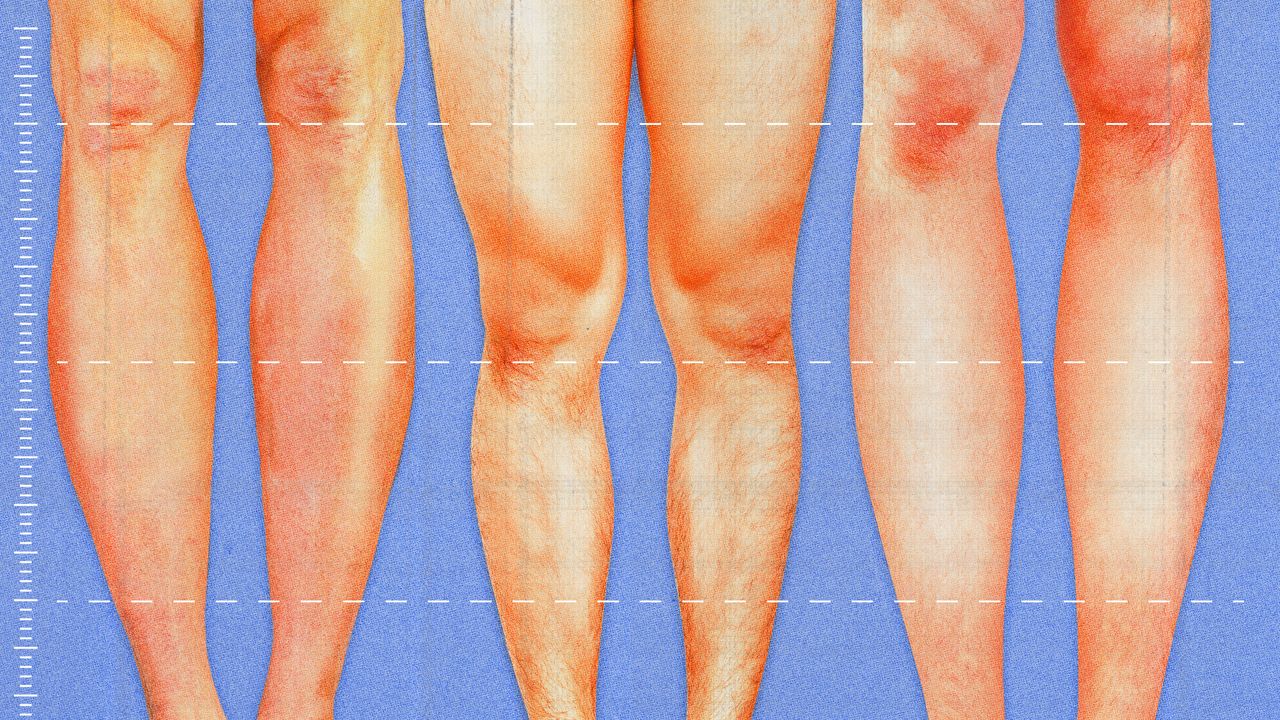
A new innovation in leg-lengthening might just make the once agonizing procedure more mainstream.Kelsey Niziolek; Getty ImagesA lot has happened since so-called leg-lengthening surgeries—the process of breaking the bones in one’s legs and resetting them with a gradual extending device—were first introduced about 75 years ago. As GQ detailed in 2022, it began as a procedure meant to treat traumatic injuries or limb length discrepancies. More recently, it’s been adopted as a cosmetic surgery that people—oftentimes men with height dysmorphia and, notably, Pedro Pascal’s character in The Materialists—get to gain an inch or three.But the surgery is no walk in the park. It takes about a year to get back to your regular level of athleticism, but it’s not until five months into the painful recovery process that you can even walk without crutches or other forms of mobility support.A new leg nail for the procedure aims to change that. The device, which is called the PRECICE Max, or PMax, is an internal lengthening implant that is better than its predecessors on two points: it comes with improved reinforced titanium walls and more diameter sizes to be better support heavy weight.According to Dr. Dror Paley, the doctor who helped develop the PMax and has been working in the limb-lengthening field for four decades, the new nail can minimize post-op pain and shrink the time between operation and unassisted walking from five months to two weeks. Where the first leg-lengthening instrument—named the Ilizarov apparatus after its creator Gavriil Ilizarov—was an external and especially painful device that caused long-lasting scars, the eventual development of PRECICE nails meant the lengthening could be done internally with minimal scarring—albeit still with a considerable amount of pain. Paley says the next evolution of PRECICE nails aims to erase that discomfort. “I still remember what it was like when I did one of my first surgeries and what they went through and the suffering they went through,” Dr. Paley says. “[With the PMax] I would pretty much now remove that word ‘suffering.’”The PMax received FDA approval in 2023, and Dr. Paley used the first seven PMax nails this month at Paley Orthopedic & Spine Institute in West Palm Beach. We called Dr. Paley a day after his first surgery using the them to discuss his invention and what it means for the future leg-lengthening surgeries. In short: “It’s going to make stature lengthening a much more ubiquitous thing,” he says.GQ: Was there a defining moment in your life that made you want to set off onto this path?Dr. Dror Paley: I found the field of bone regeneration and [I was fascinated on how] it removed many of the so-called “limits” of what you can do surgically. Surgery is a three-dimensional thing by adding the element of time such as limb lengthening where you lengthen something over a period of time. So you're creating an anatomic change over time. And that fascinated me and has never stopped fascinating me.How would you explain the PMax nail to someone who doesn’t understand anything about medicine?First of all, there are two main techniques of limb lengthening. Ilizarov invented an external fixator. So it was a device that attached to the bone with pins or wires that went through the leg and it created a kind of scaffold on the outside. You broke the bone, you pulled the bone apart gradually, and bone—being a living substance—makes new bone to fill in the gap. And then the muscles and all the other soft tissues grow in response to the stretch that's coming from the bone pulling apart. That's the process of limb lengthening in less than 30 seconds.That evolved in the '90s when we started using devices that instead of being outside the bone were inside the bone. Many of those devices had mechanisms to expand. In other words, you would drill bone to have a hollow space and then you put one of these telescopic rods in the bone. These telescopic rods have a mechanism and that mechanism can be activated mechanically, electronically, or magnetically. And initially these mechanisms were crude and in fact, the process was painful. And in fact, by the name PRECICE nail, the reason they named it that was because it was one of the first very ‘precise’ ways of lengthening the bone exactly how much you wanted. The initial devices were weak, meaning they weren't strong enough to allow you to put your full weight on them. After implementation you start gradually lengthening the bone a millimeter a day. That's typically the rate the bone can keep up by making new bone and the soft tissues can regenerate new muscle, nerves, arteries, skin, et cetera. That was Ilizarov’s work that introduced that. He did that by experimental work: going faster, slower, finding what the ideal rate was in animal leg lengthenings—and then of course in thousands and thousands of humans since then.For myself, I have now done, gosh, over 25,000 limb lengthenings in my career. So we've also had a lot of experience seeing what rates and what works best for people so they don't have pain so they can regenerate bone. You go too fast, you actually get failure of formation, you get a lot of complications, and if you go too slowly, the bone actually heals up prematurely and you can't keep lengthening because bone is very strong.And now the latest evolution, the PMax, is strong enough to allow full weightbearing, as in the patient’s full weight. They’ll be sore after surgery, and they do use walking aids for a few days. Usually in two to three weeks they’re not sore anymore and once the pain from surgery has gone away, they can walk without walking aids. And that's the big new deal. The PRECICE 2, which was the PMax’s predecessor, could only bear weight between 50 and 75 pounds every time you took a step. So most people weigh more than 50 to 75 pounds. So that meant you had to use a walker or crutches for a long time, often for about five months [until the new bone is healed and as strong as normal]. We let them start doing impact things like running, jogging, things like that at about five months after surgery.How do you control how much you’re stretching at a time?So you have a machine on the outside, and it’s a remote-controlled machine magnetic device. The PMax has a magnet on the inside of it, and the external device is about six inches by a foot long. Patients are trained to use it and they lengthen themselves at home four times a day. They put this big block up against their leg, they press a few buttons, and it gets longer inside. It's such a small amount that it gets longer each time that the actual lengthening is imperceptible and this is a big misconception. People have this vision of limb lengthening that you're getting stretched and that's the painful part. The actual rod lengthening one 25th of an inch is imperceptible. What can be uncomfortable for patients or what patients frequently talk about is stretching the soft tissue along with the bone, which happens gradually over several months.And the duration of the lengthening depends on how much they're lengthening. So the nail can expand up to eight centimeters. That's 3.1 inches. And a lot of patients in fact are lengthening to the maximum of that excursion. So they're lengthening at a millimeter a day–that takes 80 days. We don't start lengthening for seven days. So that's 87 days from surgery and 90 days is three months. So it basically is 12 weeks.And then there's a two to three month process called consolidation where even though the bone has been stretched, it needs to fill in and get hard to regain its full strength. And then after that, patients return to their full activity and mobility that they had before. So generally patients are at about 90% of their prior athleticism at nine months. And then by a year patients, unless you're a very high level athlete, it can take longer, but by a year, patients are typically fully back to any activities that they could do before surgery and the bone is just as strong as it was before.What’s the next problem you want to tackle within limb lengthening?You're going to see in the future mechanisms that are more automated where the nail lengthens on its own. You don't need that external remote control where the nail even sends feedback. So the doctor could look at their iPad or iPhone on any one of their patients and see how much lengthening they've done and really do a lot of the monitoring that we are currently doing remotely. Obviously those are already things where the technology exists and AI will get more involved in a lot of the evaluation and management of these patients. I think that's inevitable.Are there still prospective patients who shouldn't get this operation done?I think obviously everyone's health history is important and so there are some medical conditions that make you a higher risk and we always of course investigate what medications people are on and what illnesses they have and we're careful to avoid treating certain patients or who might be at greater risk. But for the most part, most people are very good candidates for this. Our oldest patient was 68 and our youngest patient was 15 for this process.Are there still moderate amounts of growing pains during the lengthening process?So when you're more active and you're walking around, just the activity of walking stretches your muscles. What we've seen is that the difference between a nail where you can't fully bear weight and a nail that you can is the patients are rehabilitating while they're lengthening. So they're never losing muscle mass. They're never getting weak.One perfect example is when you lengthen the lower leg below the knee, you're stretching your Achilles tendon, your biggest tendon in your body. And I'm sure you've stretched your Achilles before. It can get tight very quickly. Well, imagine if we add two inches of length to that muscle, it gets very tight, but being able to put your full weight on it stretching it on every step—that promotes the regeneration of the soft tissues. And it's the soft tissues that really cause the pain. It's not the bone.So if you are regenerating the soft tissues, stimulating them all the time, especially during your waking hours, then you don't get much pain. And so they're really getting a lot of regeneration and stimulus to the soft tissues, which means more comfort, less discomfort, and quicker rehabilitation. At five months, when the bone is already head, with the PRECICE 2, patients were just starting to put their full weight on the leg.The PMax is actually quite a big deal and it's going to make stature lengthening a much more ubiquitous thing. Right now it's not as well known, a little bit science fiction-y to a lot of people, even though we've been doing it for a very long time and more and more doctors are doing it and more and more patients are having it done.Because the process used to be so arduous, I spent more time talking people out of doing this even though our results are excellent. We're getting basically 100% of our patients 97% reach their full height goal and basically 100% reach almost their full height goal without any long-term effects. And I've studied these long-term for over 30 years, so I know they're not getting arthritis or other bad things down the road. And so I used to spend a lot of time, and I still do, every single patient, I really like to prepare them for this. Even though we do it very safely, protocol-driven, nobody does it better than us, but we still are very, very careful that people really know what they're getting into.The most important thing is that the patient eventually walks out of our practice the same way they walked in, in terms of how physically functional they are. Look, I tell everyone, we do not make better basketball players. We want to make people taller, feel better about themselves and have the same function they came into. They have 100% function starting. We can't make it 120%. We're not making superhumans.Not a subscriber? Join GQ to receive full access to GQ.com.Tyler Chin is GQ's associate wellness & grooming editor. He'll occasionally dabble in the menswear space, but otherwise you'll usually catch him trying out new headphones, lifting in fresh workout gear, or testing out the latest and greatest in skin care. Before he ended up at GQ, he worked at ... Read More
Why Leg-Lengthening Surgeries May Soon Become Way More Common
Full Article
Original Source
Read the full article at Gq →KhanList aggregates and links to publicly available news content. We do not host full articles from third-party sources. Always verify important information with original sources.