
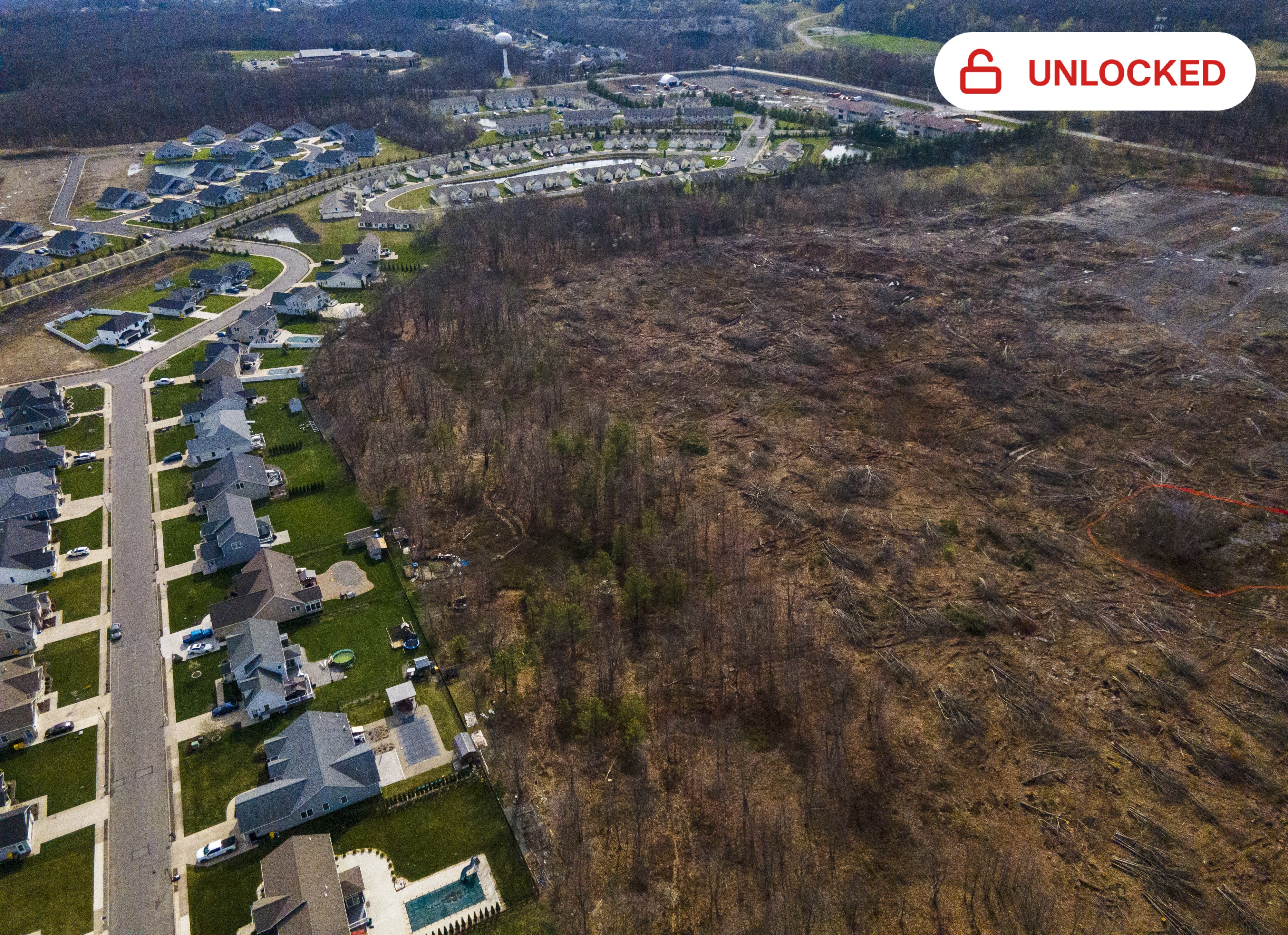
You’re reading Dispatch Markets, a weekly newsletter on economics featuring Scott Lincicome, Kyla Scanlon, Karl Smith, Marian Tupy, and Adam Ozimek. To access more Dispatch reporting and analysis, become a member today. Predicting winners and losers is a tough task when an industrial revolution is underway. There is a chance we are at such an economic inflection point today with AI, which makes it natural to wonder where, exactly, we will see the winners. Will it be the AI companies in the lead today like OpenAI and Anthropic? Will it be Big Tech incumbents like Meta and Amazon that have made large AI bets? Will it be software companies like Microsoft whose work seems most supercharged by AI? Beyond the firms, what types of workers will benefit? History shows there is a massive amount of uncertainty around these questions. But I have one big idea I believe we can be confident in: Land will be a winner. And so will the construction workers who turn the land into housing. But before we talk about land, let’s start with two historical examples that show how hard this exercise can be. Land of Opportunity An aerial view of Archbald, Pennsylvania, Wednesday, April 15, 2026. (Photo by Heather Ainsworth/Washington Post via Getty Images) Time traveling to 1900. Imagine if in the year 1900 you had the foresight to know not just that you should invest in the embryonic automobile industry but that Henry Ford would be the man to invent the mass-production system that would soon take us from a few thousand vehicles per year to millions. Unfortunately, you would have lost your shirt. In 1900, Henry Ford was superintendent, inventor, and a shareholder at the Detroit Automobile Company. To the investor with impeccable foresight, the scene might appear to be perfectly set. However, the company went out of business in January 1901. Ford Motor Company, the real superstar of the early auto industry, would be founded two years later. Picking the winners is hard even if you know the right innovator and the right technology, and are just two years away from the right time. Advertisement Stay ahead of the policies shaping free enterprise and impacting American business. Get the U.S. Chamber’s free newsletter for insights on the economic policy, workforce trends, and regulatory landscape that affect businesses and markets. By subscribing you agree to receive communications from the U.S. Chamber of Commerce. Computing disruption. The Detroit Automobile Company never had much momentum, manufacturing only a few cars. But even firms that take an early lead can fail when technological disruption is afoot. We can see this in the history of the computer industry. In the 1960s, mainframe computers were gigantic machines that took up a lot of space. The industry was dominated by IBM and then a handful of smaller manufacturers, known colloquially as “IBM and the seven dwarfs.” As Clay Christensen explains in his canonical management book The Innovator’s Dilemma, the rise of so-called minicomputers disrupted these incumbents. Neither IBM nor any of the seven dwarfs would be leaders in the minicomputer market. Instead, upstarts like Digital Equipment Corporation (DEC) would displace massive batch-processing mainframes with smaller, cheaper, interactive general-purpose computers like the PDP-1. Shown below, this is the kind of computer that created hacker culture and which some of the first video games were written on. The mainframes and their makers were left in the dust. A PDP-1 computer at the Computer History Museum in Mountain View, California. (By Alexey Komarov/Wikimedia Commons) But minicomputer companies like DEC would themselves be disrupted by the personal computer, an industry that would be driven by Apple, Tandy, and the returning mainframe champion IBM. Later the center of gravity would turn to Hewlett-Packard and Compaq, the latter of which absorbed a shrunken and struggling DEC in 1998. You could have made money on each of these companies along the way, but disruption and the disappearance of leaders have been a constant feature. Not only were individual companies disrupted by the computer revolution, but wave after wave of computing technologies were disrupted. The mainframe was disrupted by the minicomputer, the minicomputer by the personal computer. And today the personal computer arguably has been disrupted by smartphones and tablets. In an industry with rapid technological innovation, it can be hard to know who to bet on and risky to be an incumbent. AI today. If the optimists are right, we are entering a similar period of rapid innovation today. And certainly we have some early leaders. OpenAI and Anthropic have soared to massive valuations, and AI-related stocks are powering the S&P 500 to more than double over the last few years. The market may be speaking, but it remains unclear who will win eventually. Are today’s leaders going to fizzle out like the Detroit Automobile Company or the seven dwarfs of the early computing industry? Or, for a slightly more optimistic take, perhaps they lead for a while and then decline like DEC? The technology itself faces questions of disruption. Will AI be extremely valuable, or, like mainframes, will it be replaced by smaller, cheaper models? Perhaps these models will even be ultimately offshored. On top of the usual challenge of predicting winners in times of change, part of the challenge with AI is it’s difficult to tell empowered from endangered in advance. At the occupational level, for example, researchers have a hard time distinguishing which jobs will be replaced by AI and which will simply be changed by it. As the economist Daniel Rock, co-author of one of the most highly cited AI-exposure papers, tells me, “It’s easier to map capabilities to tasks that have the potential to change than to predict in advance what the changes will be.” This holds at the company and industry level too. Take the software-as-a-service industry (SaaS). Companies in this sector, like Salesforce and Workday, are experiencing a selloff known as the SaaSpocalypse due to concerns that ease of “vibecoding” software will mean less demand for experts. Salesforce CEO Marc Benioff argues defensively “People think we have our back against the wall when in fact the opportunity has never been greater.” Rather than replace its software, Benioff believes that AI will simply make it better. Whether history proves him right or wrong, at least some people think software companies have their backs against the wall. Industries, firms, and occupations that are touched in a substantive way by technology seem to be facing uncertainty, both good and bad. Where can we find the safer winners then? What growth looks like. To find winners we can be confident in, we need to sketch out some ways that AI will reshape the macroeconomic map that we can really believe in. We need changes that are robust to the many different futures we might face. What can we say with some degree of certainty? Hold aside a scenario where AI is a flop. If it matters economically, I think we can be pretty confident that mean incomes will go up more quickly than in the past. Here are a few reasons why. First, even if AI causes a lot of job loss—I don’t believe it will—this won’t be enough to slow down mean income growth. That is because even if we get the disruption for a lot of workers, and the bottom half of the labor market doesn’t share equally in the benefits of growth, mean income will be driven up by gains of those at the top. I wouldn’t say the same about median income growth, which tells you what happens to the typical worker. If we see enough job loss, median wage growth could fall below productivity growth as gains accrue to those at the top. But mean income growth increases even if the benefits are skewed toward the highest-paid workers and capital owners. Let me say this part clearly: I’m not saying those outcomes would be great news! It would be better, of course, if AI reduces inequality and boosts median wage growth. Second, we can look at history and see that mean income in the U.S. has historically enjoyed strong growth, even during periods of stagnating median wage growth. This is typically treated as a problem, and again it is. But in the U.S. economy at least, GDP growth really reliably drives up mean income growth. As much as we can be confident about anything, I think we can be confident that AI will drive up mean income growth. Who wins in the age of AI? If you are with me so far, we are confident about two things in an age where AI has a big economic impact: Outcomes are hard to predict for directly affected firms, industries, and workers Mean income will go up What will benefit in a world governed by these two primary forces? I would argue that this points clearly to land. We cannot create more land with AI. We cannot replace land with AI. The demand for land does go up with mean income. This is consistent with a wise recent essay from Alex Imas where he argued that to figure out what will be in demand in an AI-abundant economy, we need to focus on what will be scarce: If advanced AI brings material abundance—if machines can produce many if not all forms of human production at very low marginal cost—does economics become irrelevant? No, we will still have scarcity, but the kind of scarcity that matters will change. Ultimately the answer to any question about the future economics of advanced AI begins with identifying what becomes scarce. His essay focused on what happens to workers, but we can use this framework for thinking about other “factors of production,” as economists say. Undoubtedly, land is a factor of production that will remain scarce. Indeed, it’s not the main point of his piece, but he notes in a footnote that land itself may also absorb a lot of income in the future. The demand for land. It seems common sense enough (to me at least) that growth in mean income will drive up land values. And it’s certainly consistent with the economics of scarcity laid out by Alex Imas. But just in case you need convincing, here are a few pieces of evidence. At the very high end of incomes, it seems anecdotally at least that the demand for land goes up quite a bit. In fact you might argue nobody loves land more than the superrich. The billionaire Ted Turner exemplified this impulse. The urban legend was he could ride a horse from Canada to New Mexico without having to leave his property. That wasn’t true, but when he died in May he owned an impressive 2 million acres of land. Even that did not place him at No. 1. The top landowner in the country is Stan Kroenke, who owns 2.7 million acres. That’s bigger than the state of Delaware. According to Forbes, Kroenke is worth $24.3 billion. That’s obviously the most extreme case possible. But even the 100th biggest landowner in the U.S., the Irwin family, own 170,000 acres. That’s bigger than Chicago. For the very rich, scooping up land can add up to a lot of space quickly. How many millionaires is AI going to mint? Probably quite a few. But the relationship between income growth and land demand is broader than that. This is not just a story about a handful of millionaires. The figure below, from a paper by Schuyler Louie, John Mondragon, and Johannes Wieland, shows mean per capita income growth compared to house price growth at the metro level from 2000 to 2020. I don’t agree with all of the results in their (somewhat controversial!) paper, but income growth driving up house prices seems clear enough to me. And if house prices are going up, land prices almost certainly are too. There aren’t many microeconometric estimates of land demand, but they are consistent with this scatterplot. Joseph Gyourko and Dick Voith estimated that land prices go up 1.5 percent for every 1 percent of income growth, which would make land what we call a “luxury good.” That study was focused on one Pennsylvania county, however. In a broader analysis, Ed Glaeser, Matthew Kahn, and Jordan Rappaport estimate that land prices were more likely to go up somewhere between 0.25 percent and 0.5 percent for every 1 percent of income growth. This would make it what we call a “normal good,” meaning when people have high incomes they want more of it. This means that the demand for land in the age of AI is not simply about rich people buying more land. Broader income growth, even if it’s concentrated in the top half of the income distribution, will also generate demand for land. So when mean income goes up, I think we can be confident the demand for land will too. And AI will simply be unable to disrupt it. How to make good news better. If the tale I’ve painted so far sounds like a dystopian tale of AI inequality gone wrong, keep in mind I am not predicting that the benefits of AI flow only to a few, I am simply saying the demand for land is robust to the scenario where it does. But the story I have sketched out begins to hint at how we can better ensure a future with lots of demand for the kinds of stuff humans build. I think we really need only two moves. Guarantee broad wage growth with a wage subsidy. We can say confidently that mean income will go up, but there may nevertheless be lower demand for some workers who don’t reap as much benefit from fast growth. To ensure broader prosperity, we can convert high mean income growth into high median wage growth via a wage subsidy. (For more on what that would look like, consider my longer piece on how a wage subsidy would work.) Make sure demand for housing turns into houses. Once we have wide wage growth in place, we can be sure there won’t just be demand for land but demand for housing broadly. The next policy move we need to make is to fight for zoning reform at the federal, state, and local level. If we can continue the march of YIMBYism that we’ve been seeing grow as a political force over the past few years, then we can ensure housing demand manifests as more housing instead of just higher house prices. One future of work. If we can land the plane on those two policy challenges—or if AI simply delivers strong median wage growth—there is one area where there are likely to be lots of jobs in an AI future: construction. The construction industry is one of the most productivity-resistant industries we have. Empirical estimates suggest that construction productivity has actually fallen over time. Normally that is bad news. But in this case it does suggest that AI is unlikely to change the basic number of workers needed per new home. After all, if computers writ large have failed to prevent productivity from falling in this sector, why would smarter computers succeed? Even if we do see an improvement in productivity in this sector, it’s going to require lots of human labor for the foreseeable future. The future of building isn’t just about houses. In this piece I have focused on how the consumer demand for land and housing will reliably come from mean income growth. But I’d like to zoom out even further. The reality is that if all AI does is power raw GDP growth, this creates the opportunity to build all sorts of stuff in the real world. Whether through strong private demand, redistribution, or direct government subsidies, there is no shortage of things we can build if there is money to pay for it. Build more houses, more bridges, more roads, more spheres, new bowling alleys. Before he died, Walt Disney had originally envisioned Epcot as a futuristic city. We could build that city. We could build California Forever. We could build a dozen new cities and a hundred new theme parks. AI can’t replace restaurants, but income growth creates demand for dining out. So we can build more restaurants. We can even build forests if we are willing to pay for it. The demand for building things of all sorts has three useful features in our AI future. Demand goes up with income, it takes lots of workers, and there are tons of possibilities. Land may be a big winner from AI, but everyone who consumes or produces physical things in the physical world can win too. Markets FTW Video games can be copyrighted, which means they have protection for between 70 and 120 years. The first video game copyrights were issued in the late 1970s and became widespread and litigiously defended in the 1980s. This means it will be at least 2050 when the earliest video game source codes are released into the public domain. These intellectual property protections are a serious problem for video game historians and archivists attempting to preserve classic games and provide access to them. Hardware patents, on the other hand, expire after 20 years. As a result, you have competition and innovation happening in hardware. As an example, defense tech entrepreneur Palmer Luckey’s new company ModRetro just this summer released a stunning (in the eye of the beholder) new Nintendo 64-compatible console, the M64, with many more features than the original. We have unleashed the market in classic video game hardware, but not software. The results are visible. Chart of the Week Worth Your Time Disclaimer: The opinions expressed above do not necessarily reflect those of the presenting sponsor.
Why Land Will Be a Winner in the Age of AI
Full Article
Original Source
Read the full article at Thedispatch →KhanList aggregates and links to publicly available news content. We do not host full articles from third-party sources. Always verify important information with original sources.